


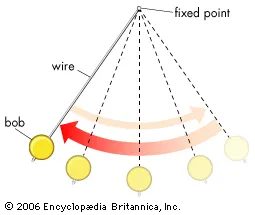


The pendulum is simple in concept, but complex in application. It is a weight, often called a bob, that hangs from a fixed point. Gravity pulls it down. When you press it, it swings back and forth. This rhythmic movement is not just a toy for physics classes. It has been the heartbeat of timekeeping for centuries.
The reason pendulums work so well in clocks is because of their consistency. Each complete swing, also called a period, takes about the same amount of time. This stability allows them to regulate the gears inside a clock. If you know how long a swing lasts, you can count the swings to measure hours, minutes, and seconds.
The Mathematics of Swing
The duration of the swing depends on two main factors. It is determined by the length of the pendulum and the force of gravity. The formula is simple: T = 2π√(L /g ). Here, T is the period. L is the length from the hinge point to the center of the bob. g stands for acceleration due to gravity.
Notice what’s missing. Mass doesn’t matter. A heavy and light bob of the same length swing at the same speed. A change in weight does not change your period. Length does. If you lengthen the string, the swing will slow down. Shorten it and the swing will be faster.
But gravity is hard. It is not uniform across the planet. Earth’s gravitational field varies by location. The pendulum swings faster at the poles than at the equator. It also swings faster at sea level than on a mountain. This is because gravity is stronger closer to the center of the Earth and near the poles due to the shape of the planet. These variations made pendulums useful tools for mapping Earth’s gravity.
Galileo’s lamp and Huygens’ breakthrough
The story begins around 1583 in Italy. Galileo Galilei was in a cathedral in Pisa. He noticed the swinging chandelier. It slowed down, but the time of each swing remained constant. He measured it with his own pulse. He realized that the period was constant regardless of the size of the arc. It was a fundamental insight.
However, Galileo did not build a clock. This honor belongs to Christiaan Huygens. In 1656, a Dutch mathematician created the first functional pendulum clock. Some argue that Galileo came first, but Huygens solved the engineering nightmare.
A simple circular arc does not produce a completely constant period with large variations. To remedy this, Huygens devised a mechanism that force the bob to follow the path of the cycloid. This special curve ensures that the period remains true even when the variation is large. It was a crucial improvement that turned a scientific observation into a practical watch.
More than time
Not all pendulums look like grandfather clock weights. In physics, a simple pendulum is based on a massless string and point-like bob. Real devices are messier.
A compound pendulum has extended mass. Think of a teeter-totter or a playground swing. It oscillates around a horizontal axis. Scientists use a special type called a Kater’s reversible pendulum to measure g very precisely. By adjusting the pivot points, you can precisely determine the acceleration due to local gravity.
Then there is the Schuler Pendulum. It behaves differently. If you hang it vertically, it will stay aligned with local gravity, even though the attachment point is accelerating laterally. This property is important for inertial control systems. Ships, aircraft, and missiles use Schuler tuning to maintain accurate vertical reference during high-speed maneuvers. Without it, navigation systems would run wild.
Proof that the planet rotates
The most famous visual representation is the Foucault pendulum. It is a spherical pendulum, which means it can swing in any vertical plane. When it is set in motion, its plane of its swing appears to rotate over time.
It doesn’t actually spin. The earth spins below. This simple device provides visible evidence that our planet rotates on its axis. The rotation speed depends on the latitude. At the North Pole, the plane completes a full circle in 24 hours. At the equator, it does not rotate at all. In between, it varies.
Why it matters
Today we rely on atomic clocks. They are much more accurate than pendulums. However, the principle is still relevant. Understanding vibration helps us design stable structures, control vehicles, and even measure the fundamental forces of nature.
The pendulum teaches us consistency in a chaotic world. It shows how small, regular movements can measure large and complex ones. The logic applies from Pisa’s swinging lamp to modern control systems.


