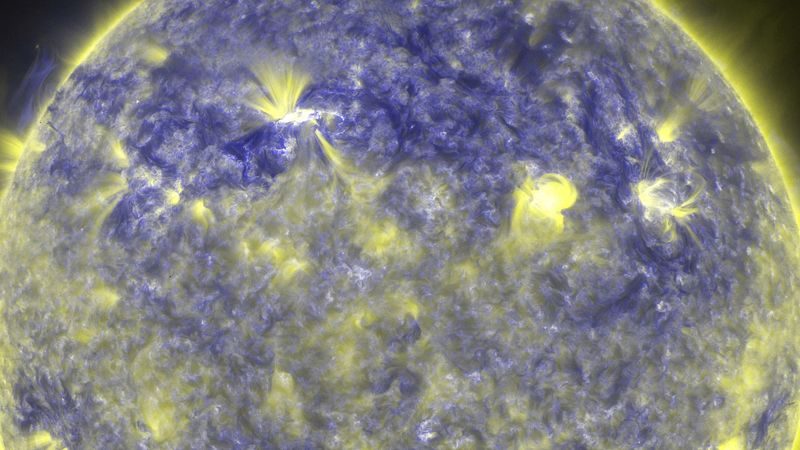

It starts with a snap in the sun’s magnetic field. Then, in a matter of seconds, a region near a sunspot group flares up with blinding intensity. This is a solar flare, a sudden burst of energy that transforms the solar corona from a quiet plasma soup into a violent explosion. The event doesn’t fade away gently either. It can rage on for hours before finally subsiding.
When these flares happen, they don’t just shine. They shoot. High-energy particles. Electron streams. Hard X-rays. Radio bursts. All of it gets hurled into space. If the flare is strong enough, it creates a shock wave that ripples through the interplanetary medium. Think of it like a sonic boom, but in the vacuum of space, moving at speeds that can reach Earth in days rather than minutes.
The Superhot Cloud
The action takes place above the sun’s visible surface, in the corona. But the energy doesn’t stay there. It dumps into the surface below, triggering a reaction that brings up a cloud of plasma superheated to about 100 million Kelvins. That is roughly 180 million degrees Fahrenheit. It is an incredibly potent source of X-ray radiation.
Not every flare puts on this kind of show. Smaller events lack the full suite of attributes. They might emit a bit of light and a few particles, but they rarely cause the kind of disruption that matters to us. There is also a weird category known as “spotless flares.” These occur without the usual sunspot associations. Instead, they are tied to filament eruptions. They can be massive. They sometimes produce coronal mass ejections. Yet, they tend to hold back on the high-energy particles, making them less immediately dangerous in terms of radiation, though still impactful on space weather.
When Do Flares Happen?
You won’t see these explosions every day. Flares are closely tied to the sun’s 11-year cycle. They rarely show up during the three or four years of sunspot minimum. When the sun is quiet, the magnetic fields are relatively stable. The flares need instability.
The biggest flares occur with large sunspots. These aren’t just dark patches. They are regions with sharp magnetic gradients and intense electrical currents. Those currents are the fuel. When the magnetic field lines snap and reconnect, that stored energy is released all at once. The result is an explosion that can outshine the entire sun in X-rays for a short time.
Why It Matters
For anyone living on Earth, the flare itself is harmless. The atmosphere blocks the X-rays. But the particles and the shock wave? Those matter. If a large flare sends a coronal mass ejection our way, it can hit our magnetic field. That interaction can disrupt satellites. It can mess with radio communications. It can even affect power grids.
Understanding how solar flares ignite helps us predict these events. We monitor the sunspots. We watch for the sharp magnetic gradients. When we see a large spot with high currents, we brace ourselves. The sun is always watching. We just have to keep our eyes on it.
Why Solar Flares Hit Us Twice
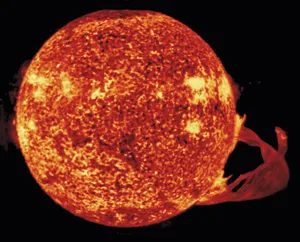
We often think of the Sun as a steady, comforting ball of light. But strip away the visible glow, and you get a violent, high-energy beast. X-ray flares don’t just shine; they outshine the entire star in specific spectral bands. The brightness isn’t in the light we see with our eyes. It’s in the ultraviolet and X-ray spectrum, where energy levels spike so high they can strip electrons from atoms and scramble electronics.
The timing of this assault is what makes it tricky to predict. When a flare erupts, the X-ray photons and high-energy particles race across the vacuum of space at nearly the speed of light. They hit Earth’s atmosphere almost instantly. That’s the first wave. It ionizes the upper atmosphere, disrupting high-frequency radio communications and GPS signals within minutes.
But the real damage waits in the wings.
The main particle flux—the bulk of the charged particles—doesn’t move that fast. It takes a few days to make the journey. By the time these particles arrive, they haven’t just brought radiation. They’ve brought magnetic chaos. This delayed influx interacts with Earth’s magnetosphere, triggering geomagnetic storms that can induce currents in power grids and threaten satellites in low-Earth orbit.
The first wave is immediate. The second wave is catastrophic.
Understanding this two-phase impact is why space weather forecasting matters. We can’t just look at the flare itself. We have to track the speed of the coronal mass ejection that often accompanies it. The X-rays tell us something is happening now. The particles arriving three days later tell us what’s going to break later.
This isn’t just academic. For grid operators, airlines, and anyone relying on precise satellite positioning, that three-day window is everything. It’s the difference between a minor hiccup and a blackout.