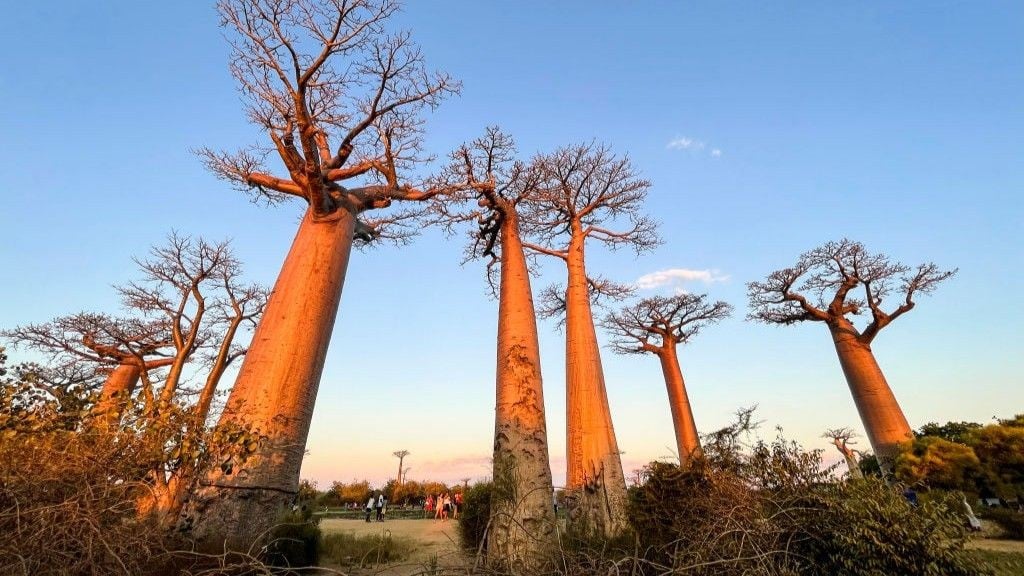
The Avenue of the Baobabs in Madagascar is one of Africa’s most striking natural sights: a dirt road bordered by dozens of ancient, towering trees known locally as “renala” – or “mother of the forest”. These aren’t just picturesque landmarks; they’re remnants of a once-vast tropical forest, now critically endangered, and a crucial part of Malagasy culture.
The Giants of Madagascar
The trees lining the Avenue are almost exclusively Grandidier’s baobabs (Adansonia grandidieri ), endemic to Madagascar. These colossal plants can reach heights of 80 feet (24 meters) and widths of 10 feet (3 meters) – with one recorded specimen stretching nearly 100 feet tall and 36 feet in diameter. Their massive trunks aren’t just for show; they’re adapted to store water within their cells, allowing them to survive the island’s harsh dry seasons and sustain new growth.
The Avenue itself runs between the towns of Morondava and Belo Tsiribihina on the west coast, but the baobabs don’t stop there. Around 25 more trees grow nearby in rice paddies and meadows, with hundreds scattered throughout the wider landscape. This suggests that the isolated trees we see today were once part of a much larger, continuous forest.
An Ancient Lineage
Recent research confirms that baobabs evolved in Madagascar between 41 and 21 million years ago. While most species remain unique to the island, two – A. digitata and A. gregorii – are also found in Africa and Australia. How they spread remains a mystery, though ocean currents and human transport are likely factors. The fact that the baobabs now exist across continents is unusual, hinting at complex evolutionary history and dispersal patterns.
Cultural Significance & Modern Threats
Baobabs aren’t just botanically unique; they are deeply woven into Malagasy folklore. One legend, the “Baobab Amoureux” (Loving Baobabs), tells of two trees intertwined as a symbol of star-crossed lovers. This myth illustrates how the trees are perceived as living entities with stories to tell.
However, the Avenue of the Baobabs and its surrounding ecosystem face severe threats from illegal logging, accidental fires, and climate change. The long-term survival of these ancient giants is uncertain, making their preservation an urgent priority.
The Avenue of the Baobabs is a poignant reminder of both Madagascar’s natural beauty and the fragility of its unique biodiversity. Protecting these “mothers of the forest” is not just an ecological imperative, but also a cultural one.