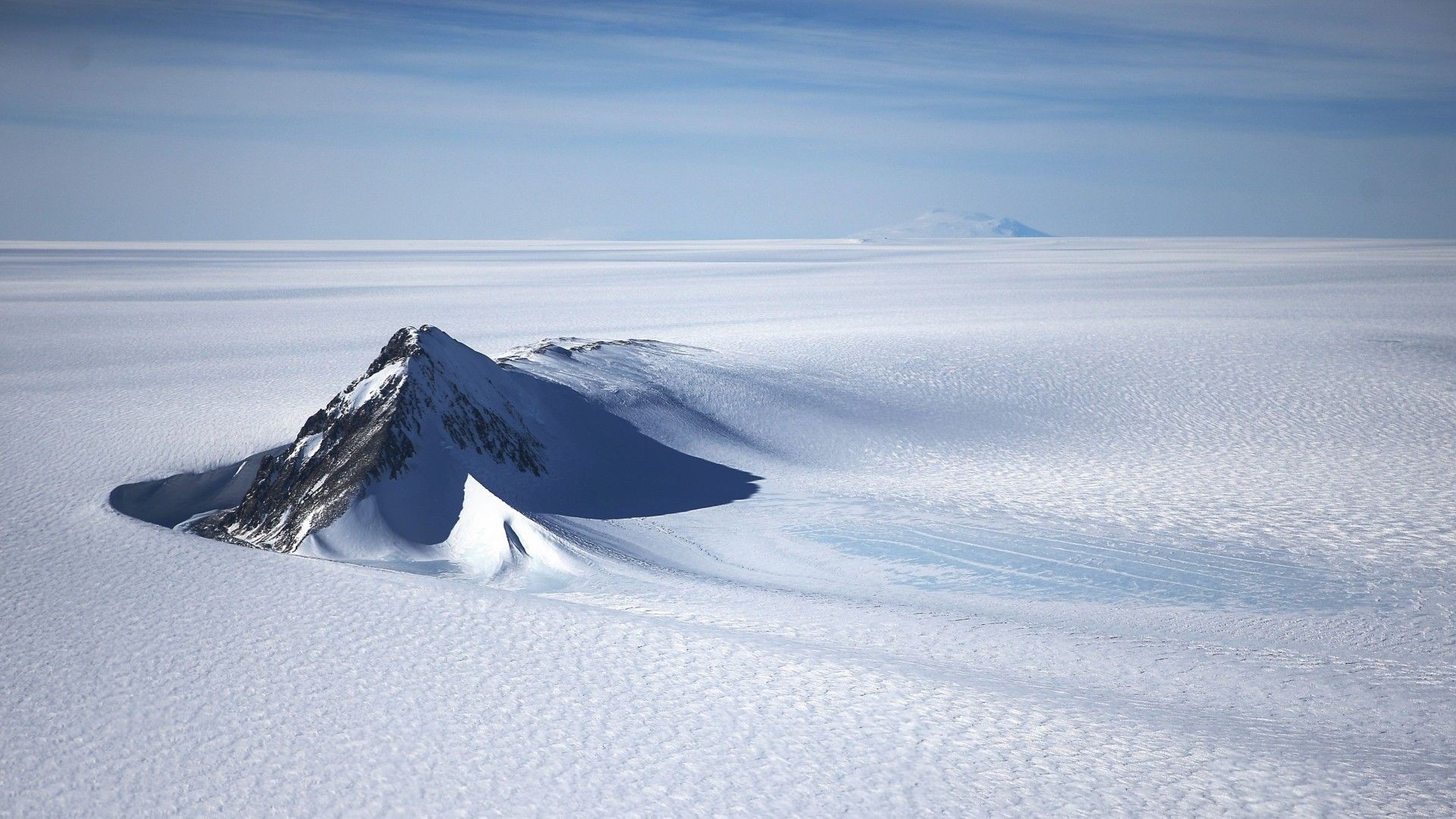
A persistent gravitational anomaly beneath Antarctica provides scientists with a unique window into the planet’s inner workings. This “gravity hole,” formally known as the Antarctic Geoid Low, isn’t a physical void, but a long-term imprint of slow, powerful movements within Earth’s mantle – processes reshaping our planet over tens of millions of years.
A Window into Deep Earth Dynamics
Researchers at the University of Florida have reconstructed the evolution of this gravity anomaly over the past 70 million years, confirming its enduring presence. The study shows that this feature isn’t a random fluctuation, but a consistent signature of deep Earth currents churning thousands of miles below the Antarctic ice sheet.
The anomaly reflects how mass is distributed inside the planet. Hotter, buoyant mantle rock rises, while colder, denser slabs sink. These slow but massive motions subtly reshape Earth’s gravity field. Where gravity is weaker, like in Antarctica, the ocean’s “level surface” (the geoid) sits closer to the planet’s center. This creates a broad, gentle low in Earth’s gravity field – the deepest long-wavelength valley on the planet.
Measuring the Imperceptible
The effect of this anomaly on people is negligible: a 198-pound person would weigh only about 5 to 6 grams less in that region. Yet, scientifically, it’s profound. It reveals how material is arranged deep within Earth and how that distribution has evolved over geological time. Scientists reconstruct the past by running physics-based models backward in time using seismic images of the present-day mantle.
The surprising consistency of this feature is key. The gravity low has persisted for much of the last 70 million years, intensifying around the time Antarctica transitioned into a permanently ice-covered continent roughly 34 million years ago. This timing suggests a potential link: changes in Earth’s gravity field could subtly influence regional sea level, affecting ice sheet formation.
Implications for Climate and Planetary Science
Today, the Antarctic geoid low causes the gravity-defined sea surface to sit approximately 394 feet (120 meters) below the global average. Over millions of years, such gravitational shifts could have influenced ice sheet boundary conditions. While glaciation was driven by multiple forces, including CO₂ levels and ocean currents, this study highlights an internal-Earth process that occurred at the right time and scale to potentially affect the sea surface.
Earth isn’t the only planet with gravity anomalies. Long-wavelength variations on Mars and Venus hint at interior structures and ancient geologic activity. However, Earth is unique because gravity measurements can be cross-checked with seismology and the geological record, allowing scientists to reconstruct how these features evolved over time.
“Our study shows how deep Earth dynamics can reshape the gravity field over geological time,” says study co-author Alessandro Forte. “Whether that translated into a measurable influence on climate/ice is a separate question that requires additional coupled modeling and evidence.”
Understanding these deep-Earth processes offers critical insight into planetary evolution. The persistent Antarctic gravity low is a powerful reminder that the forces shaping our planet extend far beyond the surface, continuously reshaping Earth’s gravity field in ways that scientists are only beginning to understand.