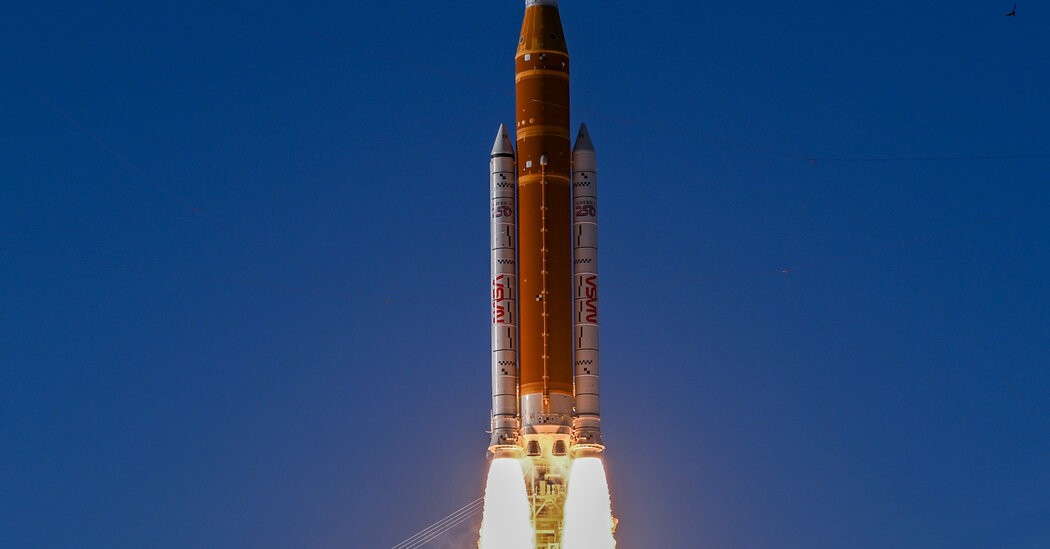
The four-person crew of Artemis II has initiated its lunar trajectory, marking a significant step in NASA’s renewed push toward deep space exploration. At 7:49 p.m. Eastern time, the Orion spacecraft executed a precisely timed engine burn, committing the astronauts to a four-day journey around the moon without landing. This mission is a critical test of the spacecraft’s systems and human endurance in preparation for future lunar landings.
Mission Objectives and Crew Dynamics
The Artemis II mission serves primarily as a shakedown flight, verifying that the Orion capsule and its life support systems function as intended in a deep-space environment. Astronauts Reid Wiseman, Victor Glover, Christina Koch, and Jeremy Hansen spent their first day in a higher-than-usual Earth orbit, conducting system checks and ensuring the spacecraft, dubbed “Integrity,” is ready for the lunar flyby.
According to NASA officials, the engine burn was “flawless,” propelling the crew into a trajectory governed by orbital mechanics. This phase is crucial because it confirms the spacecraft’s ability to perform complex maneuvers needed for future missions, including docking with lunar landers. The astronauts themselves have emphasized the importance of this journey, framing it as a testament to humanity’s capabilities.
Life in Space: Adapting to Zero Gravity
The confined living quarters of Orion demand adaptation. Without gravity, the crew will utilize every available space, including areas typically reserved for equipment or storage. Exercise is also a priority; astronauts will use a flywheel device secured to the capsule to simulate weightlifting in zero gravity.
Sleeping arrangements involve repurposing work seats and securing sleeping bags to the walls, fostering a sense of close-quarters camaraderie. As Victor Glover noted, prolonged exposure in such conditions leads to a unique bond among the crew.
The Playful Side of Space Travel: A Long-Running Game
Amidst the serious scientific objectives, a playful rivalry between astronauts and NASA engineer Mark Eigner has persisted for years. The two have engaged in a game of hidden messages, embedding clues in photos, Braille markings, and even custom candies. The latest exchange involves a New York Times article mentioning the competition, prompting Eigner to declare victory.
Looking Ahead: Flyby and Return
The crew will approach the moon’s gravity field on Sunday, completing a flyby around the far side on Monday. Communication with Earth will continue throughout the mission, including interactions with family members. The journey concludes in eight days with a splashdown in the Pacific Ocean.
This mission is more than just a test flight; it is a statement of intent. Artemis II demonstrates that NASA is actively preparing for sustained lunar presence and beyond, pushing the boundaries of human exploration.