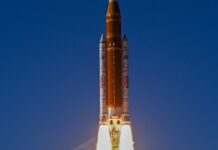
NASA’s Artemis II mission has achieved a landmark launch, marking humanity’s return to deep-space human exploration. On April 1st, the agency’s 32-story Space Launch System (SLS) rocket lifted off from Kennedy Space Center, Florida, carrying a crew of four—including Christina Koch, the first woman, and Victor Glover, the first Black astronaut, to venture beyond low-Earth orbit. This mission isn’t just about reaching the moon; it’s about setting the stage for a sustained human presence in space and, eventually, Mars.
The Mission’s Key Objectives
The Artemis II crew—Commander Reid Wiseman, pilot Victor Glover, mission specialist Christina Koch, and Canadian Space Agency astronaut Jeremy Hansen—will embark on a 10-day voyage that loops around Earth and slingshots around the moon. Unlike previous Apollo missions, this flight is a test run; the astronauts will evaluate the Orion spacecraft’s life-support systems under real-world deep-space conditions. The journey will take them approximately 248,700 miles from Earth, surpassing Apollo 13’s record set in 1970.
Why This Matters: A New Era of Space Exploration
This mission signifies a shift in space exploration. After more than half a century since humans last journeyed beyond the International Space Station, Artemis II is a clear signal that the United States is reasserting its leadership in crewed spaceflight. The Artemis program aims to establish a continuous human presence on the moon, using it as a proving ground for technologies and techniques needed for future missions to Mars in the 2030s.
The Crew’s Historic Significance
The inclusion of Koch and Glover is particularly noteworthy. Their participation breaks long-standing barriers in space exploration, and their presence symbolizes the evolving diversity of the astronaut corps. While both astronauts have downplayed the historic nature of their mission, focusing instead on the technical objectives, their journey represents a significant step forward for inclusivity in space travel.
Challenges and Preparations
The launch itself wasn’t without hurdles. NASA had to roll the rocket back to the hangar twice for unexpected tests and repairs, including hydrogen leaks and helium flow issues. These delays underscore the inherent risks of operating a complex new rocket that has flown only once before (the uncrewed Artemis I in 2022).
The astronauts endured intense G-forces—three times Earth’s gravity—during the first eight minutes of flight. Once in high-Earth orbit, at an altitude of about 46,000 miles, Koch and Glover will set new spaceflight records for women and people of color.
What’s Next: Observing the Far Side of the Moon
One key objective of the mission is to observe the far side of the moon, which is never directly visible from Earth. During a 45-minute communications blackout, as the moon blocks signals from Earth, the crew will study and photograph features such as Mare Orientale—a massive lunar landmark rarely seen from Earth.
Return and Safety Concerns
Orion is scheduled to splash down off the coast of San Diego on April 10th. However, concerns remain about the heat shield, which was damaged during the Artemis I re-entry. NASA has redesigned the landing trajectory to prevent similar extreme temperatures (approximately 5,000 degrees Fahrenheit) experienced during the previous flight.
The Artemis II mission is a testament to human ambition and technological innovation, paving the way for a future where lunar exploration is not just a dream, but a sustained reality.