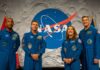
NASA is preparing to launch its first crewed mission to the Moon in over half a century, marking a pivotal moment in space exploration and setting the stage for a sustained human presence beyond Earth. The Artemis II mission, scheduled for April 1, 2026, will send four astronauts – Reid Wiseman, Victor Glover, Christina Koch, and Jeremy Hansen – on a ten-day journey around the Moon, testing critical systems for future lunar landings.
The Significance of the Mission
This mission is more than just a return to the Moon; it represents a deliberate shift toward long-term deep space exploration. For over five decades, human spaceflight has been largely confined to low-Earth orbit, primarily focused on operations around the International Space Station. Artemis II breaks this pattern, pushing the boundaries of human travel and validating the technology needed for sustained operations in deep space. The flight will test Orion’s life support, navigation, and communication systems in real conditions, a critical step before attempting a lunar landing with Artemis III in 2027.
Key Objectives and Challenges
The primary goal is to assess how humans function in deep space environments, where communication delays and extreme distances from Earth pose unique challenges. The crew will travel beyond the Apollo 13 record, reaching approximately 400,171 kilometers from Earth – farther than any human has gone before.
The program hasn’t been without hurdles. Initial launch dates were postponed due to technical issues, including liquid hydrogen leaks and helium flow problems. These delays underscore the complexity of modern spaceflight and the meticulous testing required to ensure crew safety. Despite these setbacks, NASA confirms that all countdown preparations are complete, and conditions are favorable for launch.
Beyond Artemis II: A Roadmap for Lunar Exploration
The Artemis program is structured in stages, each building toward more ambitious goals. Artemis I, the uncrewed test flight, laid the groundwork by verifying the Space Launch System (SLS) rocket and Orion capsule. Artemis III, planned for 2027, will focus on testing rendezvous and docking procedures with commercial spacecraft designed for lunar landing. Finally, Artemis IV, targeted for 2028, aims for a crewed landing near the Moon’s south pole, where astronauts will conduct scientific research and sample collection.
“This is the opportunity… to send our crew farther than anyone has gone before,” said chief flight director Emily Nelson.
The success of Artemis II is not just a technical milestone; it’s a demonstration of international cooperation, with contributions from various nations and private industries. The program embodies an optimistic vision for the future of space exploration, one that emphasizes collaboration and shared achievement.
This mission marks a new era in space travel, signaling humanity’s renewed ambition to explore and ultimately inhabit the cosmos.