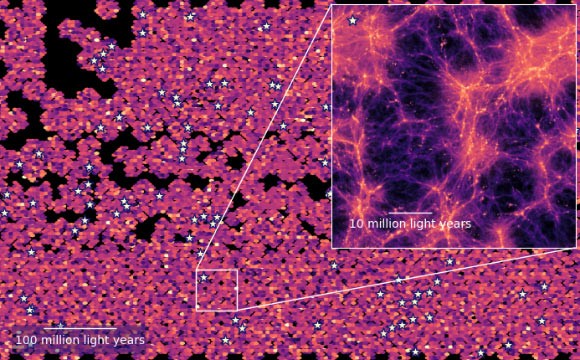
Astronomers have created the most comprehensive three-dimensional map yet of faint cosmic structures dating back 9 to 11 billion years, revealing previously unseen galaxies and intergalactic gas. The breakthrough, achieved using spectral data from the Hobby-Eberly Telescope at McDonald Observatory, provides unprecedented insight into the Universe’s formative years.
Unveiling the Invisible Universe
For decades, studying the early Universe has been hampered by the sheer distance and faintness of objects from that era. Many galaxies and gas clouds existed, but were too dim for conventional telescopes to detect. The research team overcame this obstacle by employing a technique called Line Intensity Mapping (LIM).
LIM doesn’t attempt to resolve individual objects, but instead measures the collective light emitted across vast regions. This method effectively “pulls” faint structures into view, adding detail to the early Universe’s landscape. While LIM isn’t new, this study represents the first large-scale, high-precision application of the technique for Lyman alpha emissions.
HETDEX: A Data-Rich Survey
The map stems from data collected by the Hobby-Eberly Telescope Dark Energy Experiment (HETDEX), a project designed to chart over one million bright galaxies in pursuit of understanding dark energy. The project has amassed an astonishing 600 million spectra, covering an area of the sky equivalent to over 2,000 full moons.
Interestingly, scientists only analyze about 5% of the collected data. The remaining 95% holds immense potential for further research. The team explained that most of the observed light comes not from individual galaxies, but from the faint, diffuse matter between them. This “sea of light” has now been brought into focus.
Mapping the Faint Glow
To create the map, researchers used supercomputers at the Texas Advanced Computing Center to sift through roughly half a petabyte of HETDEX data. They leveraged the known locations of bright galaxies as “signposts” to infer the positions of fainter, neighboring structures.
Gravity dictates that matter clumps together, meaning that bright galaxies are almost always surrounded by fainter companions and glowing gas. By identifying bright galaxies, the team could effectively extrapolate the location of hidden objects. The result is a map that not only clarifies the regions around bright galaxies but also fills in the details of the vast, seemingly empty spaces in between.
Validating Simulations
The new map provides an invaluable benchmark for theoretical models of the early Universe. Current understanding relies heavily on computer simulations, which, until now, have lacked a concrete observational foundation.
“We have computer simulations of this period. But those are just simulations, not the real Universe.” Dr. Lujan Niemeyer stated. “Now we have a foundation which can let us know if some of the astrophysics underpinning those simulations is correct.”
The map will allow astronomers to test the accuracy of their theoretical frameworks and refine their understanding of how galaxies evolved. The findings were published on March 3, 2026, in The Astrophysical Journal.
This research marks a major step forward in understanding the early Universe, bridging the gap between theoretical models and observational reality. It demonstrates that even the most distant and faint structures can be unveiled with advanced techniques and powerful computing resources.