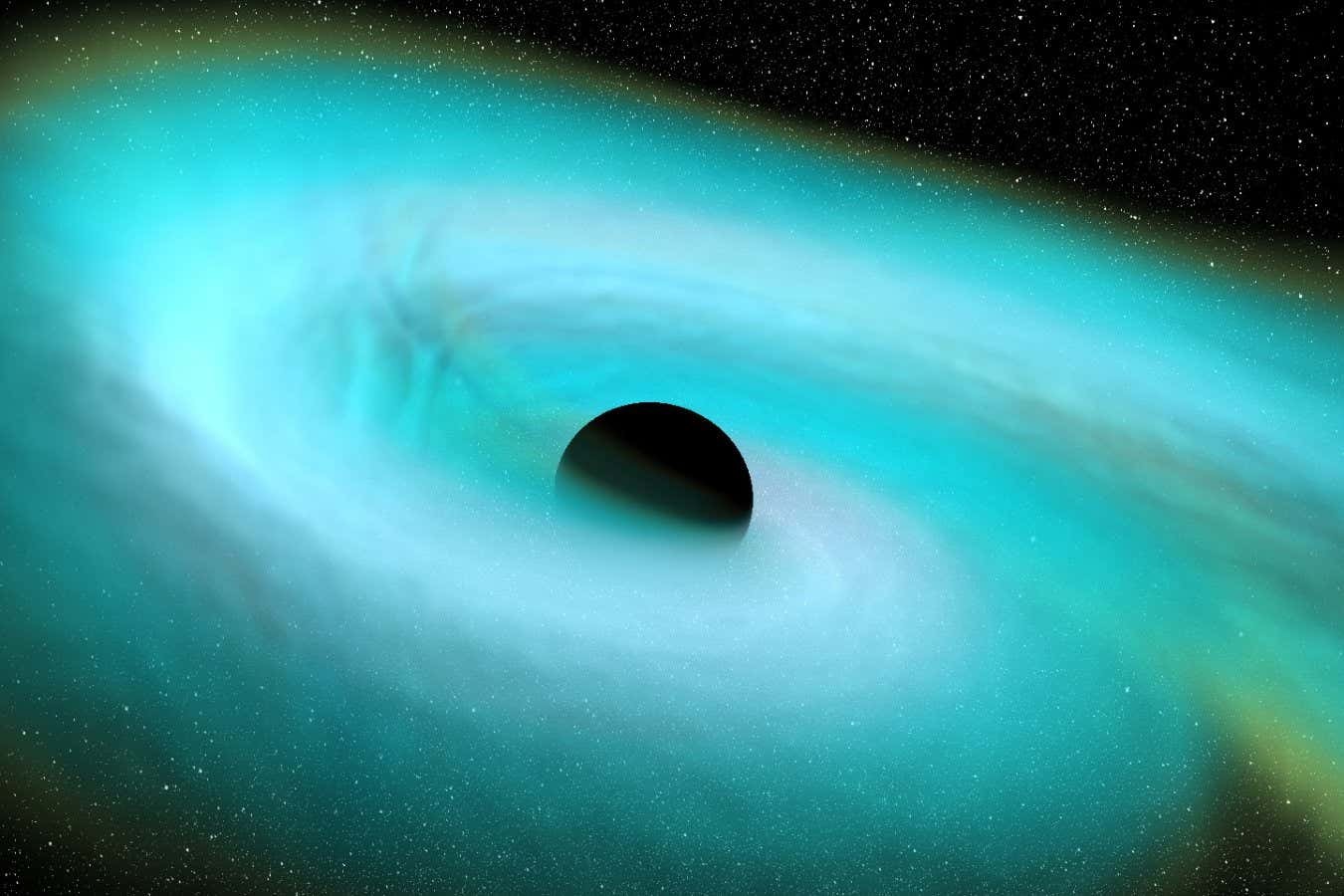
The accelerating expansion of the universe, driven by the mysterious force we call dark energy, remains one of cosmology’s greatest puzzles. For decades, scientists have searched for an explanation, but the nature of dark energy – which comprises roughly 68% of the universe – has remained elusive. Now, a growing number of astrophysicists propose a radical idea: black holes, rather than being cosmic dead ends, may be the very source of this expansion. This theory, once considered fringe, is gaining traction as it potentially solves not one, but three major cosmological mysteries simultaneously.
The Core Idea: Black Holes Converting Matter into Dark Energy
The conventional understanding of black holes is that they are regions of spacetime so dense that nothing, not even light, can escape their gravitational pull. However, a new line of thought suggests that matter falling into black holes doesn’t simply disappear; it undergoes a transformation into a form of radiation that exerts a repulsive force on the surrounding space. Individually, this effect would be negligible, but when summed across the vast number of black holes in the universe, it could explain the observed acceleration of cosmic expansion.
This concept, dubbed “cosmologically coupled black holes,” hinges on the idea that the singularities at the centers of these objects don’t truly exist as infinite densities. Instead, something prevents this collapse: the conversion of matter into dark energy. This process echoes the early universe when radiation cooled and coalesced into matter, but in reverse. The gravitational pull of the black hole remains unaffected, as it depends on energy density, not the specific form of matter.
Mounting Evidence: From Black Hole Growth to the Hubble Tension
Recent observations are bolstering this hypothesis. In 2023, research led by Kevin Croker and Gregory Tarlé revealed that black holes across the universe appear to be growing faster than expected, including even the most “boring” supermassive ones. This growth rate aligns with the universe’s expansion, suggesting a direct link between black hole activity and dark energy production.
Furthermore, the cosmologically coupled black hole theory offers a potential resolution to the long-standing Hubble tension – the discrepancy between different methods of measuring the universe’s expansion rate. The model suggests that expansion rates varied differently in cosmic history, explaining why measurements disagree.
The Neutrino Puzzle: A Third Mystery Resolved?
Perhaps most surprisingly, this theory may also explain anomalies in particle physics, specifically regarding neutrinos. Current cosmological models require neutrinos to have zero mass to balance the universe’s mass budget. However, if black holes are converting matter into dark energy, they free up mass in the budget, allowing neutrinos to have a positive mass consistent with experimental observations.
This convergence of evidence – faster-than-expected black hole growth, the Hubble tension, and neutrino mass – has led researchers to describe the current state of the theory as a “three-legged stool” that appears increasingly stable.
Challenges and Future Prospects
Despite the growing support, significant hurdles remain. The mathematical models describing these cosmologically coupled black holes are incomplete and extremely complex. However, with ongoing data from the Dark Energy Spectroscopic Instrument (DESI) and other large-scale surveys, the evidence continues to mount. As more researchers join the investigation – the latest paper on neutrino masses has 50 co-authors – the theory is moving from the fringes of cosmology toward mainstream consideration.
The idea that black holes are not just consumers of matter but also creators of dark energy is a paradigm shift. If confirmed, it would reshape our understanding of the universe’s fundamental forces and its ultimate fate.