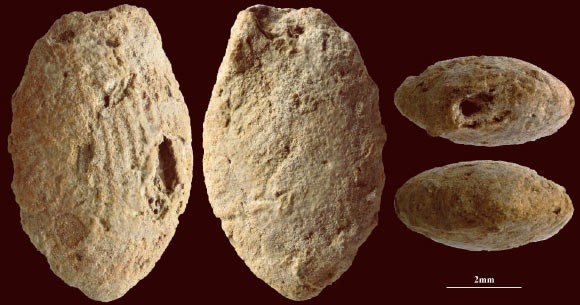
For millennia, it was assumed that clay first served practical purposes – tools, storage, cooking – before becoming a medium for art or expression. But groundbreaking archaeological findings from Natufian sites in Israel (spanning 15,000 to 11,650 years ago) have overturned this assumption. A cache of 142 clay beads and pendants proves that symbolism, not utility, was clay’s earliest function, and that this cultural shift occurred before the advent of agriculture.
The Natufian Breakthrough
The discovery, led by researchers at Hebrew University of Jerusalem, centers on an unusually large and diverse collection of ornaments. These weren’t haphazard experiments; the sheer volume and variety indicate a long-standing tradition of clay artistry. The artifacts, small enough to hold in the palm of a hand, include cylinders, discs, and ellipses – many coated in red ochre using a previously unknown early form of engobe (a liquid clay coating).
This isn’t simply about when clay was used symbolically; it’s about how. The 19 distinct bead types often mimic the shapes of key Natufian food sources: barley, wheat, lentils, peas. This suggests that nature itself was a primary source of meaning for these early settled communities. Plant fibers preserved on the beads confirm they were worn as personal adornments.
Children at the Heart of Expression
What makes this discovery truly extraordinary are the fingerprints preserved on the clay. A total of 50 prints – belonging to children, adolescents, and adults – have allowed archaeologists to directly identify the makers of Paleolithic ornaments for the first time. Some objects, like a tiny 10mm ring, were clearly designed for children.
This evidence points to ornament-making as a shared, everyday activity, integral to learning, imitation, and the transmission of social values. It wasn’t just about creating beautiful objects; it was about doing it together, across generations.
Reframing the Neolithic Revolution
For decades, the prevailing theory held that symbolic uses of clay arose only with the shift to farming and a settled Neolithic lifestyle. The new findings challenge this timeline, placing a symbolic “revolution” much earlier, during the first stages of sedentarization.
Instead of waiting for agriculture, these communities used clay to express identity, affiliation, and social relationships visually. As Professor Leore Grosman explains, the roots of the Neolithic run deeper than previously thought. The Natufians weren’t just proto-farmers; they were innovators of symbolic culture, using clay to define who they were and who they were becoming.
“These objects show that profound social and cognitive changes were already underway.”
This research, published in Science Advances, reframes our understanding of early human culture. It demonstrates that the capacity for symbolic thought – for creating meaning beyond mere survival – predates agriculture, and that children played a critical role in shaping this cultural evolution.