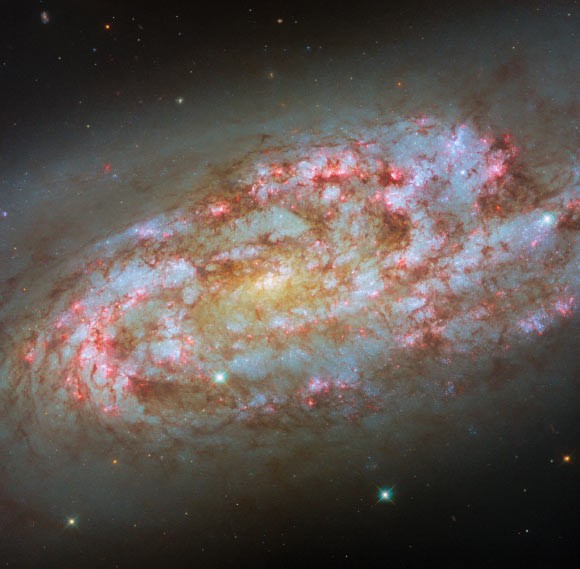
The Hubble Space Telescope has captured a new, detailed image of NGC 1792, a spiral galaxy undergoing intense star formation. Located roughly 36.4 million light-years away in the Columba constellation, this galaxy is not a tranquil spiral; it’s a cosmic powerhouse churning out stars at an accelerated rate.
A Galaxy in Turmoil
Discovered in 1826 by astronomer James Dunlop, NGC 1792 stands out due to its irregular structure. Patches of dark dust are scattered across its disk, creating a chaotic appearance. This is no accident: the galaxy is exceptionally rich in neutral hydrogen gas—the raw fuel for star birth—and actively converting it into new stars.
Gravitational Interaction Fuels Starburst Activity
The key to this rapid star formation lies in its proximity to the larger galaxy NGC 1808. The gravitational pull between the two galaxies has disrupted NGC 1792, compressing gas clouds and triggering a surge in star birth.
“The result is a torrent of star formation, concentrated on the side where gravity has a stronger effect,” Hubble astronomers explained.
This interaction makes NGC 1792 a “starburst galaxy”—a designation for galaxies experiencing an unusually high rate of star formation. Despite its moderate mass, NGC 1792 shines brightly, indicating just how efficient it is at converting gas into stars.
Observing the Starbirth Process
Hubble’s Wide Field Camera 3 (WFC3) was used to observe NGC 1792 in 2020, with additional data gathered through 2025, resulting in a sharper, deeper view of the galaxy’s inner workings. The new images reveal bright red areas in the spiral arms—regions of ionized hydrogen gas (H-alpha emission) where stars are actively forming.
These red glows mark the birthplaces of stars, which release intense ultraviolet radiation that ionizes the surrounding gas. This process creates a clear signature: a telltale red wavelength of light that astronomers can use to map out star-forming regions.
Why This Matters
NGC 1792 serves as an ideal laboratory for studying the complex interactions between gas, star clusters, and supernovae in galaxies. It provides a real-world example of how gravitational forces can reshape galaxies and drive accelerated star formation, helping astronomers understand the evolution of spiral galaxies in the universe.
The study of such active galaxies deepens our understanding of galactic evolution and provides insight into how galaxies grow and change over billions of years.