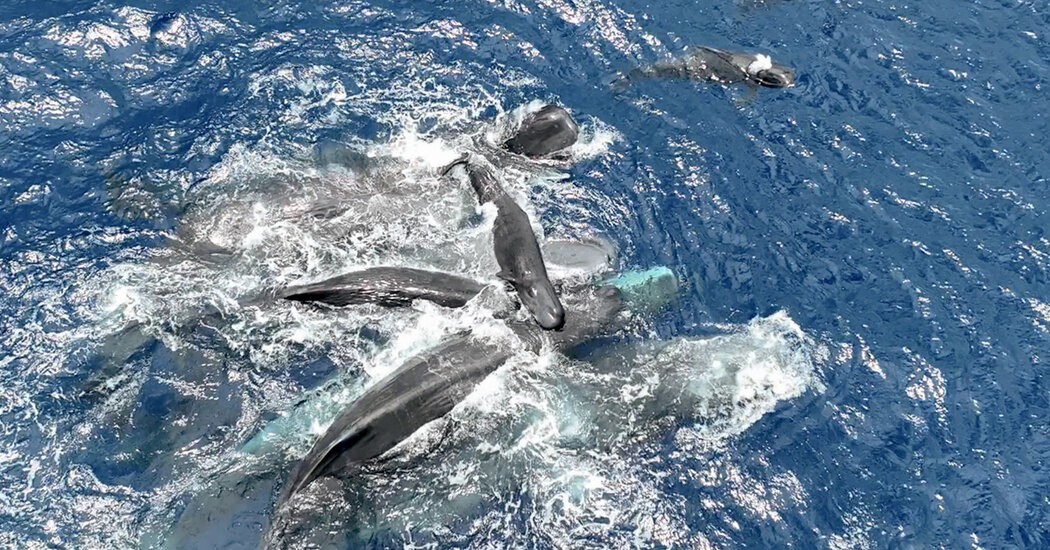
Marine biologists have documented a remarkable instance of cooperative birth behavior in sperm whales, where a mother was assisted by a group of 11 conspecifics. This event, captured on video and published in Science and Scientific Reports, provides rare insight into cetacean reproductive dynamics, challenging assumptions about solitary births in large marine mammals.
The Observation
Researchers initially observed an unusually still cluster of sperm whales at the surface, engaging in shallow, intermittent dives. After roughly an hour, increased thrashing and a visible blood plume suggested distress. However, the situation resolved as a newborn calf was physically lifted to the surface by the group, allowing it to breathe. This was not an isolated incident of support; the whales actively assisted throughout the birth process.
Implications of Social Support
The most surprising aspect of this observation is the involvement of unrelated individuals. Half of the assisting whales had no genetic connection to the mother, suggesting that social reciprocity, rather than solely kin selection, may drive this behavior. This is significant because most documented animal births occur in isolation, often to avoid infanticide or competition.
“This isn’t human midwifery, but there was clear support for both mother and calf,” explains Alaa Maalouf, a researcher with Project CETI, the group behind the studies.
Why This Matters
Birth in wild animals is rarely observed due to its private nature. Captive settings alter behaviors, making field studies crucial. The sperm whale birth event raises questions about the evolution of social cooperation in large marine species. It suggests that complex social bonds and altruistic behavior may be more widespread in cetaceans than previously understood.
The lack of prior evidence is not surprising; underwater births are difficult to witness. The fact that this event was captured at all underscores the importance of continued research using modern technologies, like machine learning, to analyze animal behavior.
Ultimately, this discovery demonstrates that humans are not alone in exhibiting cooperative birthing practices, highlighting the diverse and often underestimated social complexity within the animal kingdom.