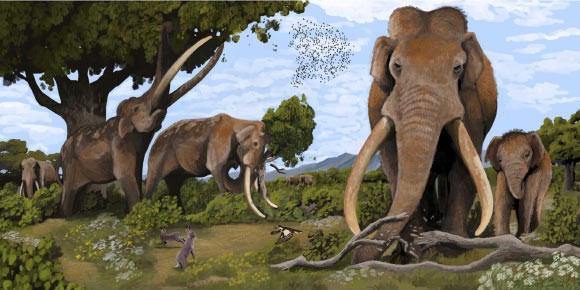
New research confirms that Neanderthals actively hunted straight-tusked elephants, massive creatures that roamed Europe over 125,000 years ago. The study, published in Science Advances, provides direct evidence of organized hunting strategies, challenging previous assumptions that Neanderthals primarily scavenged these enormous animals.
Tracking Giants Through Time
Researchers analyzed the teeth of four straight-tusked elephants ( Palaeoloxodon antiquus ) discovered at the Neumark-Nord site in Germany. Using strontium isotope analysis, they reconstructed the animals’ movements over years. The results revealed that some elephants traveled up to 300 kilometers (186 miles) before being killed, indicating they were not local to the hunting grounds. This level of mobility is similar to modern elephant behavior, where males roam larger territories than females.
Sex and Hunting Patterns
The study also identified the sex of the elephants: three males and one female. Two of the males exhibited isotope signatures inconsistent with the local bedrock, further supporting their long-distance migrations. The concentration of remains at Neumark-Nord, combined with the isotope data, suggests that Neanderthals deliberately targeted elephants rather than simply taking opportunistic kills.
A Planned Effort
“Everything points to organized hunting in which even such enormous prey animals could be deliberately targeted,” stated Dr. Elena Armaroli, lead researcher at the University of Modena and Reggio Emilia. This implies Neanderthals possessed detailed knowledge of the landscape, cooperated effectively, and planned their hunts meticulously. Hunting straight-tusked elephants, which weighed up to 13 tons, would have required coordinated effort and considerable skill.
Advancing Paleoproteomics
The research also marks a methodological breakthrough: it’s the first time paleoproteomics has been used to determine the sex of European straight-tusked elephants from proteins preserved in tooth enamel. This technique provides a new tool for understanding prehistoric animal behavior.
This discovery reinforces the understanding that Neanderthals were not just opportunistic scavengers, but capable hunters who strategically exploited large game across vast territories. The ability to plan and execute such hunts demonstrates a level of cognitive and social complexity previously underestimated in Neanderthal populations.