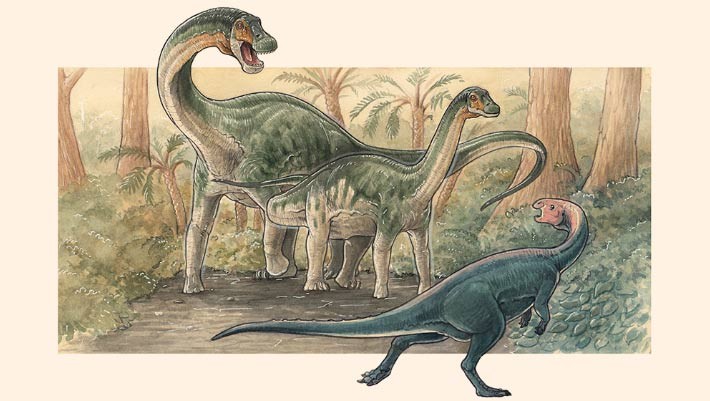
Paleontologists have identified a previously unknown species of titanosaur, a massive long-necked dinosaur, from remarkably well-preserved fossils discovered in northern Patagonia, Argentina. The new dinosaur, named Yeneen houssayi, lived approximately 83 million years ago during the Late Cretaceous period.
A New Giant Emerges
Yeneen houssayi was a member of the Titanosauria, a group of herbivorous dinosaurs that flourished across the ancient supercontinent Gondwana. The newly discovered species measured between 33 and 39 feet (10–12 meters) long and weighed roughly 8 to 10 tons. What sets Yeneen houssayi apart is its proportionally small head compared to its massive body—a feature noted by Dr. Leonardo Filippi of CONICET and the Museo Municipal Argentino Urquiza.
Fossil Discovery: A Window into Cretaceous Patagonia
The fossils were excavated from the Bajo de la Carpa Formation, specifically at the Cerro Overo-La Invernada locality in Neuquén province, Argentina. The remains include a substantial portion of the skeleton, with six neck vertebrae, ten back vertebrae along with ribs, the sacrum (hip region), and the first tail vertebra all intact.
This isn’t just one dinosaur: paleontologists also found evidence of at least two other sauropods at the site. This included a juvenile Yeneen houssayi and an adult belonging to a different, yet-to-be-described species. The discovery suggests that the area was once a thriving hub for titanosaurs.
Evolutionary Relationships and Diversification
Phylogenetic analysis places Yeneen houssayi within the Saltasauroidea clade, closely related to Narambuenatitan and Overosaurus. The presence of multiple titanosaur lineages – Colossosauria and Saltasauroidea – in the same location suggests high species diversity during the Santonian age (approximately 84-83.6 million years ago).
“The Cerro Overo-La Invernada area is now recognized as having the greatest diversity of titanosaurs for the Santonian of the Neuquén Basin,” notes Dr. Filippi. “This makes it an exceptional location to study the evolution of dinosaur faunas during that period.”
This finding underscores that titanosaurs weren’t a monolithic group but rather a diverse collection of species evolving alongside each other in specific regions. The relatively complete skeleton and multiple individuals found at Cerro Overo-La Invernada provide valuable data for understanding how these massive creatures lived and diversified in South America.
The research was published January 12, 2026 in the journal Historical Biology. The discovery highlights the rich paleontological potential of Patagonia, Argentina, and further refines our understanding of the final days of the dinosaurs.