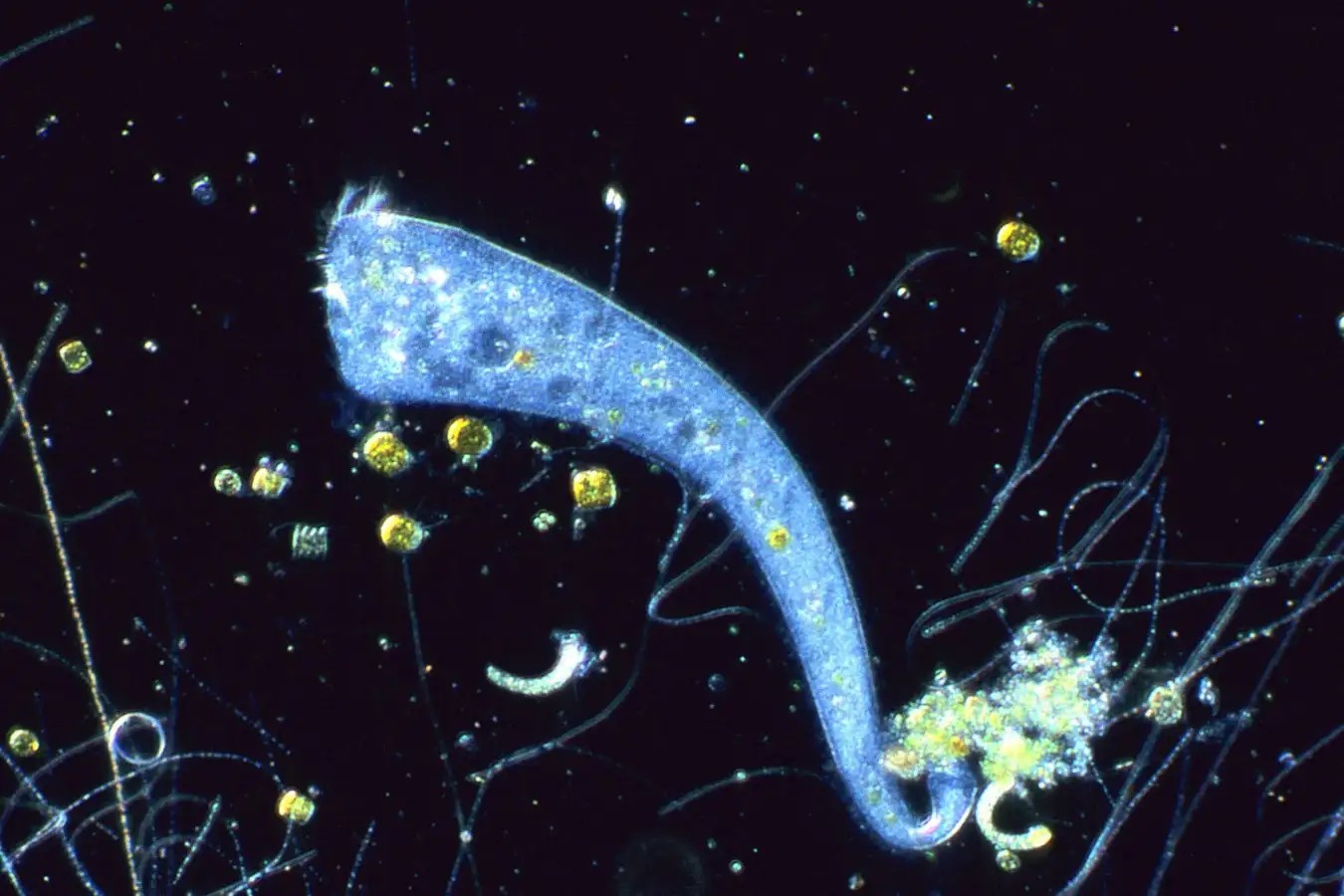
A microscopic, brainless organism has surprised scientists by exhibiting a form of learning previously thought exclusive to animals with nervous systems. Researchers have found that Stentor coeruleus, a single-celled protist, is capable of associative learning – the ability to link two unrelated stimuli and anticipate events. This discovery challenges long-held assumptions about the origins of cognition and memory.
The Experiment: Pavlovian Conditioning in a Single Cell
The experiment, conducted by Sam Gershman and his team at Harvard University, mirrored Ivan Pavlov’s classic dog-salivation study. Stentor cells, which attach to surfaces and feed using a trumpet-like structure, were subjected to a series of taps. Initially, the cells contracted defensively when tapped. However, repeated tapping caused them to habituate – a common response across the animal kingdom – reducing their reaction over time.
The crucial finding came when a weak tap was consistently paired with a stronger one, delivered just one second later. Over multiple trials, the Stentor cells initially increased their contraction rate in response to the weak tap before gradually decreasing it again. This “bump” in the data suggests the organism had learned to associate the weak tap with the impending stronger stimulus.
Why This Matters: Rewriting the History of Cognition
This is the first documented case of associative learning in a protist, an organism lacking any neural tissue. Stentor ’s ability to learn without a brain suggests that the fundamental mechanisms of cognition may be far more ancient and widespread than previously assumed.
The implications are significant: Associative learning likely predates the evolution of nervous systems by hundreds of millions of years. Researchers speculate that similar processes might still operate at a molecular level within neurons today, independent of synaptic changes.
The Mechanism: Molecular Memory in a Single Cell
While the exact mechanism remains unknown, Gershman hypothesizes that it involves receptors responding to touch by triggering calcium influx, altering the cell’s internal voltage. Repeated stimulation may modify these receptors, creating a molecular “switch” that suppresses contraction. This suggests that even the simplest forms of memory storage can occur without dedicated neural structures.
Other scientists, such as Shashank Shekhar at Emory University, believe this capacity may be more common in unicellular life than we currently understand. The discovery opens the door to exploring cognitive abilities in other single-celled organisms, potentially revealing the earliest roots of intelligence on Earth.
This research fundamentally challenges our understanding of cognition, demonstrating that advanced learning doesn’t necessarily require a brain. The ability of a single cell to exhibit such complex behavior raises profound questions about the evolution of intelligence and the limits of life’s capacity for adaptation.