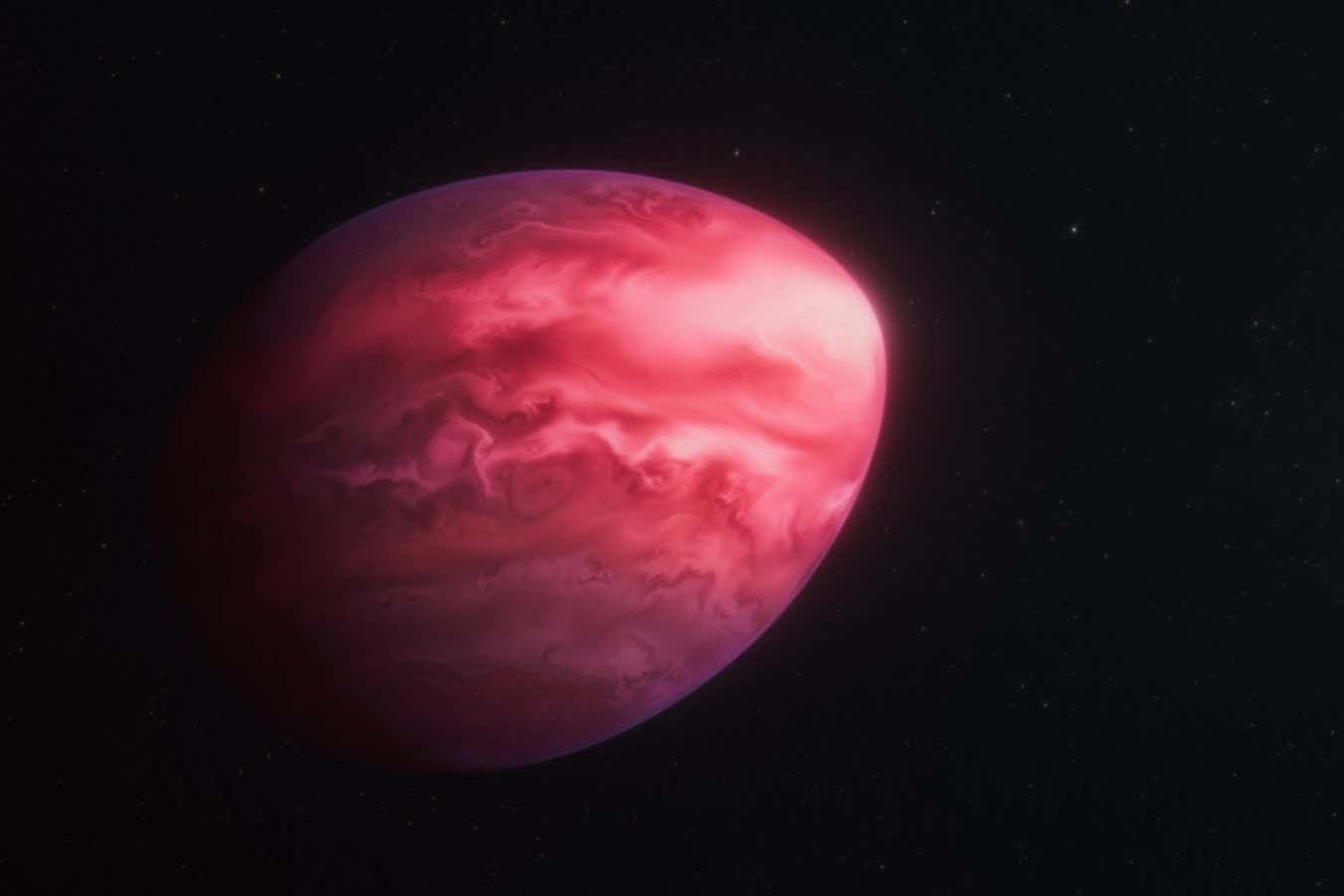
Astronomers have discovered an exoplanet, PSR J2322-2650b, that defies conventional understanding of how planets form and behave. Located over 2,000 light-years away, this world orbits a pulsar—a rapidly spinning neutron star—and exhibits atmospheric and physical characteristics unlike any other known exoplanet.
Unprecedented Atmospheric Composition
The James Webb Space Telescope detected an atmosphere dominated by pure molecular carbon. This is highly unusual: carbon in planetary atmospheres almost always bonds with other elements like oxygen or nitrogen. Researchers, including Michael Zhang from the University of Chicago, state that stripping a planet’s atmosphere of all other elements to leave only carbon is currently unexplained.
“We don’t know of any other planetary atmosphere that looks anything like this,” says Zhang.
Extreme Conditions and Distorted Shape
PSR J2322-2650b orbits incredibly close to its pulsar, completing a full orbit in just 7.8 hours. The intense gravity of the neutron star has stretched the planet into an oblong, lemon-like shape. Surface temperatures remain scorching, averaging around 650°C (1202°F) even in the coldest regions.
Adding to its oddities, the planet’s winds flow against its rotation – another deviation from typical planetary behavior. Researchers speculate that the atmosphere would appear deep red, filled with graphite clouds, resembling what Zhang calls an “evil lemon.”
Implications for Planet Formation
The existence of PSR J2322-2650b poses a significant challenge to current planet formation models. The combination of its atmospheric composition, distorted shape, and extreme orbital conditions suggests that either the established theories are incomplete, or entirely new formation processes must be considered. The discovery highlights how little we still know about the diversity of planetary systems beyond our own.
This exoplanet is a total mystery, and further research is needed to unlock its secrets.