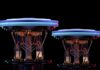
A breathtaking long-exposure photograph taken by NASA astronaut Chris Williams from the International Space Station (ISS) vividly illustrates the station’s unique vantage point: a blend of Earth’s cities, distant stars, and the complex machinery that keeps the orbital laboratory functioning.
Orbital Speed and Light Trails
The image was captured while the ISS flew over the India-Pakistan border at approximately 261 miles (420 kilometers) above Earth. The high orbital velocity of around 17,500 mph (28,000 km/h) turns city lights into streaks of glowing trails far below, while the station’s rotation during orbit causes stars in the background to form circular patterns.
This effect isn’t just aesthetic; it demonstrates how drastically different perspective looks from space compared to ground-level observation. The Earth moves under the station at incredible speed, but the ISS itself is also rotating as it maintains its orientation to the planet.
Visible Spacecraft Hardware
The foreground of the photo features docked spacecraft crucial for the ISS’s ongoing operation. Visible is the Cygnus-23 cargo craft, attached to the Unity module. Delivered in September 2025, this updated version of Northrop Grumman’s resupply vehicle carried nearly 11,000 pounds (4,990 kilograms) of equipment to the station.
Additionally, the Japan Aerospace Exploration Agency’s (JAXA) HTV-X1 cargo craft is docked to the Harmony module, positioned behind the Canadarm2 robotic arm. These supply missions are vital, as the ISS is entirely reliant on external deliveries for food, experiments, and maintenance.
A Reminder of Scale
The photograph serves as a striking visual reminder of the vast distances and technological marvels involved in space exploration. From the immediate presence of spacecraft to the distant lights of cities and the almost incomprehensible scale of the cosmos, the image encapsulates the unique perspective offered by the ISS. The station is not merely a scientific outpost, but a testament to human engineering, international cooperation, and our enduring quest to understand the universe beyond our planet.
The photograph powerfully illustrates how much effort and technology is required to sustain a human presence in orbit, while simultaneously highlighting the humbling beauty of the cosmos.