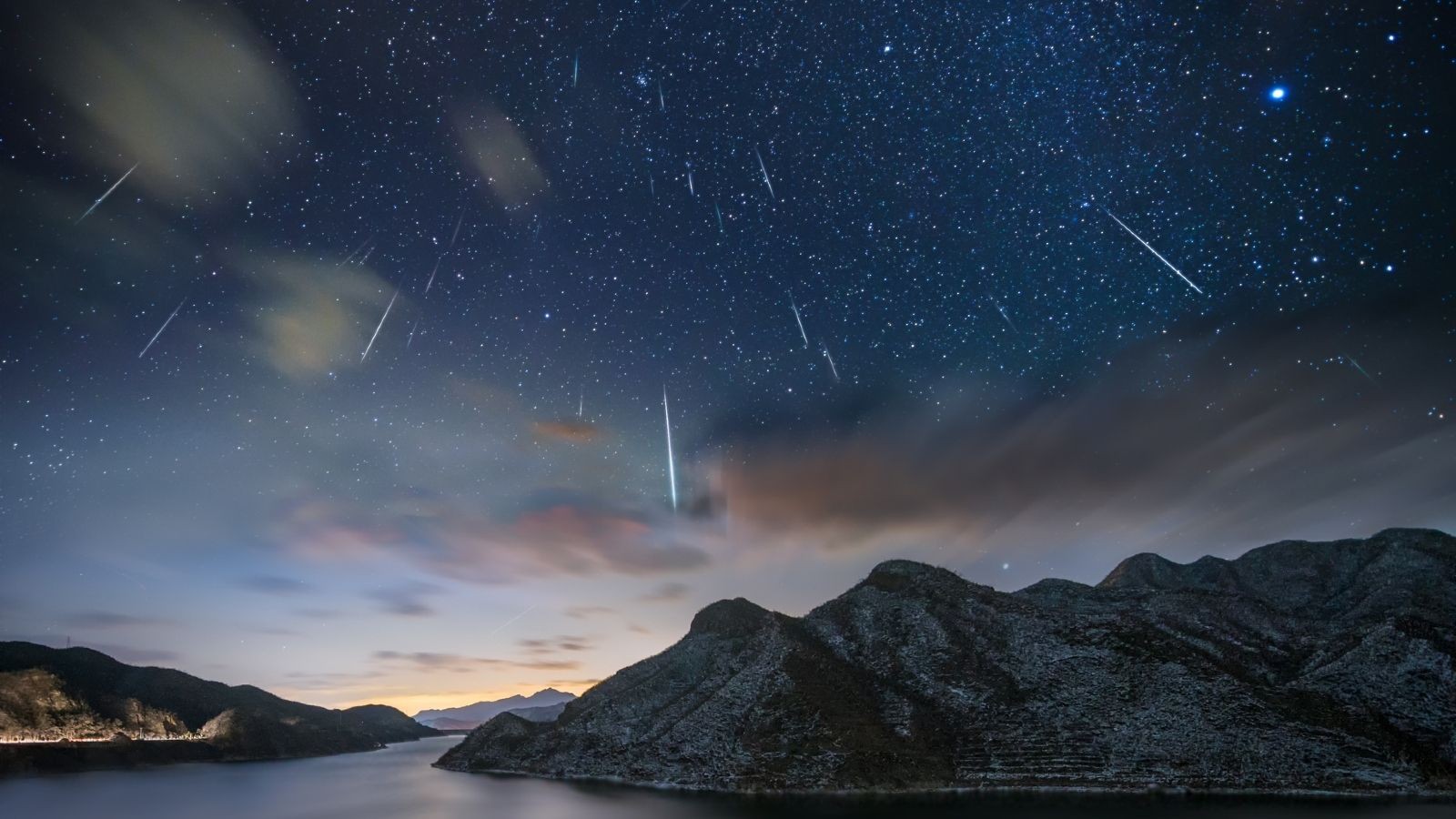
While mainstream news often focuses on massive asteroids that pose a threat to Earth, a different, more subtle story is unfolding in our night sky. By studying the tiny fragments of dust and rock that enter our atmosphere daily, scientists are uncovering the secrets of how small celestial bodies evolve—and how they occasionally fall apart under the intense heat of the Sun.
The Science of Shooting Stars
To understand this discovery, one must first understand what a meteor actually is. When a tiny piece of space debris—often no larger than a grain of sand—hits Earth’s atmosphere at speeds exceeding 15 miles per second, it vaporizes instantly. This process creates a streak of electrically charged gas that we see as a “shooting star.”
In the solar system, these fragments generally come from two sources:
– Comets: Often described as “dirty snowballs,” these icy objects release massive amounts of dust as their ice turns directly into gas (sublimation) near the Sun.
– Asteroids: Rocky, dry leftovers from the early solar system that typically do not possess the icy tails characteristic of comets.
When an object begins shedding dust or gas, astronomers call it “active.” While comets are naturally active due to their ice, asteroids are much more mysterious. They can become active due to heat stress, small impacts, or even spinning so rapidly that they begin to fly apart.
A New Discovery in the Night Sky
In a study published in March 2026, researchers analyzed millions of meteor observations from automated camera networks across Canada, Japan, California, and Europe. Amidst the vast amount of data, they identified a distinct, newly formed cluster of 282 meteors.
This cluster is not a random occurrence; it is the debris trail of a specific asteroid currently being “baked” by solar radiation.
Key characteristics of this discovery:
- Extreme Orbit: The parent asteroid follows a path that brings it nearly five times closer to the Sun than Earth is.
- Composition: By analyzing how these meteors break apart in our atmosphere, scientists determined they are “moderately fragile”—tougher than cometary dust but more brittle than a solid rock.
- The Process: The intense solar heat is literally cracking the asteroid’s surface, forcing trapped gases to escape and causing the outer layers to crumble into the debris stream we now see as a meteor shower.
Why Meteor Showers Matter for Astronomy
Finding a meteor shower is like finding a “breadcrumb trail” left by a celestial object. When an asteroid sheds debris, the fragments initially travel in a tight group. Over time, the gravitational pull of planets acts like currents in a river, spreading the debris out across the asteroid’s entire orbit.
This creates a vital diagnostic tool for astronomers. Because these debris streams can be detected even when the parent object is too dark or distant to see with traditional telescopes, meteor showers act as sensitive probes for discovering “hidden” asteroids.
The Path Forward: Planetary Defense
Identifying these crumbling, sun-approaching asteroids is more than just an academic exercise; it is a critical component of planetary defense. Understanding the population of near-Earth objects (NEOs) helps scientists predict which rocks might pose a future risk to our planet.
While the exact identity of this specific “crumbling” asteroid remains unknown, the scientific community has a clear next step. NASA’s NEO Surveyor mission, scheduled for launch in 2027, is specifically designed to hunt for these dark, hazardous, sun-approaching objects.
Finding these hidden meteor streams allows us to study the physical evolution of our solar system and identify potentially dangerous objects that remain invisible to conventional telescopes.
Conclusion
The discovery of this new meteor cluster reveals a dynamic solar system where even “dead” rocks can become active through solar heating. As we refine our ability to track this debris, we move closer to mapping the hidden populations of asteroids that inhabit our cosmic neighborhood.