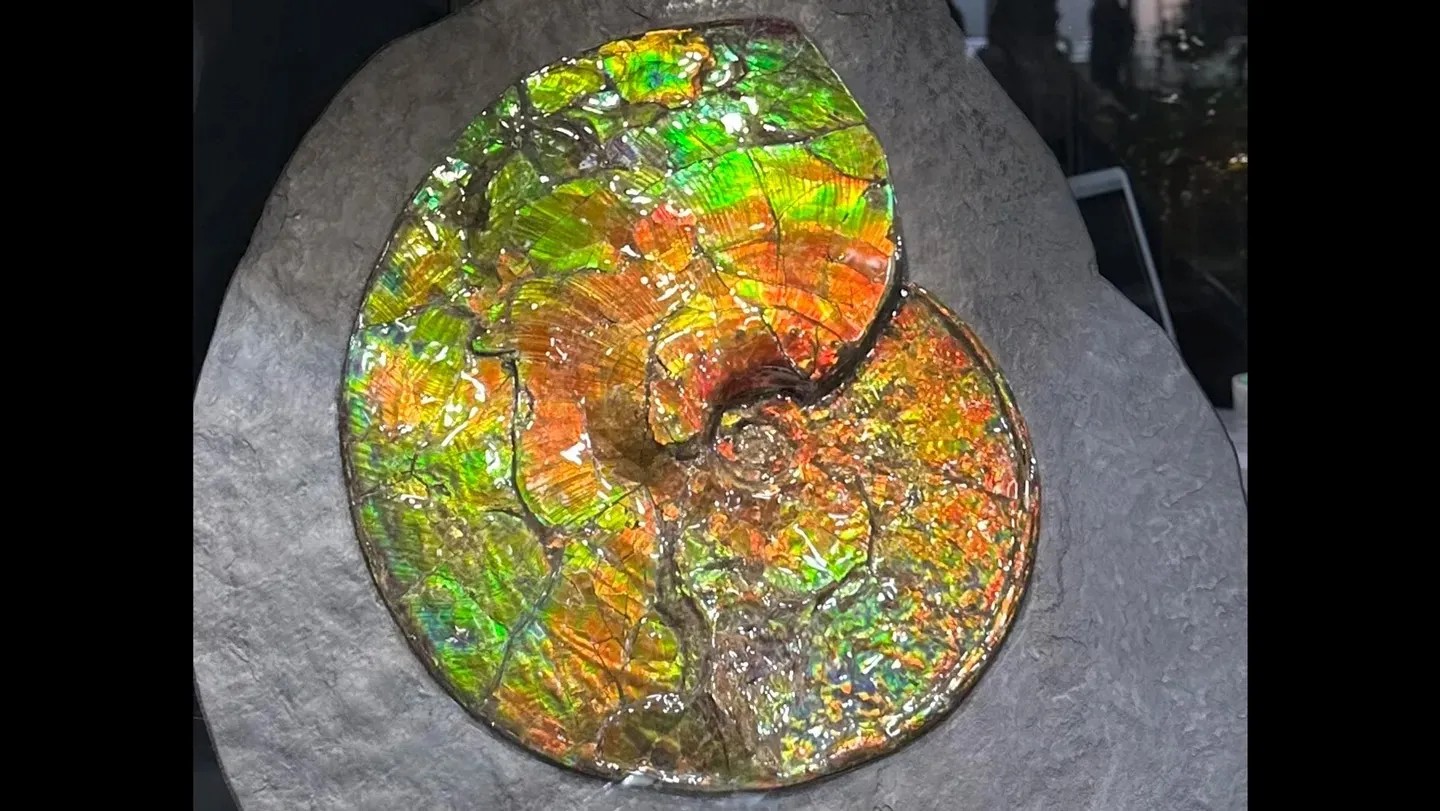
Ammolite, a rare and striking gemstone, owes its vibrant rainbow shimmer to an ancient lineage: the extinct ammonoids. These creatures, distant relatives of modern squids and octopuses, thrived in Earth’s oceans for over 350 million years before vanishing 66 million years ago with the dinosaurs. But their legacy lives on in the stunning play of color found within their fossilized shells.
The Biology of Brilliance
Ammonites possessed a distinctive coiled shell, similar in shape to a coiled snake, divided internally into a series of chambers. While the shells themselves were initially composed of minerals like silica and carbonates, their true beauty emerges after millions of years of fossilization. The key isn’t pigment, but structural color.
Unlike typical color created by chemical pigments, ammolite’s iridescence arises from the microscopic arrangement of layers within the shell. These layers, primarily composed of nacre (also known as mother-of-pearl, the same substance found in some mollusk shells), refract light in a way that splits white light into its component hues: red, orange, yellow, green, blue, indigo, and violet—creating a natural rainbow effect. This is the same principle behind the blue sheen on bird feathers or butterfly wings; the color isn’t in the material, it’s created by how the material is structured.
From Fossil to Gemstone
The best ammolite specimens come from fossil beds in Madagascar, though they can also be found elsewhere. The process of fossilization itself is crucial. Over millennia, pressure and mineral-rich fluids seep into the ammonite’s shell, altering its composition and enhancing its iridescent properties.
Materials scientists use tools like electron microscopes to study the precise arrangement of layers in ammolite, revealing how even slight variations in thickness and spacing can dramatically affect the color display. The result is a gem unique in the world: a fossil that literally holds a rainbow within its ancient structure.
Why This Matters
Ammolite’s story is more than just geology. It’s a testament to how life’s history can be preserved in stone, and how seemingly simple structures—like the chambers of an ammonite shell—can produce extraordinary optical effects. The study of ammolite also offers insights into the broader field of biophotonics, where scientists aim to mimic nature’s structural color for advanced technologies.
The iridescent shimmer of ammolite is not just beauty, but a reminder that even extinction can leave behind a lasting legacy of wonder.