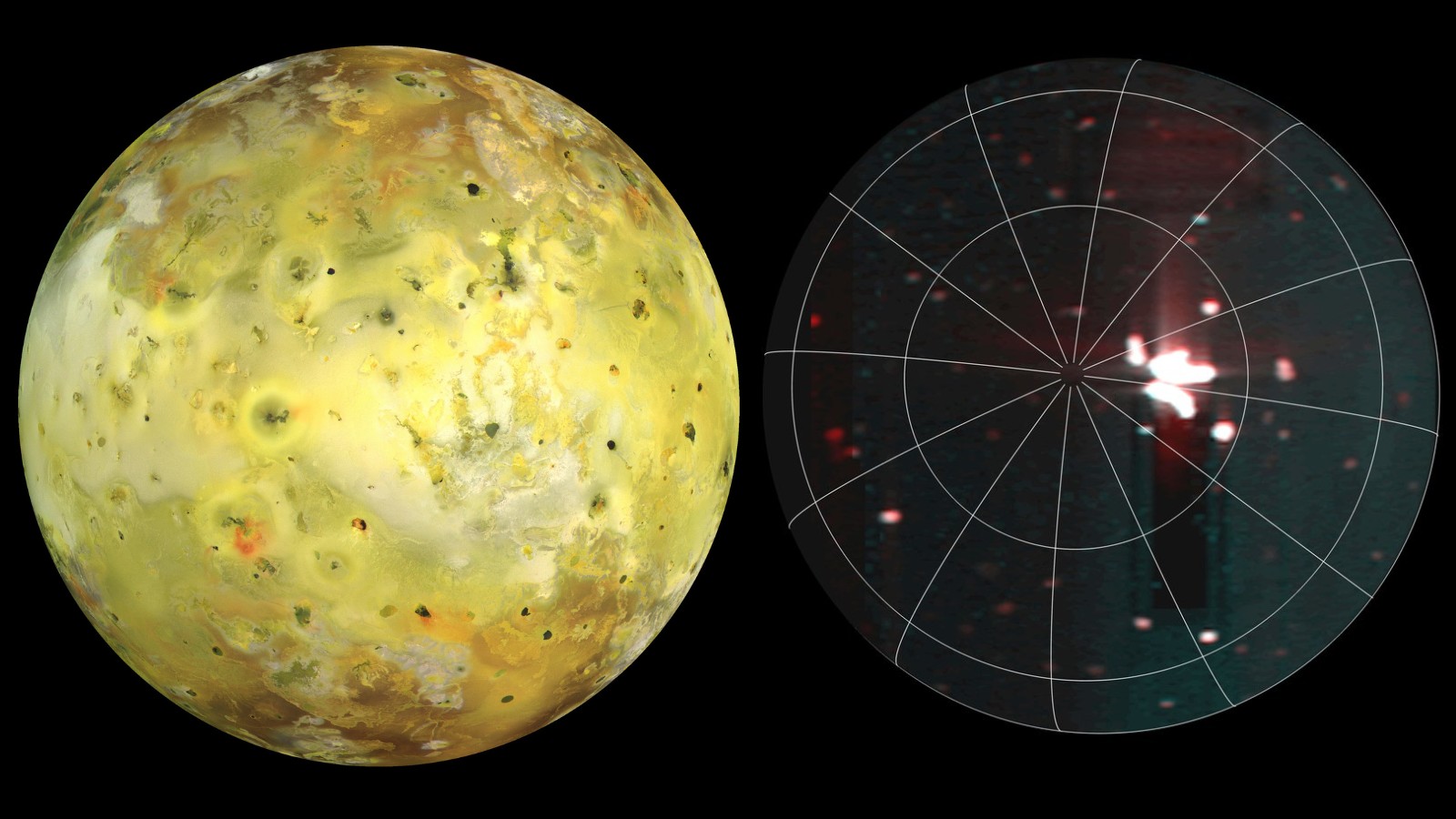
NASA’s Juno spacecraft has documented the largest volcanic eruption ever observed in our solar system on Jupiter’s moon Io. The event, which occurred on December 27, 2024, unleashed an astonishing 140–260 terawatts of energy – far exceeding any previous eruption recorded on Io, including the 80 terawatt blast from Surt volcano in 2001. For perspective, this dwarfs even the 1980 Mount St. Helens eruption, which released 52 terawatts.
Synchronized Cataclysm
What sets this eruption apart is its synchronicity. Multiple volcanoes across Io erupted simultaneously, brightening by over a thousand times their usual intensity. This suggests a previously unknown network of interconnected magma reservoirs beneath the moon’s surface. The scale of the event covered an area of 65,000 square kilometers (40,400 square miles), indicating a single, massive eruption propagating through hundreds of kilometers of subsurface magma.
Tidal Forces and Io’s Volcanic Fury
Io’s extreme volcanism is driven by Jupiter’s immense gravitational forces, which flex and squeeze the moon’s interior. This constant tidal stress generates enough heat to keep its mantle molten, fueling roughly 400 active volcanoes across the surface. The recent eruption provides new evidence that Io’s subsurface may be akin to a “magma sponge,” with vast interconnected pores of molten rock.
Juno’s Unexpected Role
The discovery was made using Juno’s JIRAM (Jovian InfraRed Auroral Mapper) instrument, originally designed to study Jupiter’s atmosphere and aurorae. However, JIRAM’s infrared capabilities proved invaluable for detecting the volcanic hotspots on Io during one of Juno’s close flybys – at a distance of 74,400 kilometers (46,200 miles) from the moon.
Future Exploration
Juno’s extended mission now focuses on close encounters with Jupiter’s Galilean moons. Further flybys of Io will aim to map new lava flows and ash deposits resulting from this historic eruption, providing more insights into the moon’s violent geologic activity.
This event underscores the extreme conditions on Io and reveals the complex interplay between tidal forces, subsurface magma networks, and volcanic activity in the Jovian system.