


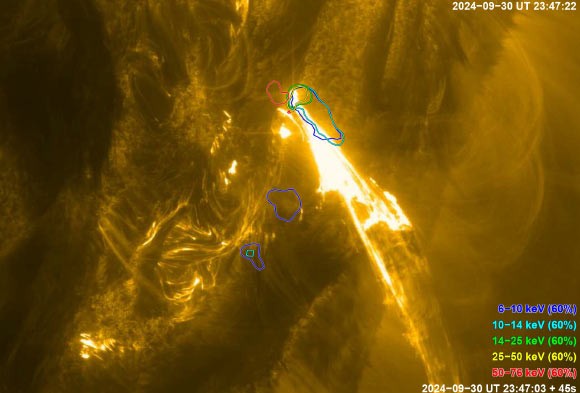
Recent observations from the European Space Agency’s (ESA) Solar Orbiter mission have provided unprecedented insight into the mechanics of solar flares, revealing they are driven by cascading magnetic reconnection events. These events release enormous amounts of energy, effectively “raining” plasma down across the Sun’s atmosphere.
The Power of Solar Flares
Solar flares are among the most energetic phenomena in our solar system. They result from the sudden release of energy stored in complex, tangled magnetic fields. Within minutes, oppositely-directed magnetic field lines snap and reconnect, rapidly heating plasma to millions of degrees and accelerating particles away from the reconnection site.
Why this matters: The most powerful flares can trigger geomagnetic storms on Earth, potentially disrupting radio communications and even damaging satellites. Understanding these events is crucial for space weather forecasting and protecting critical infrastructure.
Unprecedented Observations Reveal the Trigger
For years, scientists have known that magnetic reconnection is how flares happen, but the exact dynamics of this energy release have remained elusive. The Solar Orbiter’s observations – from four complementary instruments – offer the most complete picture of a flare ever recorded.
High-resolution imagery captured changes in the Sun’s corona (outer atmosphere) every two seconds, focusing on features just a few hundred kilometers across. Simultaneously, SPICE, STIX, and PHI instruments analyzed temperature and depth variations from the corona down to the Sun’s visible surface.
Magnetic Avalanches in Action
The observations reveal that flares begin with a magnetic avalanche: ribbon-like features rapidly descending through the atmosphere before the flare itself. These streams of “raining plasma blobs” demonstrate increasing energy deposition as the flare intensifies, and continue even after the initial explosion subsides.
“We didn’t expect that the avalanche process could lead to such high energy particles,” said Dr. Pradeep Chitta, an astronomer at the Max Planck Institute for Solar System Research.
This is the first time this process has been observed at such high spatial and temporal resolution. The data confirms that the avalanche mechanism is central to the flare’s energy release.
Future Research
Scientists emphasize the need for even higher-resolution X-ray imaging from future missions to fully disentangle the remaining details of this process. An open question is whether this avalanche mechanism occurs in all flares, and if it applies to other flaring stars.
The study, published in Astronomy & Astrophysics, confirms that magnetic avalanches are the central engine powering solar flares, and highlights the importance of this process for understanding space weather. The findings are one of the most exciting results from the Solar Orbiter so far, offering critical new insights into the Sun’s most powerful explosions.
L.P. Chitta et al. 2026. A magnetic avalanche as the central engine powering a solar flare. A&A 705, A113; doi: 10.1051/0004-6361/202557253


