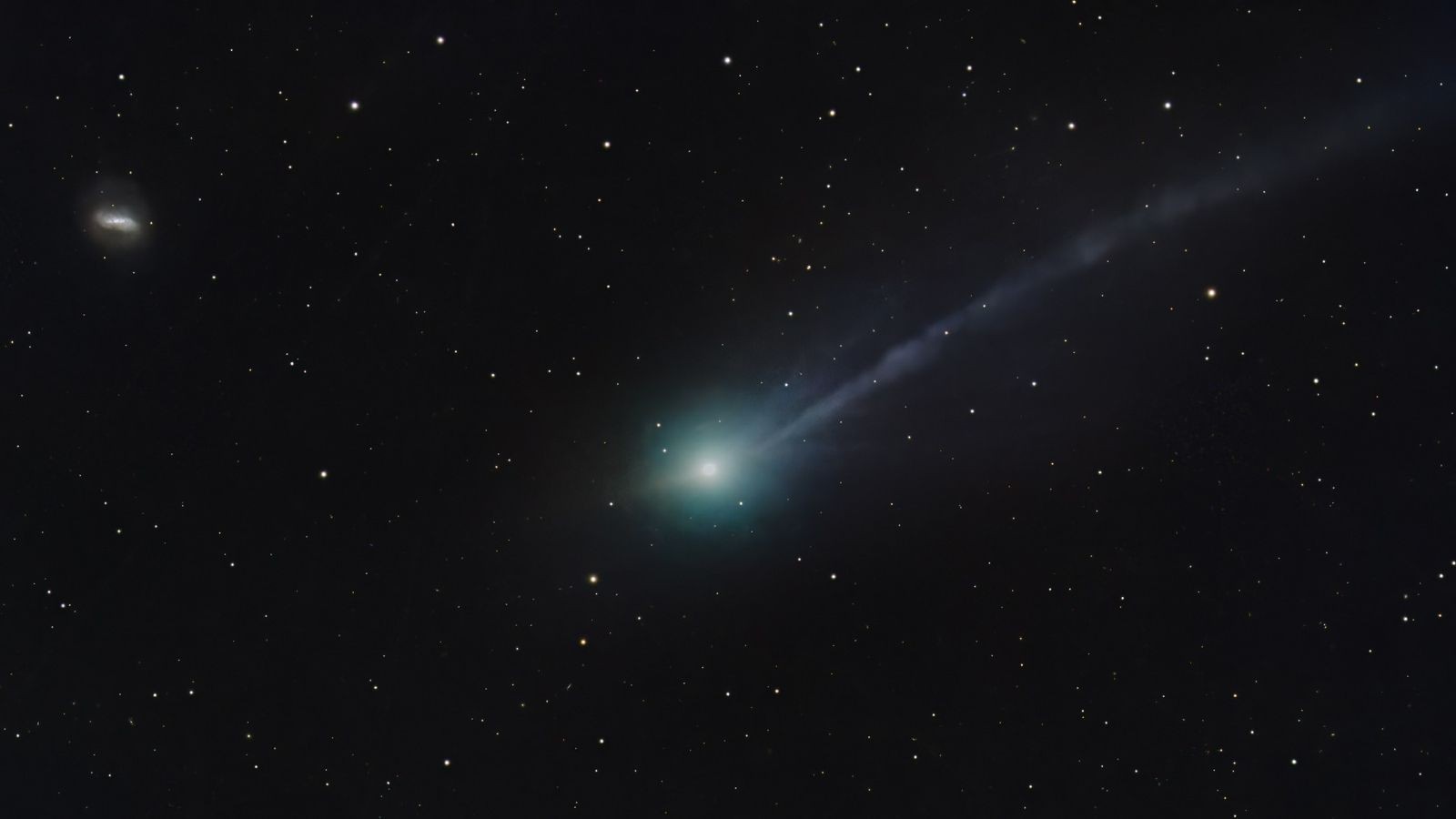
New observations from the James Webb Space Telescope suggest that interstellar comet 3I/ATLAS is one of the oldest objects ever observed, potentially forming between 10 and 12 billion years ago. This makes it significantly older than our solar system, and nearly as ancient as the Milky Way galaxy itself. The discovery offers a rare glimpse into the conditions of the early universe, revealing clues about how planets and stars formed in its infancy.
An Interstellar Visitor
Comet 3I/ATLAS gained attention in 2023 when it was detected traveling through our solar system. Unlike most comets originating within our own cosmic neighborhood, this one came from another star system. Initial speculation even included theories about it being an alien spacecraft, though scientists have since confirmed its natural origin.
The comet’s speed and trajectory hinted at its extreme age, but recent analysis of isotopic measurements taken by the JWST confirms that 3I/ATLAS formed in a distant and cold region of the Milky Way billions of years before our solar system even existed. This makes it more than twice as old as Earth, which formed 4.5 billion years ago.
What the Isotopes Reveal
Researchers examined the composition of gases released by the comet as it warmed during its close approach to the Sun. The ratios of different isotopes – variations of chemical elements – were strikingly different from those found in comets native to our solar system. Specifically, 3I/ATLAS contains a higher concentration of deuterium (a heavier form of hydrogen) and unusual carbon isotope levels.
These findings suggest the comet formed in a unique environment: a cold, dense protoplanetary disk at approximately 30 kelvins (-406°F or -243°C). This means prebiotic chemistry may have been active in the early Milky Way, potentially supporting the development of complex molecules even in the universe’s infancy.
Implications for Galactic History
The discovery of 3I/ATLAS underscores the diversity of objects within our galaxy. This interstellar messenger offers an unprecedented opportunity to study the conditions of the early Milky Way, where stars and planets were first forming. The comet’s chemical composition provides valuable data for understanding how volatile molecules, including those essential for life, were distributed across the cosmos.
While pinpointing the comet’s exact origin remains impossible, its isotopic signature confirms that it traveled through space for billions of years, exposed to cosmic radiation that has altered its makeup over time. Despite these challenges, scientists continue to analyze the comet as it exits our solar system.
A Fading Opportunity
Comet 3I/ATLAS is now moving away from the Sun after its closest approach in late 2025. Astronomers are racing against time to gather further data before it disappears into the depths of space. On March 15th, 2024, it will make its closest approach to Jupiter, providing another chance for observation. The comet’s journey is a reminder that interstellar objects like 3I/ATLAS are rare and fleeting messengers from the ancient universe.
The study of 3I/ATLAS will help us better understand the conditions in which stars and planets formed in the early Milky Way, providing insights into the origins of our own solar system and the potential for life elsewhere in the galaxy.