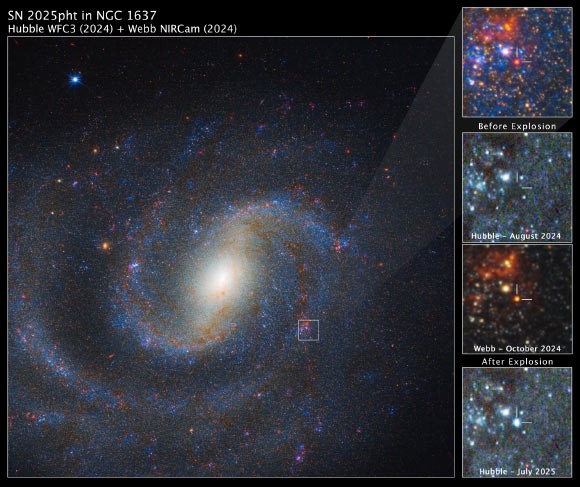
Astronomers using the James Webb Space Telescope (JWST) have, for the first time, definitively identified the star that exploded as a supernova. The progenitor star, a red supergiant heavily obscured by dust, was previously undetectable by older telescopes. This breakthrough resolves a long-standing mystery: why massive stars expected to be bright before exploding often appear to vanish before going supernova.
The Supernova and the Hunt for Its Source
On June 29, 2025, a supernova (designated SN 2025pht) was detected in the galaxy NGC 1637. Scientists immediately sought to identify the star that had detonated, but previous observations had failed to pinpoint a clear candidate. This is not unusual: massive stars, which should be among the brightest objects in the sky, sometimes seem to disappear before exploding, leading astronomers to question whether existing models accurately reflect reality.
Webb’s Infrared Vision Reveals the Hidden Star
The key to the discovery lay in the JWST’s ability to see through dust. Using its Mid-Infrared Instrument (MIRI) and Near-Infrared Camera (NIRCam), astronomers examined archived images of NGC 1637 taken in 2024. The data revealed a single red supergiant star precisely where the supernova now shines.
“We’ve been waiting for this to happen,” said Dr. Charlie Kilpatrick of Northwestern University, lead author of the study. “For a supernova to explode in a galaxy that Webb had already observed.” The combination of Hubble and Webb data allowed for a detailed characterization of the star, confirming it as the reddest and most dust-shrouded red supergiant ever observed to explode.
The Mystery of Missing Red Supergiants Explained
The extreme dust content around SN 2025pht supports a key hypothesis: that the most massive stars, which are also the most luminous, may be hidden by thick clouds of dust. If dust dims these stars to the point of undetectability, it explains why many predicted supernovae progenitors have never been observed.
“It would explain why these more massive supergiants are missing,” Dr. Kilpatrick explained. “Because they tend to be more dusty.”
Unexpected Carbon-Rich Dust Composition
Further analysis revealed that the dust surrounding the star is unusually rich in carbon, rather than the expected silicate composition. The team speculates that this carbon may have been brought to the surface from the star’s core shortly before it exploded, adding another layer of complexity to stellar evolution models.
This discovery highlights the crucial role of infrared observations in understanding stellar lifecycles. Without the JWST’s capabilities, the progenitor star would have remained invisible, and the mystery of missing red supergiants would have persisted. The research was published in October 2025 in The Astrophysical Journal Letters.
The findings underscore that our understanding of how stars end their lives is still evolving, and that the universe often hides its secrets behind clouds of dust.