


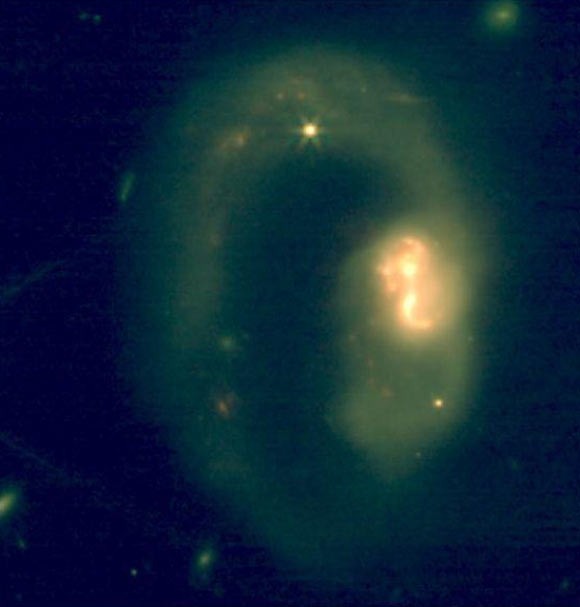
Astronomers have discovered an unexpectedly high concentration of hydrocarbons – the building blocks of more complex organic molecules – in the obscured center of the ultra-luminous galaxy IRAS 07251-0248, located in the constellation Monoceros. Using the James Webb Space Telescope, researchers detected an abundance of small gas-phase hydrocarbons including benzene, methane, acetylene, and, for the first time outside our Milky Way galaxy, the methyl radical.
Overcoming Obscuration with Infrared Light
IRAS 07251-0248’s nucleus is heavily shrouded in gas and dust, making it nearly invisible to traditional telescopes. This material absorbs most visible light and other wavelengths, hindering studies of the supermassive black hole at its core. However, infrared light can penetrate this dust, providing unique access to the chemical processes occurring within. The Webb telescope’s NIRSpec and MIRI instruments were used to analyze the region across a 3-28 micron range, revealing detailed chemical signatures.
Rich Organic Chemistry Beyond Expectations
The spectroscopic data revealed a far richer inventory of organic molecules than previously predicted by theoretical models. In addition to the gas-phase hydrocarbons, significant amounts of solid molecular materials like carbonaceous grains and water ice were also detected. According to Dr. Ismael García Bernete of the Centro de Astrobiología, the observations suggest a continuous source of carbon is fueling this complex chemical network.
Implications for Prebiotic Chemistry
While these small organic molecules aren’t directly found in living cells, they are considered vital precursors to more complex organic chemistry. Professor Dimitra Rigopoulou from the University of Oxford notes that these molecules could represent a key step towards the formation of amino acids and nucleotides – the building blocks of life. The findings suggest that galactic nuclei may be important sites for the development of prebiotic chemistry.
The research, published in Nature Astronomy, highlights the power of the Webb telescope to reveal hidden aspects of the universe and deepen our understanding of organic chemistry in extreme environments. These observations open new avenues for studying the potential origins of life in galaxies beyond our own.


