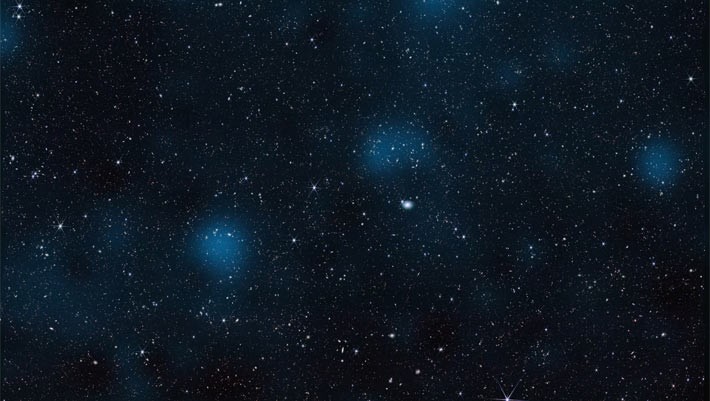
The James Webb Space Telescope has produced the most detailed map of dark matter ever created, providing astronomers with a clearer picture of how this invisible substance shapes the cosmos. The new map, created as part of the COSMOS-Web survey, offers twice the resolution of previous surveys and extends to earlier epochs of cosmic evolution. This breakthrough is significant because dark matter, despite constituting 85% of the Universe’s matter, remains undetectable by conventional means, influencing visible matter through gravity alone.
Mapping the Invisible: How Webb Achieved This
Scientists leveraged Webb’s ultra-sharp imaging to measure distortions in the shapes of approximately 250,000 distant galaxies. These distortions occur because intervening mass — both dark and ordinary — bends the path of light. By analyzing these distortions, researchers reconstructed the most detailed mass map to date for a contiguous region of the Universe.
Previous dark matter maps, relying on instruments like the Hubble Space Telescope, were limited by either insufficient resolution, sensitivity, or area. Webb overcomes these limitations, revealing structures previously too faint or distant to observe.
What the Map Shows: Filaments and Clusters
The map reveals not only massive galaxy clusters but also the intricate networks of dark matter filaments that connect them. These filaments act as scaffolding upon which galaxies form, consistent with the prevailing cosmological model. This is crucial because it confirms the theoretical prediction that galaxies arise at dense nodes within these dark matter structures.
“Previously, we were looking at a blurry picture of dark matter,” stated Dr. Diana Scognamiglio of NASA’s Jet Propulsion Laboratory. “Now we’re seeing the invisible scaffolding of the Universe in stunning detail.”
The Significance of Dark Matter: Holding Galaxies Together
The implications of this map extend beyond visualization. The distribution of dark matter directly influences the formation and stability of galaxies. Without dark matter, the Milky Way itself would likely spin apart due to insufficient gravitational cohesion. This map underscores that dark matter isn’t just a theoretical construct but a fundamental force shaping the Universe as we know it.
As Dr. Gavin Leroy of Durham University put it, “By revealing dark matter with unprecedented precision, our map shows how an invisible component of the Universe has structured visible matter to the point of enabling the emergence of galaxies, stars, and ultimately life itself.”
The findings, published in Nature Astronomy, represent a major step forward in understanding the Universe’s unseen architecture. The map provides critical evidence of dark matter’s role in organizing cosmic structures, solidifying its place as the true architect of the cosmos.