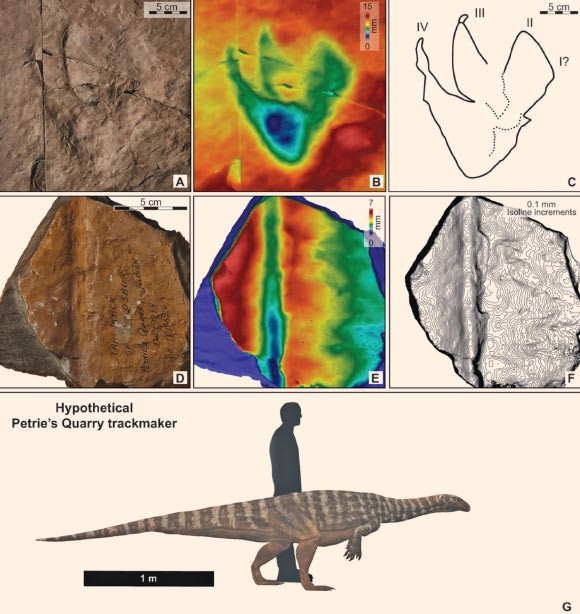
A 230-million-year-old dinosaur footprint, discovered in 1958 by a teenage fossil hunter near Brisbane, Queensland, has been confirmed as the oldest known dinosaur trace in Australia. This discovery pushes back the known timeline of dinosaur presence on the continent, revealing they roamed what is now a major Australian city much earlier than previously understood.
The Discovery and Its History
The 18.5 cm (7 inch) long footprint was unearthed at Petrie’s Quarry, part of the Aspley Formation, and later moved through several university collections before its significance was fully recognized. The site itself has since been redeveloped, making this fossil the only surviving dinosaur evidence from the original location.
The footprint preserves three forward-pointing digits in a fan-shaped outline, characteristic of a bipedal dinosaur. Alongside it, a linear groove suggests a possible tail trace, although its connection to the dinosaur cannot be confirmed definitively without additional surrounding footprints.
What the Footprint Reveals
Paleontologists estimate the dinosaur that made this print stood around 78 cm (31 inches) tall at the hip and weighed approximately 144 kg (89 miles). Based on these dimensions, scientists calculate a potential running speed of up to 60 km per hour (37 mph).
The footprint’s morphology closely matches the Evazoum ichnogenus, a type of footprint associated with early sauropodomorph dinosaurs – the precursors to the massive long-necked dinosaurs that dominated later periods. The discovery is significant because no dinosaur skeletal remains have been found in the Aspley Formation, making this footprint the only direct physical evidence of dinosaurs from this era in the region.
Why This Matters
This discovery highlights how vital trace fossils are: they can reveal dinosaur presence even when bones haven’t survived. The footprint was preserved in sandstone that was later quarried for construction in Brisbane, underscoring how easily paleontological evidence can be lost to urban development. Without preservation, this chapter of Brisbane’s natural history would have remained unknown.
The find also demonstrates that significant paleontological discoveries can remain hidden in plain sight, even within capital cities. The footprint serves as a reminder that the story of life on Earth is still being written, one trace fossil at a time.
The research was published in The Alcheringa, an Australasian Journal of Palaeontology, on February 1, 2026.