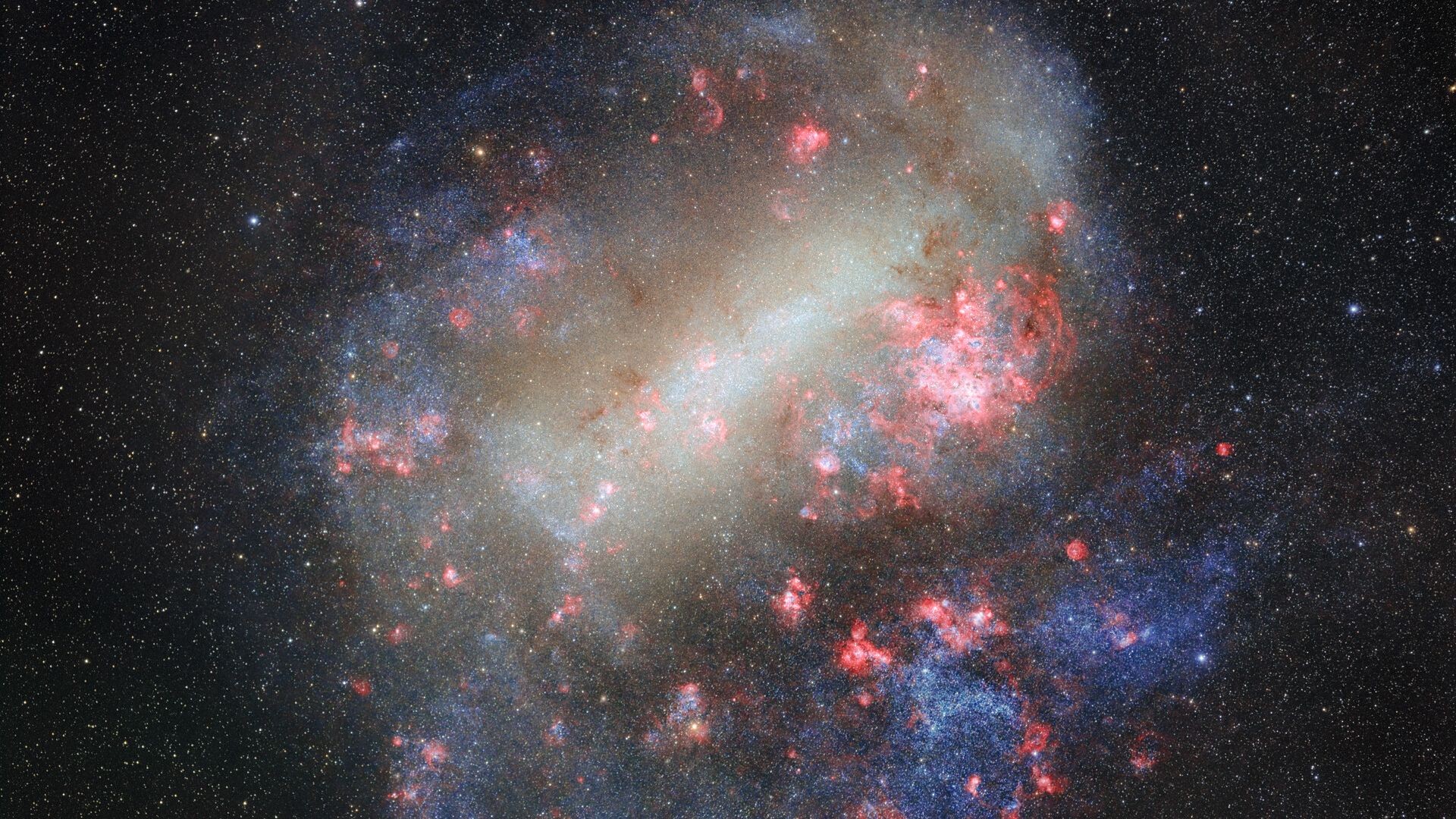
The Large Magellanic Cloud (LMC), a dwarf galaxy visible from the Southern Hemisphere, is currently undergoing a period of intense star formation, captured in stunning detail by photographer Petr Horálek using a long-exposure technique from Chile’s Cerro Pachón observatory. The image, requiring over four hours of integration time, reveals luminous galactic features that would otherwise remain faint.
What Makes the LMC Unique?
The LMC is one of the Milky Way’s closest galactic companions, containing roughly 20 billion stars compared to our galaxy’s 100–400 billion. Unlike the Milky Way’s defined spiral structure, the LMC is classified as irregular. This means its shape is distorted, likely due to gravitational interactions with both the Milky Way and its smaller neighbor, the Small Magellanic Cloud (SMC).
This distortion isn’t a flaw, but a catalyst. The gravitational “tug-of-war” between these galaxies triggers intense star formation, making the LMC a cosmic hot spot.
A Galactic Heist and Stellar Birth
The LMC is actively pulling gas and stars from the SMC, a process that reshapes both galaxies. As material collides, shock waves compress gas clouds, igniting star birth on a massive scale. This process is particularly evident in the Tarantula Nebula (30 Doradus), a region within the LMC that contains some of the most massive and luminous stars ever observed.
The ongoing interactions create a sprawling gaseous bridge between the LMC and SMC, providing ideal conditions for star formation. Essentially, the LMC is not just forming stars; it’s consuming its neighbor to do so.
Location and Significance
The LMC resides approximately 160,000 light-years from Earth, making it a relatively close galactic neighbor. Studying its star formation rates and interactions with the SMC provides valuable insights into galactic evolution. Irregular galaxies like the LMC offer a window into how galaxies change over time under external forces.
The LMC’s active star birth and unique structural distortions make it a key subject for astronomers seeking to understand the dynamics of galactic interactions and the processes that drive stellar evolution.
The Large Magellanic Cloud serves as a dynamic laboratory for observing galaxy evolution in real-time. Its interactions with the Small Magellanic Cloud and the Milky Way provide unparalleled opportunities to study star formation, galactic structure, and the forces that shape the universe.