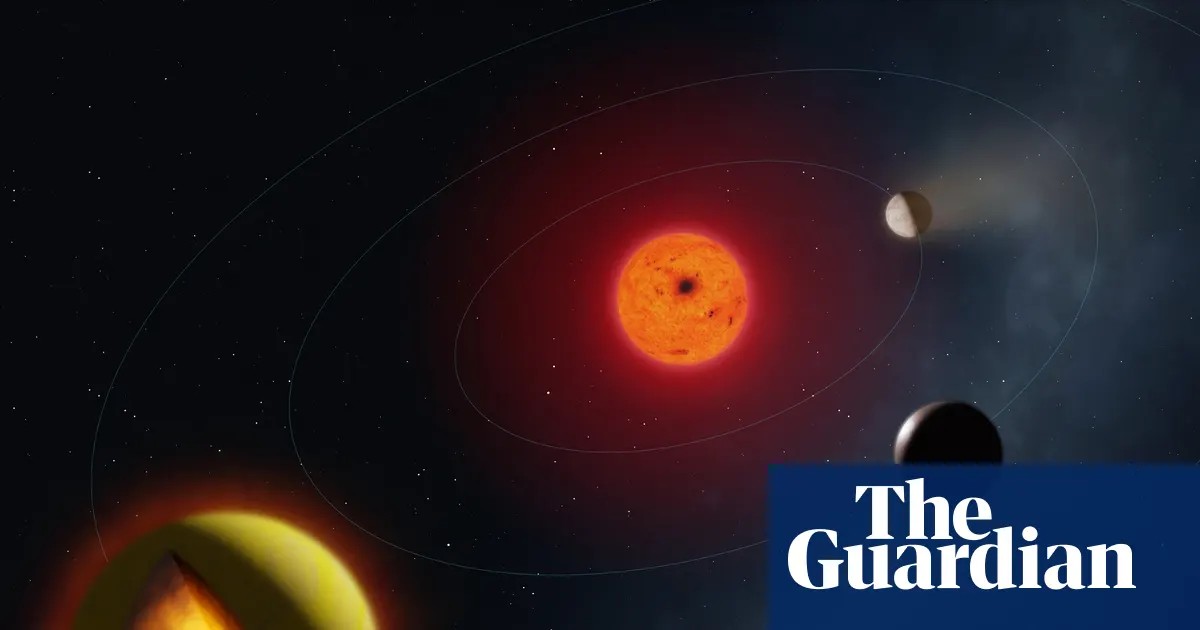
Astronomers have confirmed the existence of a planet unlike any previously observed – a world composed almost entirely of molten lava. The distant exoplanet, designated L98-59d, orbits a small red star 35 light-years from Earth and presents a radical departure from conventional understanding of planetary composition.
Discovery and Initial Confusion
The planet, roughly 1.6 times the size of Earth, initially intrigued scientists with the possibility of a deep ocean of liquid water. However, recent analysis using the James Webb Space Telescope (JWST) revealed a far more extreme reality. Instead of water, L98-59d appears to be in a “molten, mushy state,” as described by astrophysicist Dr. Harrison Nicholls from the University of Oxford. This means the planet’s interior – and potentially its core – is likely liquid.
Extreme Conditions and Composition
Surface temperatures on L98-59d soar to 1,900°C (3,500°F), hot enough to sustain a global magma ocean thousands of kilometers deep. The planet’s atmosphere is rich in hydrogen sulphide, creating a pervasive stench of rotten eggs. Tidal forces from neighboring planets likely generate massive waves across the magma surface. These conditions make the planet demonstrably uninhabitable; even hypothetical lifeforms adapted to lava would struggle to survive.
The Role of JWST and Computer Simulations
Until recently, characterizing exoplanets relied on crude estimates based on silhouettes during stellar transits. JWST’s ability to analyze starlight filtered through planetary atmospheres has revolutionized this field. Observations of L98-59d’s sulphur-rich atmosphere initially puzzled scientists, as such a composition wouldn’t be stable on either rocky or water-based planets over billions of years. Advanced computer simulations reconstructed the planet’s history, concluding that a deep magma ocean is the only plausible explanation for its atmospheric composition.
Implications for Exoplanet Classification
The discovery of L98-59d suggests that molten planets may be far more common than previously assumed. This finding challenges the traditional categorization of exoplanets and highlights the need for caution when assessing habitability. Some planets within the “habitable zone” may, in fact, be molten worlds incapable of supporting life.
“Some planets in the so-called habitable zone might not be very habitable at all, they might be these molten planets.” — Dr. Harrison Nicholls
Future Research and Uncharted Worlds
The existence of L98-59d raises questions about the diversity of planetary systems and the potential for discovering even stranger worlds. Dr. Jo Barstow, a planetary scientist from the Open University, suggests the planet could be even more extreme than previously imagined, perhaps resembling Jupiter’s volcanic moon Io on an unprecedented scale. The exploration of exoplanets will continue to reveal unexpected phenomena, pushing the boundaries of our understanding of the universe.
This discovery underscores that the cosmos holds a far wider range of planetary conditions than previously considered, and further research is essential to catalog and understand these exotic environments.