The astronomical community was bracing for a spectacular celestial event that, instead, ended in a dramatic disintegration. Comet C/2026 A1 (MAPS), a highly anticipated “sungrazer,” has been destroyed after attempting a perilous close approach to the Sun.
Rather than the brilliant, daytime-visible spectacle many experts predicted, the comet emerged from its solar encounter as a “headless wonder”—a ghostly trail of debris stripped of its nucleus.
A High-Stakes Solar Slingshot
Comet MAPS belonged to the Kreutz sungrazer group, a family of comets believed to be the fragmented remnants of a much larger, ancient comet. These objects are famous for their extreme orbits, which bring them incredibly close to the Sun.
Initially, scientists estimated the comet’s nucleus to be roughly 1.5 miles (2.4 km) wide. However, high-resolution data from the James Webb Space Telescope later corrected this estimate, revealing a much smaller body of approximately 0.25 miles (0.4 km) in diameter. This smaller size likely contributed to its ultimate demise.
On Saturday, April 4, the comet reached perihelion —its closest point to the Sun. It dove into the solar corona, passing just 100,000 miles (160,000 km) from the solar surface. To put that distance in perspective, it was roughly half the distance between the Earth and the Moon.
Why the Comet Failed to Survive
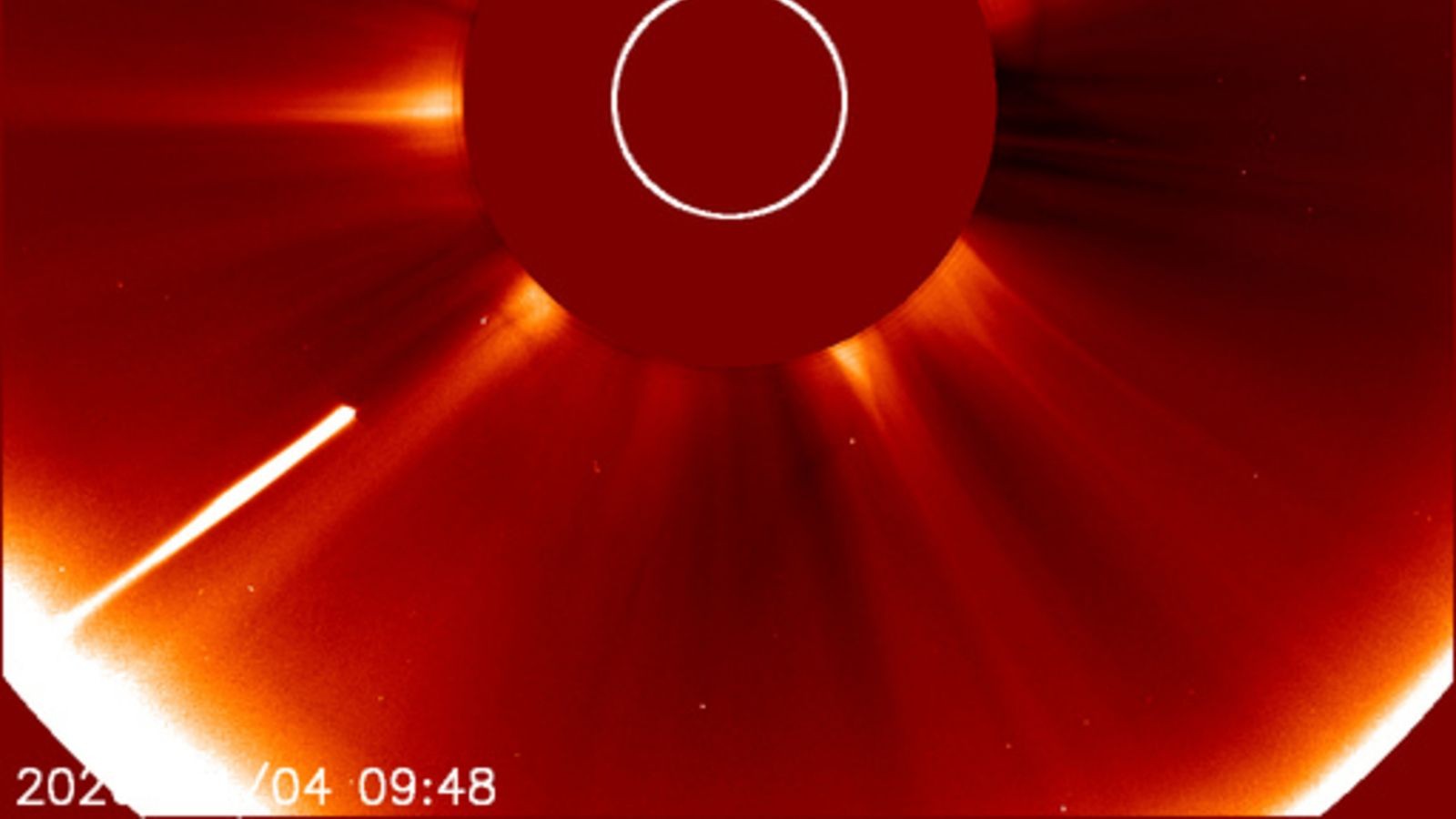
While the proximity to the Sun prevented ground-based photographers from capturing the event, space-based observatories like the Solar and Heliospheric Observatory (SOHO) caught the destruction on film.
The footage shows a bright object streaking toward the Sun, only to emerge on the other side as a shapeless plume of dust and gas. Experts attribute this disintegration to two primary forces:
– Extreme Thermal Stress: The intense heat from the Sun likely vaporized the comet’s icy shell.
– Gravitational Tidal Forces: Traveling at a staggering 1 million mph (1.6 million km/h), the comet was subjected to immense gravitational pull that literally tore its structure apart.
The comet’s remains, known as striae, briefly shimmered as a “headless” tail before the debris scattered into space, leaving nothing behind for observers to track.
Looking Ahead: A New Target for Skywatchers
While the loss of Comet MAPS is a disappointment for those hoping for a naked-eye spectacle, astronomers are already turning their attention to the next candidate: Comet C/2025 R3 (PanSTARRS).
Unlike its predecessor, PanSTARRS is expected to take a much safer path. Its perihelion on April 19 will occur approximately 46.4 million miles (74.6 million km) from the Sun. This distance provides a much higher probability of survival, making it a much more reliable target for telescopes and binoculars.
Given the sudden disappearance of Comet MAPS, the prediction that PanSTARRS could become the “Great Comet of 2026” has gained significant traction among experts.
Conclusion
The destruction of Comet MAPS serves as a stark reminder of the violent environments found within our solar system. However, the upcoming approach of Comet PanSTARRS offers a second chance for stargazers to witness a major cometary event this month.