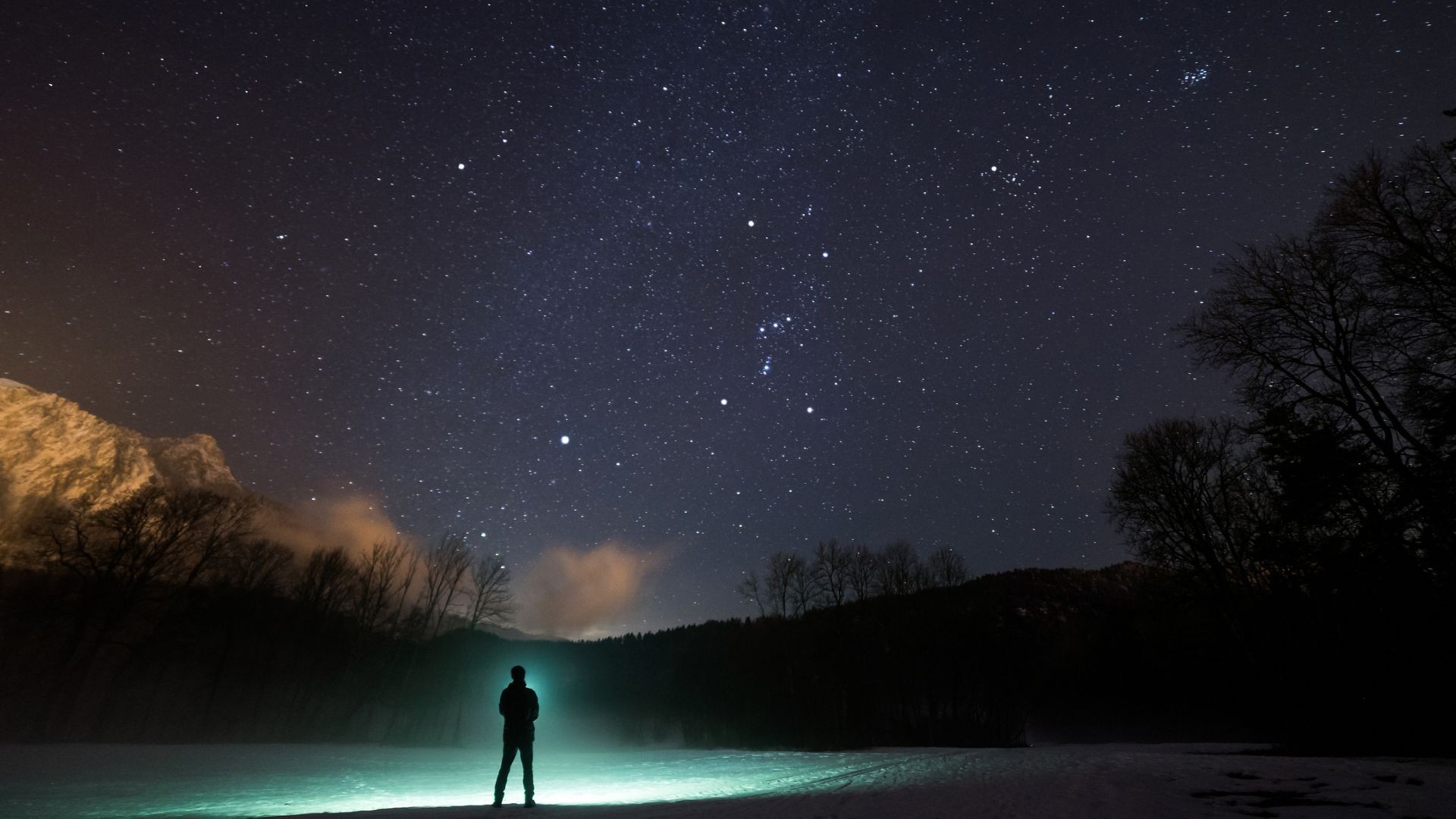
The winter sky offers some of the most rewarding stargazing opportunities. While cold temperatures require preparation, the clear, crisp air delivers exceptional views of deep-sky objects. Whether using the naked eye, binoculars, or a telescope, there are several celestial sights worth seeking out during the long evenings of January and February. Here’s a guide to five standout wonders.
Preparing for Cold-Weather Stargazing
Observing under winter skies demands practical preparation. Layers are key: a hooded ski parka provides lightweight insulation, while ski pants offer superior warmth compared to standard trousers. Prioritize your feet with two pairs of warm socks inside loosely fitted shoes, and consider insulated boots for extended sessions in truly frigid conditions.
Top Five Winter Deep-Sky Objects
This list presents five deep-sky objects readily visible during winter evenings, approximately 90 minutes after sunset when complete darkness falls.
5. Messier 35: A Splendid Star Cluster
Located in the constellation Gemini, near the brighter stars Pollux and Castor, Messier 35 is a striking open cluster visible with binoculars. Look westward from Alhena, a foot of the Twins, to find this faint, unresolved cloud. Even light-polluted skies reveal at least half a dozen of its brightest stars among roughly 200 fainter members. Veteran skywatchers have described M35 as a “splendid specimen” whose stars appear in curving rows reminiscent of a bursting firework.
4. The Double Cluster of Perseus
High in the northwest, the zigzag pattern of Cassiopeia leads to the Double Cluster (NGC 869 and NGC 884). These two magnificent open clusters appear as a single, faint glow to the unaided eye. Binoculars reveal them as distinct, spectacular sights spanning approximately one-third of the Moon’s apparent diameter. Use low magnification to capture both clusters in a single field of view for maximum impact; higher powers will spread the star field too thinly.
3 & 2: The Hyades and the Pleiades
Taurus the Bull hosts two of the most famous star clusters: the Hyades and the Pleiades. The Hyades, about 150 light-years away, form a distinctive V-shape outlining the bull’s face. The bright orange star Aldebaran appears within this pattern but is actually a foreground object at a closer distance.
The Pleiades, at 440 light-years, resemble a tiny dipper. Beginners often mistake them for the Little Dipper. Careful viewing reveals six to seven bright stars, with more visible under excellent conditions. Binoculars at low magnification reveal a glittering array of icy blue diamonds. Modern research shows the Pleiades are part of a vast complex containing over 3,000 stars.
1. The Orion Nebula
Orion, high in the southern sky, hosts Messier 42, the Orion Nebula. Visible as a fuzzy patch below the hunter’s three-star belt, it appears as a bright, gray-green mist through binoculars and small telescopes. Larger instruments reveal its irregular, translucent fan shape. The nebula is illuminated by four hot stars within it, known as the Trapezium.
At 1,500 light-years away and 30 light-years across, the Orion Nebula is an active stellar nursery where new stars are forming. The nebula’s beauty has inspired generations of astronomers, with some comparing it to a ghostly bat. It remains a prime target for both visual observers and astrophotographers.
These winter sky wonders offer a glimpse into the vastness and beauty of the cosmos, accessible to anyone willing to bundle up and look up.