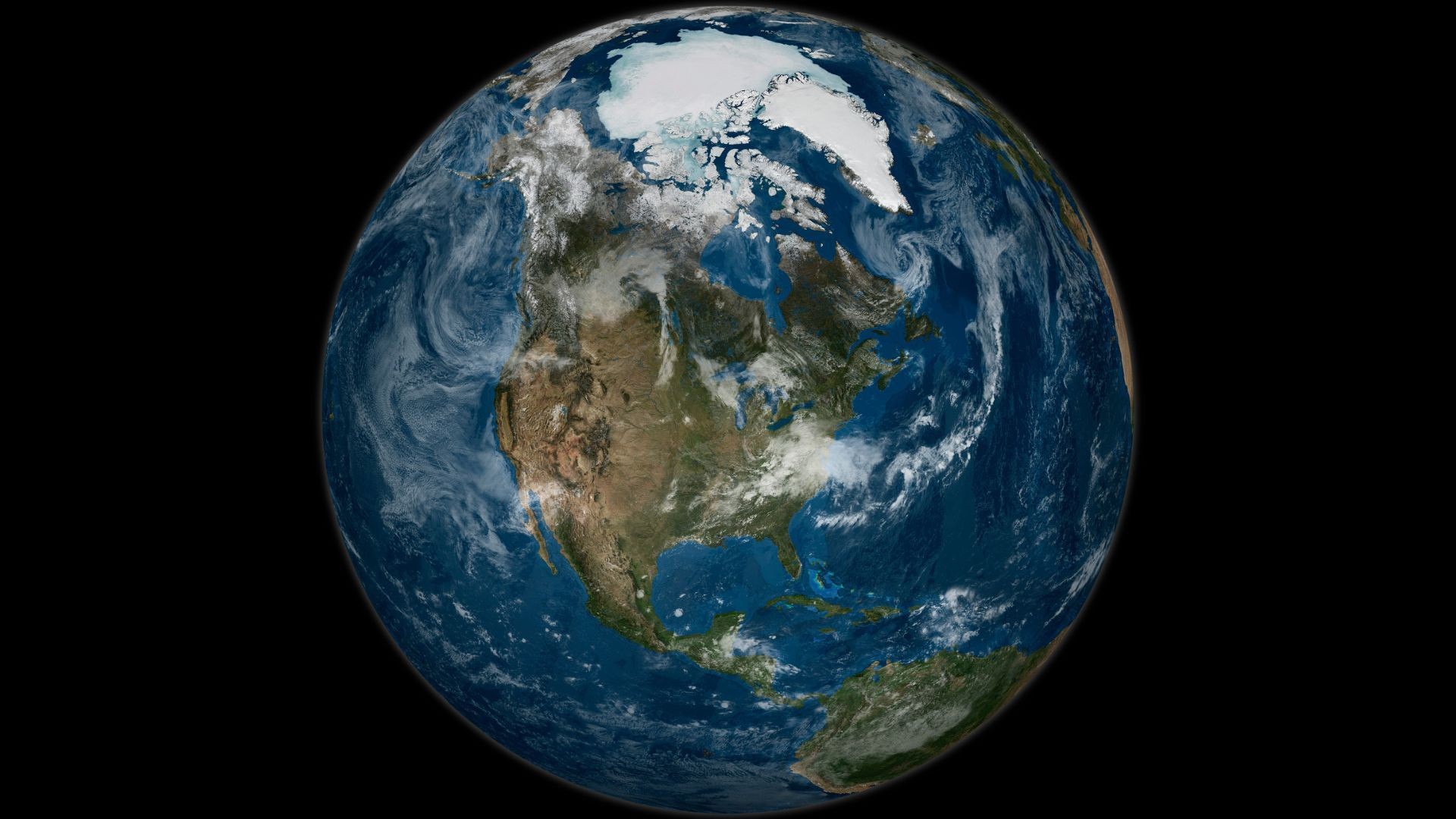
Human-driven climate change is altering the planet’s spin in a way not seen for 3.6 million years. A new study reveals that rising sea levels are lengthening Earth’s days by 1.33 milliseconds per century—a rate that stands out even when considering natural fluctuations over millennia.
How Earth’s Spin Works
The Earth’s rotation speed is tied to how its mass is distributed. Just like a skater spinning faster with arms pulled in, a more concentrated mass means faster rotation. Rising sea levels shift this mass, slowing the planet down. While the moon’s gravity and post-glacial rebound already influence the day length, the current rate of change due to climate change is unusually high.
The moon currently lengthens the day by approximately 2.4 milliseconds per century, while glacial rebound shortens it by 0.8 milliseconds per century—resulting in a net increase of 1.71 milliseconds per century. Climate factors, such as stronger winds during El Niño, also play a role, but their effect is smaller.
Unprecedented Acceleration
Recent research indicates that climate change is becoming a dominant factor in altering Earth’s rotation. Geoscientist Mostafa Kiani Shahvandi of ETH Zurich says that this effect is “quite anomalous” and is directly linked to human activity. By analyzing fossils of ancient marine organisms, researchers found that the current rate is among the fastest in the past 3.6 billion years.
The last time Earth’s rotation slowed at a comparable rate was around 2 million years ago, during a period of high carbon dioxide and rising temperatures. That slowdown reached 2.1 milliseconds per century—though historical estimates have some uncertainty.
Future Implications
If greenhouse gas emissions continue to rise, the study projects that the day could lengthen by 2.62 milliseconds per century by 2080. Though imperceptible to humans, this change has real-world consequences for precise timekeeping technologies. Instruments on spacecraft and high-precision computing systems may require recalibration to account for the shift.
“This tells us about the rapid climate change—the melting of snow and ice in polar ice sheets and mountain glaciers, and the increase in sea levels,” Shahvandi concludes.
The findings underscore how quickly human activity is reshaping fundamental planetary processes. The rate of change in Earth’s rotation is a stark reminder of the speed and scale of the climate crisis.