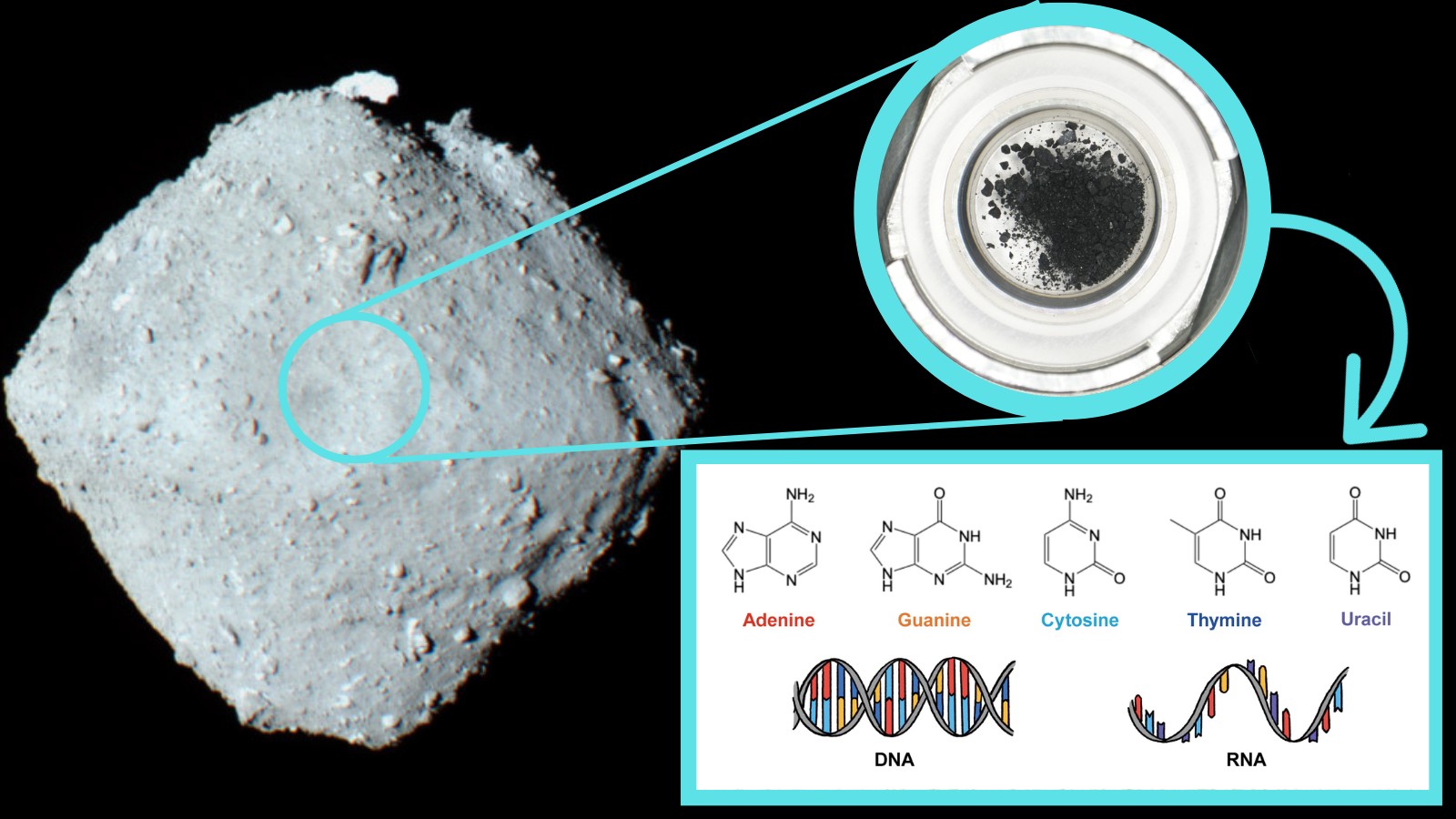
Scientists analyzing samples from the Ryugu asteroid, delivered to Earth by Japan’s Hayabusa 2 mission, have definitively found all five nucleobases essential to DNA and RNA. This discovery – adenine, guanine, cytosine, thymine, and uracil – provides strong evidence that the fundamental components of life could have formed before life existed, and were readily available throughout the early solar system.
The Dawn of Life’s Chemistry
The Ryugu asteroid is a relic from the solar system’s formation, roughly 4.6 billion years ago. Unlike Earth, which has undergone constant geological and biological changes, asteroids like Ryugu have remained largely untouched. This makes them a pristine record of the chemical conditions that existed when planets were still forming. The presence of these nucleobases in an asteroid confirms they can be created abiotically – that is, without the involvement of living organisms.
Why this matters: The discovery supports the theory that these compounds weren’t necessarily created by life, but instead, were widespread ingredients delivered to early Earth by asteroids and comets. It shifts the question from how life began to where the ingredients came from.
How the Samples Were Collected and Analyzed
The Hayabusa 2 mission collected samples from Ryugu between 2018 and 2019, returning them to Earth in December 2020. Researchers, led by JAXA biogeochemist Toshiki Koga, then analyzed these samples alongside those from the Bennu asteroid, as well as the Murchison and Orgeuil meteorites (recovered in 1969 and 1864, respectively).
The team found that while all samples contained the nucleobases, their concentrations differed significantly. Ryugu’s composition was relatively balanced, whereas Murchison was purine-rich, and Orgeuil was pyrimidine-rich. These differences likely reflect variations in the asteroids’ origins and environments.
Implications for the Origins of Life
The study reinforces the idea that asteroids played a critical role in seeding Earth with the chemical building blocks necessary for life. Previous analysis of Ryugu samples already showed evidence of liquid water on its surface, further strengthening the hypothesis that space rocks delivered water to our planet.
The key takeaway: The widespread presence of DNA/RNA components across the solar system suggests that these compounds are not unique to Earth, and their distribution may have been instrumental in making life possible. This finding expands our understanding of the conditions that could have supported the emergence of life not just on Earth, but potentially elsewhere in the cosmos.