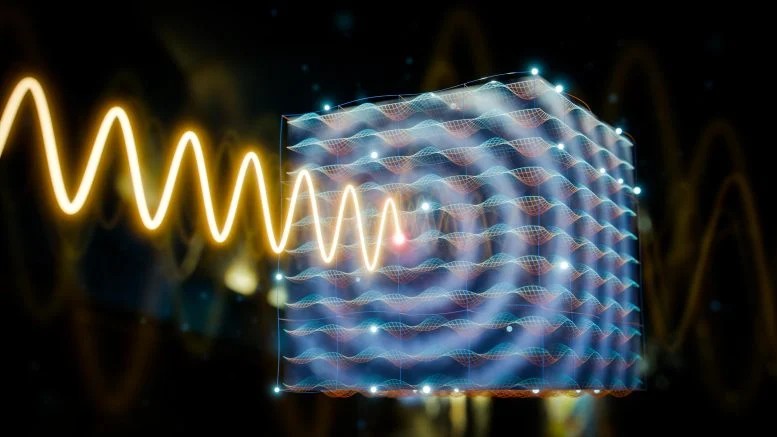
Light doesn’t just bounce. It can be reshaped, trapped, and manipulated on a timescale that feels like an eternity to a computer, but a blink to the universe. Researchers have now demonstrated the world’s first photonic time crystal.
It’s not science fiction. It’s physics, executed with terrifying precision.
The study, published in Nature, details an all-optical system where light-matter interaction is pushed into uncharted terahertz territory. By altering optical properties over picoseconds—the billionth of a billionth of a single second—the team has opened a door to ultrafast optical computing.
This isn’t about making faster CPUs. It’s about controlling the fundamental behavior of photons in ways that were previously impossible.
Bridging the Terahertz Gap
Electronic components hit a wall. At high frequencies, they lag. Photons are faster, but manipulating them in the terahertz range has long been a holy grail of optical physics.
“The THz range represents the frontier between electronic photonic technologies… It is a range full of opportunities… yet is still under-developed.”
— Yannis Laplace, École Polytechnique
The terahertz frequency sits between microwaves and infrared. It’s 1,000 times faster than standard electronic signals. It’s also where matter reveals its secrets. But until now, we lacked the tools to control light effectively in this zone.
The solution? A material that changes not just in space, but in time.
From Static Lattices to Dynamic Crystals
Conventional photonic crystals are nanostructured materials with repeating patterns. Like semiconductor lattices control electrons, these structures control photons. You set the geometry, you get the result. Once built, the rules are fixed.
Temperature shifts. Magnetic fields. Minor tweaks. But the structure itself remains static.
The new approach breaks that mold.
A photonic time crystal doesn’t just shape light spatially. It shapes it temporally. Its optical properties—reflectivity, resonance—flip rapidly over picoseconds. The material’s behavior oscillates at the same frequency as the light itself.
It’s a new dimension of control.
“By extending photonic crystals from space time, we open a new path toward amplification and lasing,” says Tingwen Guo, lead author and PhD student at École Polytechnique. “That could be a game-changer.”
The Engineering Nightmare
Building this required a device so specific, so delicate, it borders on the absurd.
The team—spanning École Polytechnique, Collège deFrance, and Helmholtz-ZentrumDresden-Rossendorf (HZDR)—constructed a plasmonic metamaterial. It’s complex.
- Gold Patterns: Micrometer-scale crenelated structures.
- The Substrate: An insulating layer atop an indium-antimony semiconductor.
- The Trap: The gold forms cavities that confine photons.
When the semiconductor surface is excited, electrons move as a collective wave. These are surface plasmons. They capture light. They hold it.
But holding it isn’t enough. You need to change it. Fast.
Feeding the Beast with TELBE
You can’t test picosecond changes with a flashlight.
The researchers needed high-field, phase-stable pulses. They found it in TELBE, a superconducting terahertz source at HZDR’s ELBE accelerator facility.
They blasted the metamaterial with terahertz laser pulses. The result was immediate. The material’s reflectivity shifted dramatically. The effect was huge. The timing was instantaneous.
“TELBE’s unique ability… was critical,” notes Jan-Christoph Deinert, TELBE coordinator. “Without this infrastructure, achieving coherent, ultrafast modulation… would have been impossible.”
Losing Less Light
Here is where the physics gets interesting.
Usually, photons get absorbed. They scatter. They disappear into heat. In a standard metamaterial, efficiency is a constant battle.
In the photonic time crystal regime, dissipation dropped by half.
More photons stayed trapped. Fewer passed through lost. Marco Schiró of Collège de France confirmed the results with a theoretical model that matched the experimental data perfectly. The theory didn’t just explain what happened. It provided a blueprint for scaling it up.
“The theory not only reproduces the experiment but provides the basis for guiding future discoveries.”
Why This Matters for You (Eventually)
You might not buy a terahertz camera tomorrow. But the implications ripple outward.
Faster optical computing. Advanced telecommunications. Lasers that can change their own “color” almost instantly.
The next step is simple but difficult: reduce photon loss further. Amplify the signal. If the researchers can trap enough photons, the system becomes a laser source. An adjustable one. One that can tune properties on demand.
Medical imaging? Communications? Security scans? The terahertz range could handle all of it, faster and smarter than current tech.
We are no longer just guiding light. We are commanding it. In real-time. In picoseconds.
The gap between electronics and photons is closing. And it’s happening in the dark.