NASA is thinking big. Really big.
They are building a crewed outpost on the lunar south pole over the next ten years. But don’t picture a tiny flag planting ceremony or a single modular shack. They envision a sprawling settlement. Hundreds of square miles of it.
“We envision the moon base to be hundreds of squares miles,” said Carlos García-Galán, manager of the Moon Base program. He wasn’t boasting. Just stating the physical reality of what they plan to construct.
The location matters. The south pole has water ice. It has sat there in permanent shadow for billions of years. You want that water for life support and fuel. But you also want sunlight for power. Those two things rarely share the same real estate.
Habitats need hilltops for solar exposure. Nuclear reactors? Those need distance. At least a kilometer away from where people sleep, to handle radiation. You start laying these assets out on a map and the footprint grows. It doesn’t stay compact. It ends up looking a bit like a city. A sparse, dust-choked city, but still spread out.
We don’t know much about that part of the moon yet. That uncertainty is part of the plan.
“We’re going to want to explore different sitios to really maximize the mix of economic objectives and viability of a presence.”
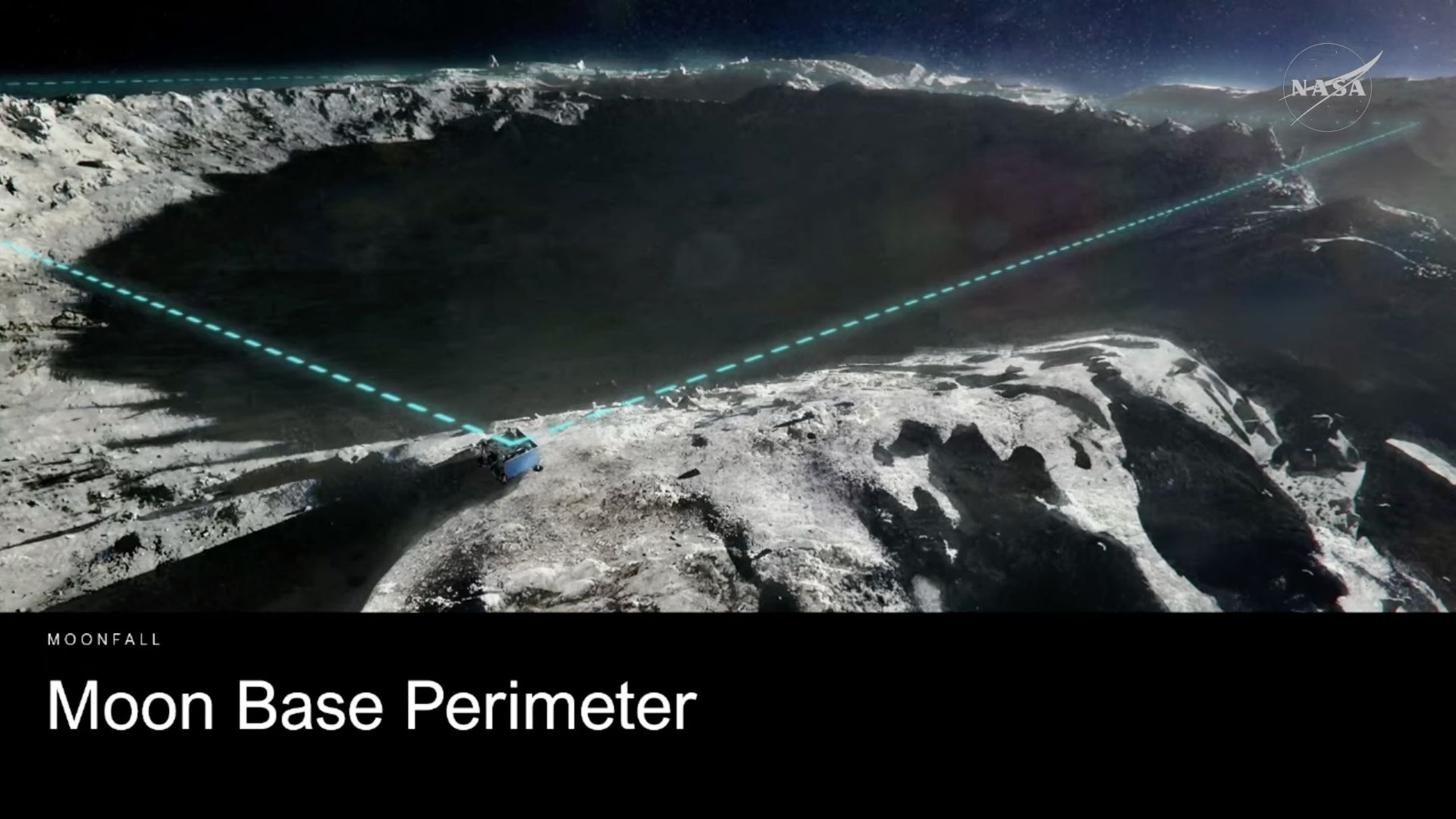
How do you map unknown territory without sending people in first? Drones. Hopping ones.
NASA announced today they will use “MoonFall” drones to scout. Small robots that jump rather than fly, navigating the cratered landscape before construction starts. The first batch—three or four craft—launches in 2028. Firefly Aerospace built the lander. They got a $75 million check for the trip.
These drones do more than look around. They could mark the corners of the base. Define the property lines, essentially.
China is coming too. They aim for their first landing in 2030. Washington is eager to be there first. Not just to plant a flag. To set the norms. The idea is that the U.S. establishes responsible behavior protocols under the Outer Space Treaty.
Ars Technica’s Eric Berger put the question bluntly to Administrator Jared Isaacman: Can the drones create a keep-out zone?
Isaacman nodded. Sort of.
“I think it is important for us to get here first.” He emphasized respect for the treaty. We want to explore our high-interest zones. Other nations have assets there too. It needs to be reciprocal. We mark our areas. You mark yours. Don’t crash into each other.
The size of the base was just context, though. The real news today was money moving.
Firefly got their contract. So did Astrolab in California. $219 million. Lunar Outpost in Colorado? $220 million. They are both building Large Rovers (LTVs).
These aren’t the tiny scooters of the Apollo days. These are heavy workhorses. Artemis astronauts will ride them. But the rovers can also think for themselves. They can land alone. Drive from Earth remote control. Wait for the crew to arrive.
That is the schedule. NASA wants at least one rover on the ground before the first astronauts touch down late in 2028 during Artemis 4.
Blue Origin’s “Blue Moon” lander will deliver these machines. Two separate contracts there, worth $234 million each. Blue Moon is also trying to become a crew vehicle. It is in the mix to fly humans on Artemis 3 and beyond.
Speaking of Artemis 3. That mission is moving. Or rather, shifting definition.
Originally planned as the landing, Artemis 3 is now a docking test. NASA’s Orion capsule meets either Blue Moon or SpaceX’s Starship in Earth orbit. No moon landing. Just a handshake in space. Aiming for mid-2027.
Isaacman laid out the timeline clearly. No fuzzy promises.
Phase One (Now to 2029): Secure access. Get there reliably. Gather data.
Phase Two (2029–2032): Initial operating capability. The base starts working.
Phase Three (2032–Future): Semi-permanent presence. We stop visiting and start staying.
It sounds straightforward on a spreadsheet. Living in one of the most dangerous environments in the known universe is never straightforward. Every landing is a lesson. Every powered system a gamble.
“Every mission… will be a learning opportunity as We return to the Lunar Surface… and master the Skills Required to Live and Operate in one of the most Demanding and Dangerous Environments Imaginable.”
That is what Isaacman wrote. A lot of words about risk. A lot of money being spent.
The drones go up in two years. The rovers follow. The people come last.
Hopefully they don’t mind the commute. It will be long.