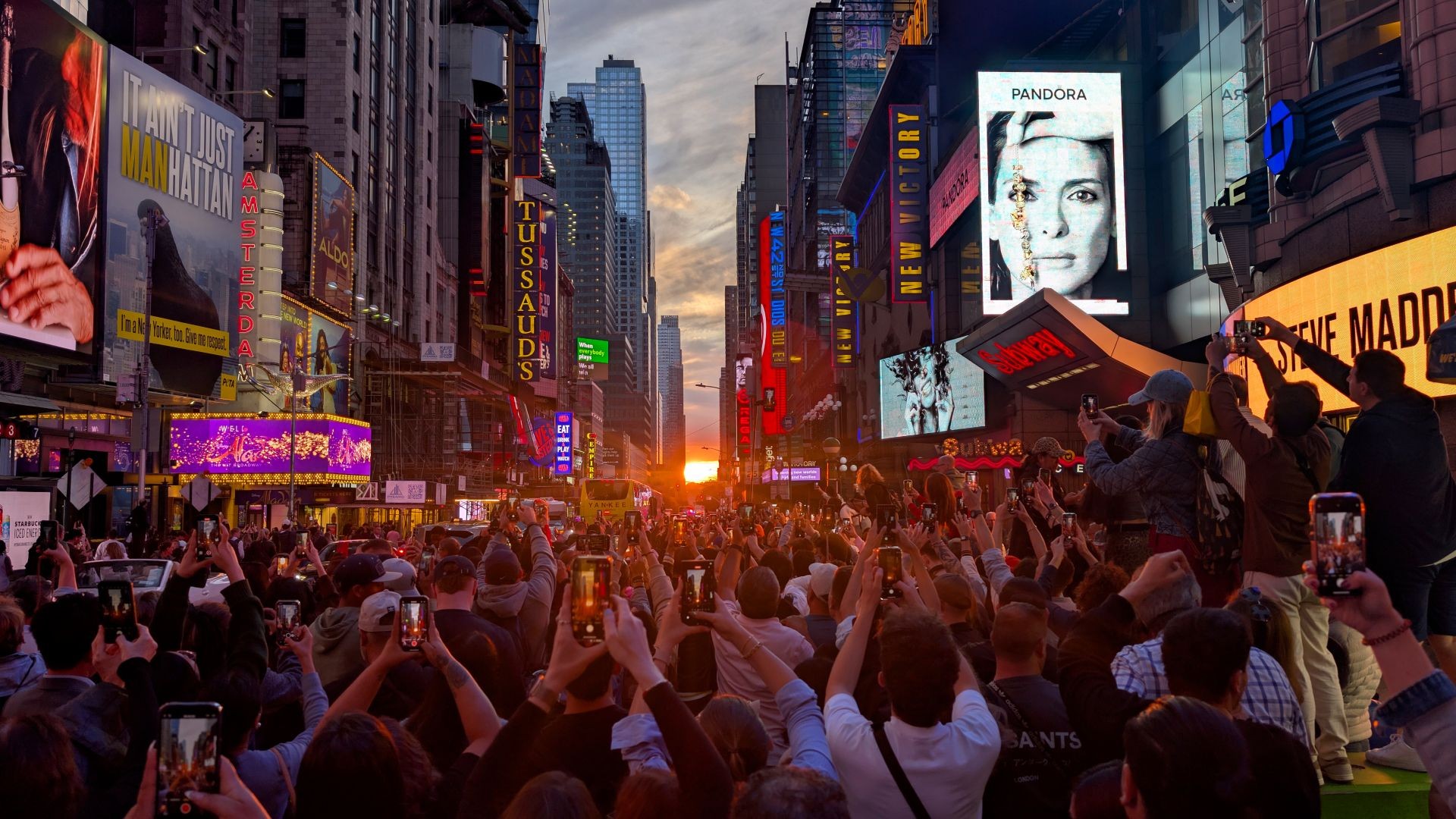
Sunset is tricky in Manhattan. Twice a year, the grid lines up. It’s called Manhattanhenge. The sun drops straight down the canyon of streets like it’s reading a script.
For 2026 you’ve got two windows. May 28-29. Then July 11-12
Most folks don’t care about the celestial mechanics. They just want the photo. The alignment makes the sky look like it belongs to another city entirely. Not a place where light pollution usually wins every time.
The city becomes a telescope.
The Math of the Street
Why does this happen? Simple geometry.
In 1811 the Commissioners drew up the plan. A rectilinear grid. Tilted thirty degrees east of true north. That tilt mimics the angle of the island itself. Most places the sun sets somewhere vague near the west. Not here.
Due west happens only on equinoxes. March. September. Boring.
But in late spring the sun sets north of west. Its azimuth shifts. On the summer solstice it hits 302 degrees. Too high. Too north.
The streets need 300 degrees. Exactly thirty degrees north of due west
The sun hits that mark twice on its arc. Once on the way up. Once on the way down
Dr. Neil deGrasse Tyson brought this into the mainstream decades ago. He knows the spots. You need wide avenues. Places with no trees blocking the view of New Jersey
- 14th Street
- 23rd Street
- 34th Street – The Empire State Building frames it beautifully
- 42nd Street – Chrysler Building does the honors
- 57th Street
Go wide. Two-way streets offer the best horizon line
Don’t wait until sunset. Show up thirty minutes early. The corners will be packed. People always stand on the pavement. Tripping hazards abound.
May or July: What’s the Difference?
You might notice two days in May. And two in July
Here is the distinction. The sun’s apparent size and position shift slightly day by day
On May 28 the sun is half above the skyline. A “half sun.” Then the next day at 8:13 pm it rests fully above the buildings. “Full sun”
July reverses it. July 11 gives you the full disk. July 12 leaves half submerged in the brick
Who cares about the technical definition of sunset? The Nautical Almanac cares. For this event the “sunset” is actually a degree or so above the true astronomical horizon. You’re accounting for the hills of Jersey. If you use standard sunset times you’ll be late
Not as Mysterious as England’s Stonehenge
The name is a gimmick. It borrows weight from the actual Stonehenge.
In England farmers built upright stones over fifteen hundred years ago. Gerald Hawkins claimed in the 60s it was a massive astronomical calculator. Others scoffed. Nobody really knows. Maybe it was a burial ground. Maybe not. The mystery remains
Manhattan’s grid is less romantic. More bureaucratic. The mystery isn’t why the stones are there. The mystery is why the city tolerates the traffic gridlock while three thousand photographers wait on the curb
Is it an alien phenomenon? No. It’s urban planning meeting orbital mechanics
Morning Light is Brutal
Think sunrise works better?
Good luck
Winter mornings are freezing. The air temperature can be fifty degrees colder than a summer night. And snow. Probably snow under your shoes
Plus the geometry fights you. You look east. But not due east. 30 degrees south
Dec 9 gives you a full sunrise. Dec 10 is half
January 1 is half. January 2 is full
The view is blocked. The Bronx rises in the north for Harlem viewers. Queens blocks the East Side. Brooklyn towers over the Village
Winter weather in NY is not clear skies. It is wind and sleet. Summer evenings are nicer. The odds of clarity are higher.
Check your calendar. Mark May 28. Or July 11. Bring a coffee. Or don’t.