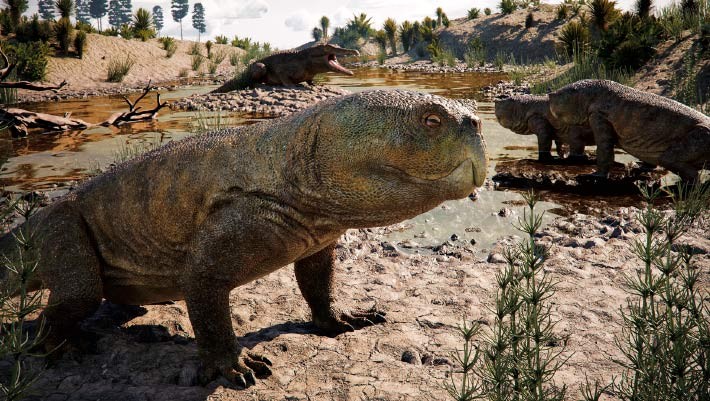
Paleontologists have unveiled a new species of extinct reptile that is reshaping our understanding of how ancient herbivores lived and evolved. The discovery of Isodapedon varzealis , a member of the rhynchosaur lineage, suggests that the prehistoric landscapes of the Triassic period were far more ecologically complex than previously believed.
A Specialized Eater from the Triassic
Found in the Rio Grande do Sul state of Brazil, the fossil—comprising a partial skull and lower jaws—dates back approximately 230 million years to the Carnian age of the Triassic period.
Rhynchosaurs were highly successful, beaked herbivores that dominated much of the supercontinent Pangea. They were characterized by a specialized feeding mechanism:
– A toothless beak for grasping plants.
– Rows of grinding teeth designed to process tough, fibrous vegetation.
Because they were so abundant—sometimes making up 90% of vertebrate fossils in certain areas—they serve as critical “biostratigraphic markers,” helping scientists date and understand the geological layers in which they are found.
Why Isodapedon varzealis Matters
The discovery of Isodapedon varzealis is significant because it breaks the established patterns seen in its relatives. Most notably, its upper jaw features symmetrical tooth-bearing areas, a rare trait among rhynchosaurs. Additionally, its unique lower jaw structure suggests a distinct method of feeding.
This anatomical deviation is more than just a biological curiosity; it points to a phenomenon known as niche partitioning.
“These differences probably reflect divergent ecological strategies within a diverse herbivorous guild,” the researchers noted, suggesting that different species evolved unique ways to eat to avoid direct competition.
This diversity likely emerged during the Carnian Pluvial Episode, a period of significant environmental and floral shifts. As plants changed, these reptiles adapted their feeding habits to exploit different food sources, allowing multiple species to coexist in the same ecosystem.
Redefining Evolutionary History
The presence of Isodapedon varzealis also forces a taxonomic rethink. Previously, many similar species were lumped into the well-known genus Hyperodapedon. However, this new find suggests that Hyperodapedon should be more narrowly defined, while other species belong to distinct branches.
The research highlights a broader evolutionary trend:
– Wide Distribution: Closely related forms were spread across southwestern Gondwana (the southern part of Pangea), including modern-day Brazil, Argentina, and possibly Zimbabwe.
– Morphological Stability: Despite their wide range, these animals maintained relatively similar body plans, suggesting a period of ecological stability before more specialized lineages emerged later in the Triassic.
Conclusion
The discovery of Isodapedon varzealis reveals that rhynchosaurs were not a monolithic group of plant-eaters, but a diverse and adaptable lineage capable of complex ecological specialization. This finding underscores the importance of Brazil’s fossil record in reconstructing the intricate dietary webs of the Triassic era.