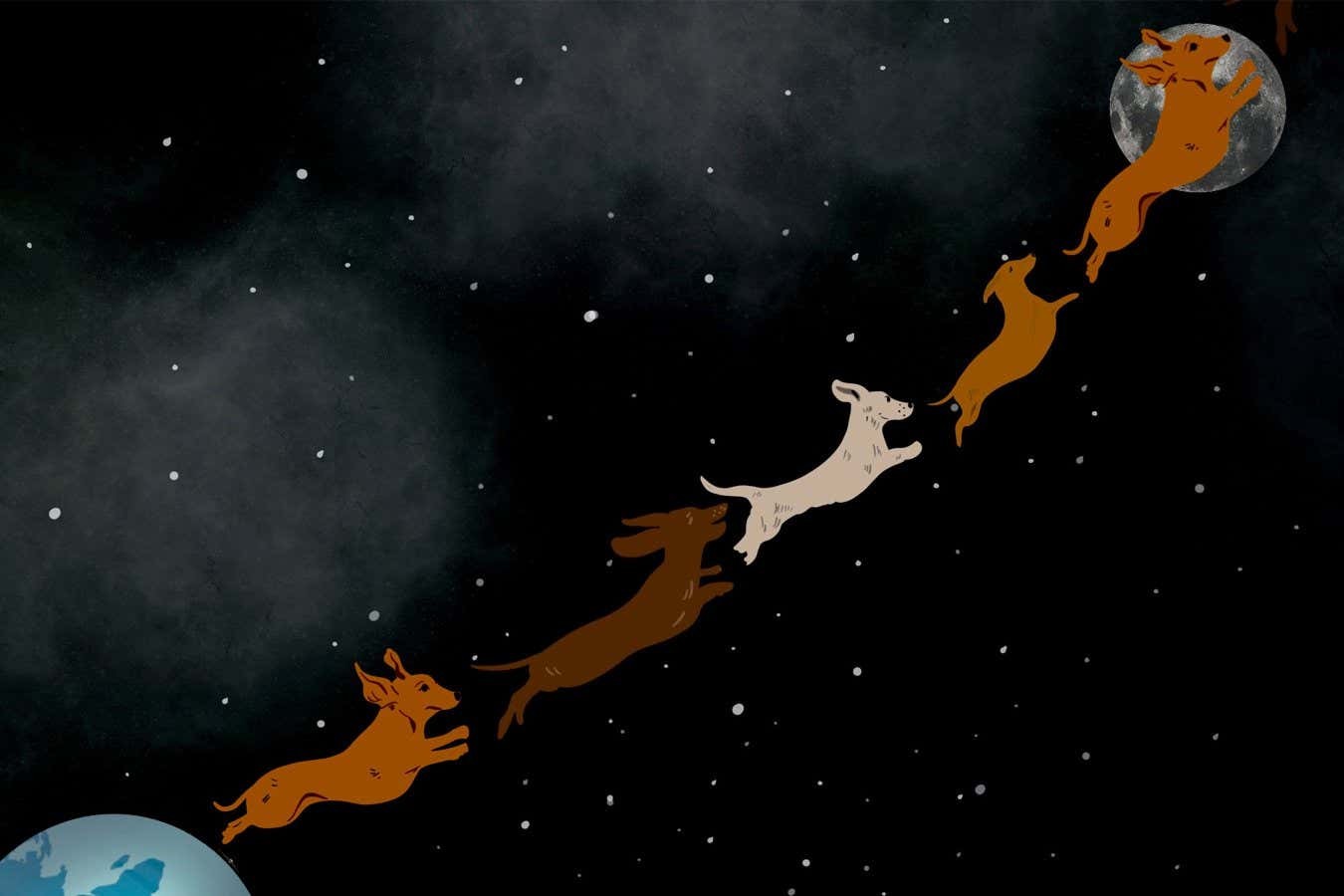
Science and technology news often struggle with a fundamental problem: how do you make the incomprehensible feel real? Whether it is the vastness of space or the complexity of government data, the scale of modern achievements can feel abstract.
In this overview, we explore how journalists attempt to bridge that gap—sometimes through whimsical comparisons—and the risks involved when we delegate high-stakes tasks to artificial intelligence.
Measuring the Moon with Sausage Dogs
The recent Artemis II mission achieved a historic milestone, with its crew traveling to a distance of 406,771 kilometers from Earth—the furthest any human has ever ventured. However, conveying that distance to a general audience presents a unique challenge.
To illustrate the scale, The New York Times employed a series of unconventional, almost surreal, units of measurement:
- The Dachshund Metric: If you lined up 22-inch dachshunds nose-to-tail, you would need roughly 728 million dogs to reach the moon.
- The Walking Metric: At a brisk walking pace of 3 mph, it would take a person nearly 10 years of continuous walking to cover the distance.
- The Hot Dog Metric: A chain of 2.37 billion hot dogs would span the gap. To consume them all, a professional eater would need to eat nonstop for 594 years.
While these comparisons succeed in making the distance “felt,” they raise questions about scientific rigor. Using living animals (or processed meat) as a ruler introduces massive variables in size and consistency. Furthermore, the transition from “live dogs” to “hot dogs” as comparable units highlights a trend in science journalism: the sacrifice of precision for the sake of engagement.
The Problem of Relative Scaling
Beyond physical distance, language itself often fails to provide precise measurements. This brings us to the concept of Endogenous Relative Scaling (ERS) —units that change meaning based on the context or the person using them.
A prime example is the word “marathon.”
– In athletics, it is a fixed distance of 42.195 kilometers.
– In daily life, it is a subjective descriptor for duration, such as a “marathon study session” or a “marathon drinking session.”
The meaning of a “marathon” in these contexts depends entirely on the activity and, perhaps more importantly, the individual’s tolerance level. This linguistic fuzziness reminds us that even in a world of hard data, human perception remains a subjective filter.
The 4% Risk: AI in Government Classification
As Artificial Intelligence becomes more integrated into professional workflows, a new frontier is emerging: using Large Language Models (LLMs) to handle sensitive tasks, such as classifying government documents.
A recent paper on arXiv proposed using AI to replace the “labor-intensive” and “subjective” process of manual document labeling. Researchers tested a model on leaked US diplomatic cables and achieved a 96% accuracy rate in distinguishing between unclassified, confidential, and secret documents.
While 96% sounds impressive, in the world of national security, it reveals a critical flaw:
1. The Leakage Gap: A 4% error rate means that top-secret information could be systematically misclassified as “unclassified,” leading to catastrophic leaks.
2. The Direction of Error: In high-stakes environments, not all mistakes are equal. An AI that labels a “secret” document as “unclassified” is a security failure; an AI that labels an “unclassified” document as “secret” is merely a bureaucratic inconvenience.
The study does not yet clarify if the AI errs toward caution or toward negligence, nor how it compares to the accuracy of human experts.
Conclusion: Whether we are using dachshunds to measure the moon or AI to sort state secrets, the bridge between raw data and human understanding is fraught with subjectivity, whimsical errors, and significant systemic risks.