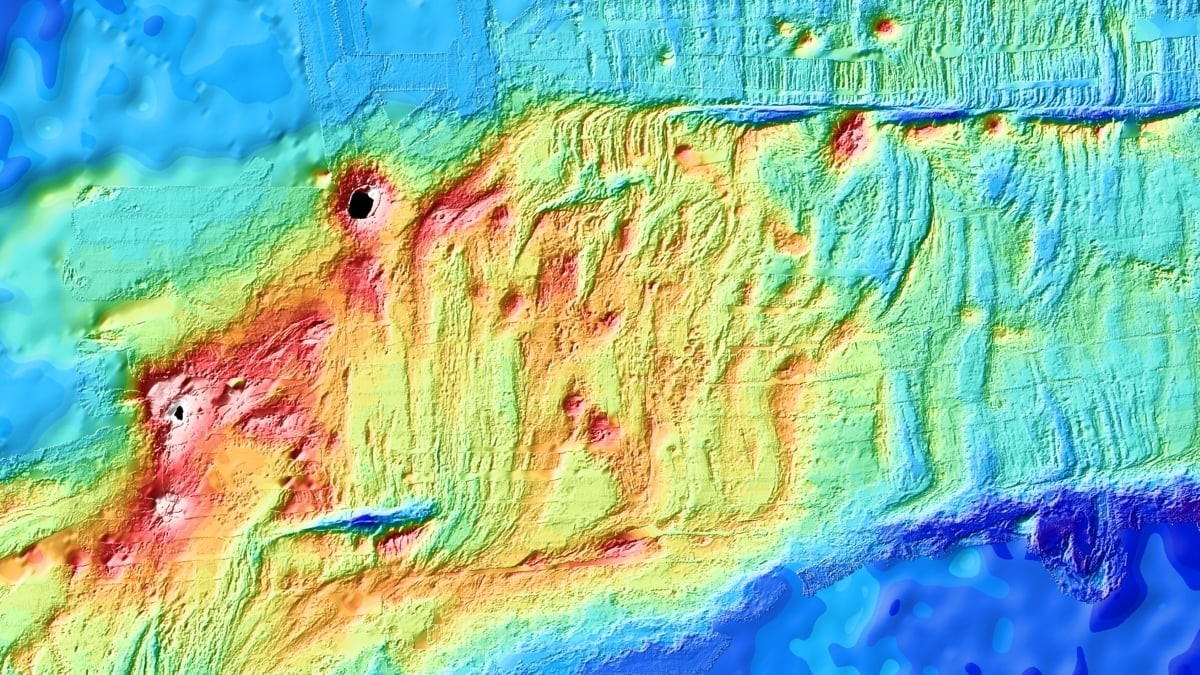
Most of the Earth’s crust forms where humans can’t look.
Sixty-five thousand kilometers of mid-ocean ridge run deep below the surface. Dark. Pressured. Hostile. That’s where tectonic plates pull apart and magma fills the gap. It hardens. It becomes new rock. Two-thirds of our planet’s skin was born this way.
Until now, we had to guess how it happened.
We never saw the mechanism. Not really.
“We did not dream of capturing such a Massive event…”
Jean-Yves Royer says they wanted to measure steady stretching. Centimeters maybe. Like watching a spring tighten. They hoped for that quiet background noise.
Instead? They got a show.
Once in forty years, the ridge failed. Completely.
The team spent years building the OHA-GEODAMS experiment. An underwater observatory. Five autonomous hydrophones. Planted near Amsterdam Island. Between Australia and Antarctica. It’s audacious work. Seafloor spreading isn’t a slow creep. It’s a series of violent bursts. “Quantum” events, the researchers call them. Decades of tension building. Then a snap.
They weren’t sure they’d see anything.
Fortune favor the bold.
April 2024 arrived. The seafloor split.
The ridge axis broke. Magma surged up from beneath. Not a trickle. A flood.
Dikes. Vast sheets of magma. They tore through the crust. Less than two hours. 150 million cubic meters of lava injected into the earth’s bones. It triggered earthquakes. It woke up dormant faults. It drained the reservoir.
Then the ground fell.
The seafloor collapsed. Fast.
Four point two meters. That’s how far the valley floor dropped. Thirteen and eight-tenths of feet. Sliding along the faults on the edges. This is the first time anyone has watched this happen hour by hour. The dikes. The faulting. The chaos. All of it.
Was it luck? Maybe. But the tech held.
We thought seafloor spread continuously. A steady pace. Six centimeters a year. That’s the long-term average.
The data proves we’re wrong.
It moves in giant lurches.
At peak intensity? The ridge pulled apart five centimeters every minute.
That’s half a million times faster than the average. The displacement recorded over sixteen days equaled thirty to sixty years of normal growth. Imagine waiting decades for movement only to get it all at once in two weeks.
It solves an old math problem too.
Scientists always noticed the numbers didn’t add up. They knew how fast the plates moved apart. They recorded the earthquakes. The sum of the shaking never matched the distance covered. There was missing motion.
They found it.
Most of the movement was silent. Aseismic. No big quake. Just the rock grinding and sliding in the dark.
So when seismometers pick up silence? That’s where the real action is.
The new Nature paper gives us ground truth. A benchmark. Now we have something real to compare against the noise. Royer says it opens new horizons.
With a bit of luck. A bit of flair.
Maybe we can watch the planet build itself next time too. Or maybe we’ll have to wait forty more years for another chance.