


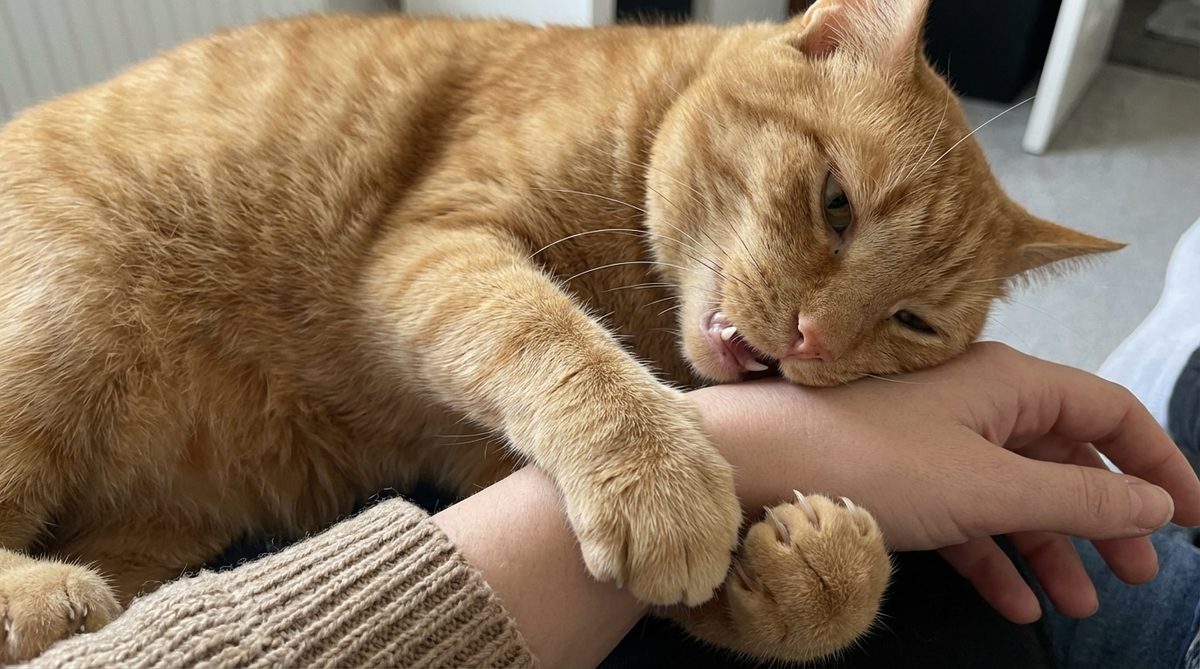
It happens every winter. You are curled up on the sofa with a glass of wine, the scent of cinnamon in the air. Your cat jumps into your lap. For a moment, everything is perfect. The purring starts. Then, without warning, sharp teeth sink into your hand.
It stings. It confuses you. You pull back. The cat walks away as if nothing happened.
This is not aggression. It is not hatred. It is a physiological limit. Your cat has reached its threshold for sensory input. This phenomenon is known as overstimulation bite, a confusing paradox where affection turns into pain in seconds.
The Biology of the Tipping Point
Cats are not plush toys. They are highly sensitive animals with specific tolerance levels. Each individual cat has a unique limit for how much physical touch they can handle at one time.
Before the bite, the body gives clues. You just have to know where to look.
The tail begins to twitch. The ears rotate backward. The skin along the back ripples. The pupils dilate significantly. These are warning signs. Most humans ignore them because we are focused on the act of petting. We miss the shift in mood.
The change is not personal. It is environmental. Winter brings long nights inside. The house is quiet. There are fewer distractions. The cat focuses entirely on your touch. The intensity builds faster than in summer. Suddenly, the pleasant sensation becomes unbearable noise to the nervous system.
The bite is a circuit breaker. It stops the flow of stimuli. It is a request for space.
Mapping the Sensitive Zones
Not all parts of a cat are created equal for petting. Some areas trigger pleasure. Others trigger panic or irritation.
Most cats enjoy scratches behind the ears. The base of the chin is usually safe. The cheeks are often well-received. These are the sweet spots.
Avoid the belly unless the cat explicitly invites it. Flipping a cat over to rub its stomach is rarely a good idea. The paws are also highly sensitive. Many cats do not like their toes touched.
Every cat has a personal map. This map changes over time. It depends on the relationship with the human. It depends on the day. Ignoring these preferences leads to the bite.
When you touch a sensitive area, or touch a safe area for too long, the cat experiences sensory overload. The brain interprets the repeated touch as a threat or a nuisance. The response is swift. A nip is the only tool the cat has to say “stop.”
How to Prevent the Bite
The solution is not to stop petting your cat. The solution is to pay attention.
Observe the body language closely. If the tail twitches, stop immediately. If the ears flatten, end the session. Do not wait for the bite.
Respect the consent. Animals have boundaries. Recognizing the signs of saturation is key to a good relationship. It shows you understand their well-being.
If you see the signs of overstimulation:
– Stop the caress instantly.
– Withdraw your hand slowly.
– Give the cat space.
– Do not punish the cat for the bite. It did not know it would reach that point until it was too late.
By reading these signals, you build trust. The cat learns that you listen. The interactions become more positive. The tension decreases.
Why This Matters
Understanding this behavior changes how you live with your cat. It moves the relationship from owner-pet to partner-partner. It requires mindfulness.
Some might ask why we should care about a small nip. It is not about the pain. It is about communication. The bite is a clear message. It is a boundary.
Respecting that boundary improves the bond. It reduces stress for the cat. It reduces frustration for the human.
Winter is a time of closeness. We seek warmth. Our cats do too. But their need for connection is different from ours. They need touch, but they also need control over the intensity.
The next time your cat nips you, do not get angry. Smile. The message has been received. The connection is intact. The magic of the season remains. The night continues. The cat settles down again, perhaps. Perhaps not. The uncertainty is part of the life with a cat.


