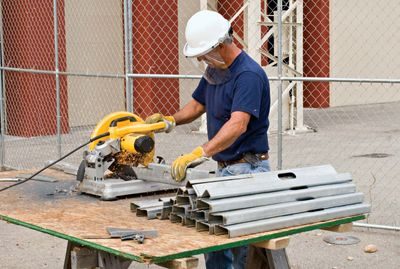
When you hear the word “saw machine”, you probably think of a carpenter’s circular saw. But in heavy industry, this image is too gentle. We are talking about devices that cut through steel bars and raw metal sheets using a variety of crude and powerful methods. The biggest difference isn’t just the size of the tool; it’s the physics of how the cut happens.
Industrial saws usually use one of three mechanisms to cut the material. You have true cutting where the teeth mechanically remove the metal. You have grinding that works like a quick sandpaper. And then there’s frictional melting. The latter sounds like a disaster waiting to happen, but it is a standard industrial technique for cutting thick structural steel.
The Reciprocating Power Hacksaw
Let’s start with the Workhorse of many workshops: power hacksaw machine. It is simple, almost archaic in logic. The machine holds the vise to firmly clamp the workpiece. a straight steel hacksaw blade is mounted on a U-shaped frame.
Here’s the trick: the blade only cuts in a forward motion. During the return stroke, the body lifts the blade away from the material. This prevents unnecessary grinding and dulling of the teeth. It’s a rhythmic, back-and-forth movement that prioritizes endurance over speed. You won’t see this with the fancy new technique, but you will see it everywhere because it only works on straight cuts of bars.
Band Saws for complex shapes
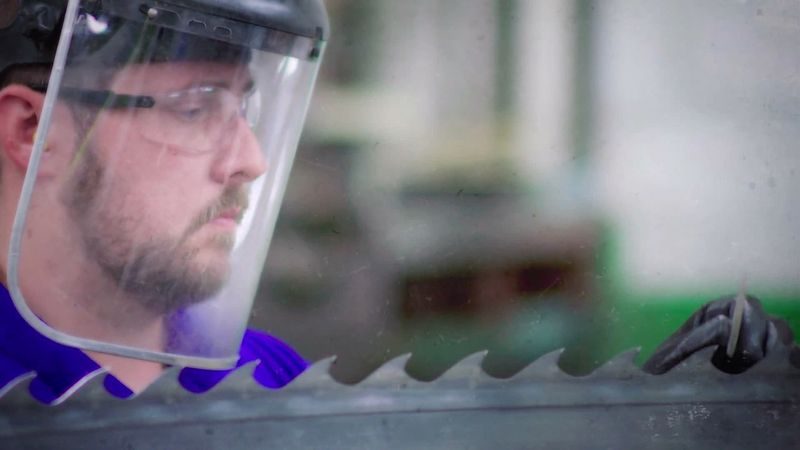
If you need to cut not only straight lines but shapes, grab a band saw. This tool uses an endless, flexible steel band with teeth along one edge. The band loops around two large, parallel wheels that rotate continuously.
Because the blade is long and flexible, it can handle curves. Vertical band saws are particularly suitable for cutting complex shapes from thin flat sheets. The workpiece lies on a horizontal table and the operator passes it through the blade. It’s precise, controlled and much more versatile than a reciprocating saw for anything that isn’t straight.
Cold sawing for mass processing
When handling large quantities of steel bars, efficiency is key. This is where cold saws with toothed disc cutters come in. These are common in steel rolling mills.
The key here is the vise. It is often V-shaped and designed to tighten a whole set of bars at once. You don’t cut them one at a time. You cut them into a group. Toothed blades cut through steel without generating enough heat to change the properties of the metal – hence the name “cold saw”. It’s all about volume. It’s all about speed. And it’s about keeping the steel cool enough to maintain its structural integrity.
Friction saws and cutting machines
Now let’s get weird. Friction saws do not use teeth to cut. They use heat. These machines spin the cutting wheel – sometimes serrated, sometimes smooth – at incredibly high speeds. The friction generates so much heat that the steel melts at the point of contact. The wheel pushes through the molten metal, effectively slicing the beam by melting it away.
This is why you can find friction saws cutting in places