


Rhythm is the skeleton of music. It organizes sound in time. More specifically, it refers to patterns of duration—long and short sounds—that occur within a regular underlying pulse. Or beat. Rhythm is fundamental to all music. You can have melody without it? No. You can have harmony without it? No. Rhythm is the one indispensable element.
In its most general sense, rhythm comes from the Greek rhythmos, derived from rhein, meaning “to flow.” It is an ordered alternation of contrasting elements. Definitions are messy, though. Attempts to define rhythm in music have produced much disagreement. Why? Because people often confuse it with its constituent parts. Accent. Meter. Tempo. They are related but not wholly separate.
The concept exists elsewhere, too. Poetry. Painting. Sculpture. Architecture. Even nature has biological rhythms. Among poets and linguists, opinions on the nature of rhythmic movement differ widely. Some theories demand “periodicity” as the sine qua non of rhythm. Others include nonrecurrent configurations, like prose or plainchant. It’s a debate that never really ends.
Elements of Rhythm
A painting is a composition in space. A sculpture is too. Music is different. It is dependent upon time. Rhythm is music’s pattern in time.
Whatever other elements a piece has—pitch patterns, timbre variations—rhythm remains central. It can exist without melody. Think of drumbeats in traditional or “primitive” music. Melody cannot exist without rhythm, though. In pieces with both harmony and melody, the rhythmic structure is inseparable from them.
Plato called rhythm “an order of movement.” That’s a convenient analytical starting point. It’s not just noise. It’s structured motion.
Beat and Tempo
The unit division of musical time is called a beat. You know that steady pulse? Like your heartbeat? Composers, performers, and listeners all rely on that periodic succession. It grounds the experience.
The pace of that fundamental beat is tempo. The word is Italian for “time.”
Expressions like slow tempo and quick tempo imply a middle ground. A moderate tempo. What is moderate? It’s assumed to be a natural walking pace. 76 to 80 paces per minute. Or a resting heartbeat. 72 per minute.
But a composer’s indication is neither absolute nor final. Performance changes everything. The performer’s interpretative ideas matter. The size of the hall matters. Reverberation shifts perception. The size of the ensemble matters. Even the sonority of instruments plays a role. A change within these limits does not destroy the rhythm of the work. It just changes its skin.
Rubato: Robbing Time
The tempo of a work is never inflexibly mathematical. Try keeping a strict metronomic beat for any length of time. It’s impossible in a musical context. It sounds robotic. Dead.
In a loosely knit passage, you might need to tighten the tempo. In a crowded, dense passage, you might need to slacken. These modifications are known as tempo rubato. Literally “robbed time.” It’s part of the music’s character.
But rubato needs a framework. It requires the inflexible beat from which to depart and to which it must return. Without that anchor, it’s just chaos.
Time and Grouping
The mind seeks an organizing principle. If a grouping of sounds isn’t objectively present, you impose one. Experiments show the mind instinctively groups regular, identical sounds into twos and threes. It stresses every second or third beat. It creates strong and weak beats from a monotonous series.
In music, this grouping is achieved by stress. Periodically making one note stronger than the others. When stress occurs at regular intervals, beats fall into natural time measures.
The concept of time measures in European music goes back a long way. But bar lines only appeared in the 15th century. That’s when we started visually marking the structure. Thus, measure and bar are used interchangeably.
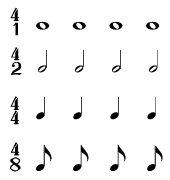
The time measure is indicated at the opening by a time signature. 2/4. 4/8. 3/4. 6/8. The length of each beat in a measure may be a time unit of short or long duration.
It’s a system. But it’s a system built for the mind to follow, not a cage to trap the sound. Or is it?

That 4/4 time signature you see scribbled at the start of a staff? It’s basically a map. The top number tells you how many beats fit in a measure. The bottom number tells you which note value gets the beat. So, 4 on top means four beats. The 4 on the bottom means that beat is a quarter note. You’re counting out four quarter notes before the bar line hits.
It scales up. Look at a 4/2 time signature. The top is still four, but now the bottom number is a 2. That half note becomes the unit of measurement. You’re fitting four half notes into that same measure. The tempo might feel slower or more expansive, but the structural count remains rigid. Four units. No more, no less.
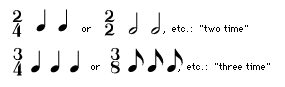
Music doesn’t just stop at four. The foundation rests on two types of basic time measures. Two-beat and three-beat. That’s it. Everything else is just notation shifting around those two core feelings.
The Two-Beat Pulse
Start with duple meter. It’s the heartbeat of march music, pop songs, and rock. You count 1-2. 1-2. Simple. The notation changes depending on the tempo and the “feel,” but the pulse stays binary.
The Three-Beat Waltz
Then there’s triple meter. One-two-three. One-two-three. A waltz is the classic example. The waltz feels lighter, more rotational. It’s not just a count change; it’s a shift in gravitational pull. Composers use 3/4, 3/2, or even 6/8 (which often feels like two big beats with three subdivisions) to create that sway.
Why It Matters
Why do musicians obsess over these numbers? Because they dictate the phrasing. A four-beat measure allows for a steady, grounded progression. A three-beat measure creates lift. If you misread the bottom number, you’re playing the wrong note length. You’ll rush or drag. The sheet music is just coordinates. The time signature is the compass.
Which notation feels more natural to your ear? The march-like 4/4 or the flowing 3/4? It’s subtle. But once you hear the difference in how the melody sits against the bar lines, you can’t unhear it.

The Hidden Pulse in 4/4 Time
It’s easy to assume four time is just four even beats. It isn’t. Or at least, it shouldn’t be.
“Common time” is technically a subset of duple time. It’s closely allied to “two time.” But if you play it flat, you’re missing the point.
Here is the trick.
You have to feel a subsidiary stress on the third beat. The half measure.
Think of it as a two-beat pulse with an extra kick.
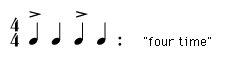
So the pattern isn’t 1-2-3-4. It’s 1-2-3-4, with a subtle dip on three.
1 – 2 – 3 – 4
That drop? That’s what keeps 4/4 from feeling like a marching drum. It turns a square count into something that breathes.
Without that third-beat emphasis, common time loses its swing. It becomes rigid.
Most pop songs rely on this structure. The bass hits one. The snare hits two. The kick drags three. The snare snaps back on four.
That drag on three is the difference between a metronome and a groove.
It’s not complicated. But if you ignore it, the rhythm feels dead.

Simple time is what you hear in most pop, rock, and country tracks. Two, three, or four beats per measure.
It’s straightforward.
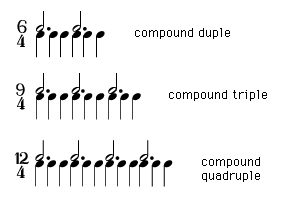
Compound time is different. It’s where the magic happens if you like syncopation or swing.
Here is the deal: In simple time, each beat divides into two equal parts. Think quarter note followed by another quarter note’s worth of eighth notes.
In compound time, the magic is that each main beat divides into three equal parts.
This creates a dotted-beat feel.
A quarter note in simple time splits into two eighth notes.
A dotted-quarter note in compound time splits into three eighth notes (or rather, it acts as the unit for a group of three).
This is why 6/8 time feels different than 3/4 time, even though both have three beats.
In 3/4 (simple triple), you count ONE-two-three, ONE-two-three. Each beat is a quarter note.
In 6/8 (compound duple), you count ONE-two-three-FOUR-five-six. But your brain groups it as two big pulses: ONE-two-three, FOUR-five-six.
Why the Division Matters
The distinction isn’t just academic music theory. It changes how you feel the rhythm.
Simple time feels direct.
Compound time feels flowing.
Think of a waltz. That’s 3/4 simple time. It’s bouncy.
Think of a blues shuffle or a traditional folk jig. That’s compound time. The triplet subdivision creates that rolling, loping feel.
You hear it in the way the hi-hat or the bass guitar locks in.
If the subdivision is two, it’s simple.
If it’s three, it’s compound.
Where You’ll Hear It
Compound meter shows up everywhere in genres that rely on swing or groove.
Blues uses it constantly. The backbeat might be on the 2 and 4, but the underlying pulse is often compound.
Rock ballads often shift into compound time for their choruses to create lift.
Traditional Irish and Scottish music relies heavily on 6/8 and 9/8 time signatures.
Even some jazz pieces use compound meter for specific textures.
It’s not about which is “better.” It’s about the energy.
Simple time drives.
Compound time sways.
Next time you listen to a song, count the beats.
Do they split in two? Or do they split in three?
Once you hear that difference, you’ll never hear rhythm the same way again.
The groove tells the story.

Breaking the Beat: Complex and Asymmetrical Meters
You hear that uneven pulse? That’s the quintuple meter in action. It doesn’t just sit there. It splits. Usually into a 3-plus-2 grouping. You feel it in Gustav Holst’s Mars from The Planets. Tchaikovsky does the same trick in the second movement of his Sixth Symphony. The rhythm feels like a stumble. It’s deliberate.
Rimsky-Korsakov goes even further. In Sadko, he treats 11 as a single unit. Stravinsky does the same in Le Sacre du printemps. It’s jarring. It’s intentional.
Then there’s Ravel. His piano trio opens with an 8/8 signature. But look closer. It’s organized as 3-plus-2-plus-3. A tight loop.
Folk music played a huge role here. Eastern European folk songs and dances pushed composers toward asymmetry. Bartók absorbed this directly. His Mikrokosmos features “Bulgarian Rhythm” pieces in 7/8 and 5/8. The influence is clear. The math is weird. The result is alive.
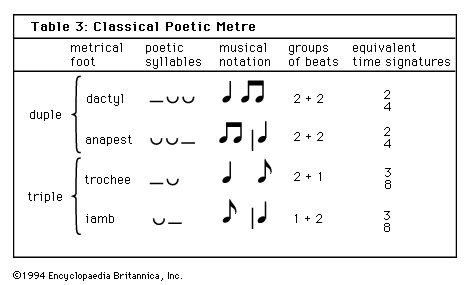

Think about a heartbeat. Thump-thump. Thump-thump. That’s it. That is the entire origin story of musical meter. It starts with long and short syllables—what prosody calls “feet.” The Romans didn’t invent this. They inherited it from the Greeks, who viewed poetry and music as one single, indivisible art form. No separation. Just rhythm flowing from text into sound.
This framework traveled north. It moved through Latin poetry and settled into medieval Europe. The structure remained. The feet of classical poetry had direct musical equivalents. Look at the reference table in standard texts if you need the specific mappings. But don’t stop there. St. Augustine added to the pile in late antiquity. His work, De musica (354–430), expanded the system. He didn’t just copy; he added more feet to the existing list.
The Roots of Rhythmic Meter
Why does this matter now? Because every time you count off-beats in a pop song or march to a beat, you are walking through Greek prosody. The Greeks laid the foundation. They didn’t see music as background noise. It was integral to the word. When the Romans adopted these principles, they kept that integrity. Then medieval scholars preserved the logic. The result is the rhythmic meter we recognize today. It’s not arbitrary. It’s architectural.
Metrical Patterns and Musical Equivalents
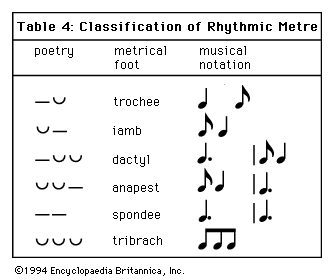
The table mentioned earlier isn’t just a list. It’s a translation guide. Long syllables became long notes. Short ones became short notes. The pattern of the word dictated the pattern of the music. This wasn’t guesswork. It was a strict code. Augustine’s contributions in De musica introduced additional complexities. He recognized that the basic dactyls and iambs weren’t enough to capture every nuance of rhythm. So he added more. More feet. More options. More ways to map text to tune.
This system survived because it worked. It provided a bridge between the spoken word and the sung note. Without it, we’d have no structured rhythm in Western music. We’d just have noise. The continuity is staggering. Greek poets -> Roman scholars -> Medieval composers -> Modern musicians. The DNA is there. You can see it in the meter. You feel it in the beat. It’s all connected. And it all starts with a long syllable.

The Shift from Plainchant to Polyphony
For centuries, church music was a monochrome affair. Until the 12th century, we’re talking unadorned plainchant. No harmony. No chords. Just a single melodic line floating in the air. But as composers began experimenting with polyphony—stacking voices on top of each other—they ran into a problem. How do you keep multiple independent lines from drifting apart?
They needed a grid. A structure.
This led to the adoption of rhythmic meter. Without it, polyphony would have collapsed into noise. Meter adds a layer of significance to what is otherwise just a forward flow of time. It gives beats weight. It creates hierarchy.
But here’s the catch. If you follow a metrical pattern too strictly, it gets boring. Monotonous.
So, by the 13th century, musicians started getting tricky. They varied the rhythmic modes. They combined several of them simultaneously across different parts of a composition. It was complex. It was messy. It was alive.
The Myth of Stressless Flow
Theoretically, meter looks like it has no stress accent. Think of the masses of Giovanni Pierluigi da Palestrina. Later periods produced music with an almost stressless flow. It glides. It floats.
But don’t be fooled. These works hide a subtle rhythmic organization.
In practice, you can’t separate meter from time measure. They’re tangled up together. Even on an instrument like the organ, which can’t produce dynamic stress (you can’t hit a key “harder” to change the volume easily in the same way), the idea of stress remains.
Consider the spondee (two long beats) or the dispondee (four long beats). They need that accent on the first beat to keep their identity. Without it, they’re just a flat line.
Meter and time measure become closely linked. Look at Beethoven’s Ninth Symphony. The scherzo. A measure has a strong first beat. It follows a meter. It demands your attention. It’s not just a sequence of notes; it’s a physical directive.
Organic vs. Rational Rhythm
Music’s time framework is built on a few pillars: tempo, time measure, meter, and period. But the life of the music? That’s different.
That life hangs on rubato. On musical motif. On metrical variation. On asymmetry and balance.
The framework is rational. Measured. Predictable.
The rhythmical life is organic. Irrational. Numerically messy.
It reflects expressive, flexible variations in timing. It’s the difference between a metronome and a heartbeat.
Prose Rhythms and the Voice of Plainchant
Rhythm isn’t just one thing. It’s not purely rational, and it’s not purely organic. It needs a rational background to be perceived, sure. But it doesn’t need all the rational factors to work.
Take plainchant. Modern plainchant makes no use of measure or regular meter. It has no grid. It is supremely rhythmical in conception. Its “free” rhythms are felt, not counted.
Most music relies on a regular repetition of underlying accent. Stress. Duration. A predictable pulse.
Plainchant breaks the rule. Its framework is irregular. Its rhythm belongs to the Latin tongue. It springs from the correct accentuation of the text. It comes from the dynamic quality inherent in how words are grouped. It’s linguistic rhythm, not mathematical rhythm.
The Trap of Harmony
You can’t examine structure in time without looking at structure in tone. Melody and rhythm are intimate. They’re linked.
Different styles standardize their melodic cadences. And with them, their time divisions.
Mozart’s melodic rhythm is tight. Regular. Predictable.
Prokofiev’s is jagged. Irregular. Unpredictable.
When harmony enters the picture, everything changes. The rhythmic structure becomes inseparable from harmonic considerations. The time pattern controlling chord changes is called harmonic rhythm.
In 17th- and 18th-century music, harmony tends to limit rhythmic subtleties. It boxes in the flexibility of melodic elements. It determines the basic type of melody. It controls the stress accents.
This is why polyphonic music from Indonesia and Southeast Asia shares traits with European music. Both exhibit certain “four-square” melodic tendencies. They are bound by similar structural constraints.
Compare that to the music of India or the Perso-Arab world.
Here, a melody instrument or voice performs in a given meter. A drum plays cross rhythms. In the Arab world, the drum might play a completely different meter.
There’s no harmony to impede the flow. No chords to lock the melody into place. Just a drone.
The result? Rhythm reaches a structure of great subtlety and complexity. It’s free. It’s intricate. It’s a dance of offsets and intersections.
The Vital Pulse
In European music, style is defined by its concept of rhythm.
Look at the progression:
* The strict rhythmic modes of the 13th century.
* The free, oratorical speech-rhythms of the Renaissance.
* The almost stressless flow of Renaissance polyphony.
* The strong body rhythms of the Baroque.
* The freedom of the late Romantics.
* The primitivistic rhythms of the 20th century, with composite and ever-changing time signatures.
Musical history shows a pendulum swing. Sometimes we crave strict rules. Sometimes we demand “freedom.” It depends on the temper of the times. On the influence of poetry. Dance. Folk music.
Plato defined rhythm as “an order of movement.”
That’s not enough.
Rhythm is “an inspired organic order of movement.” It communicates intelligibly to the senses. It is the vitality of music.
Analytically, it operates within a rational framework. It varies that framework through rubato, motif, and other deviations.
Ultimately, rhythm is the organic process of music in time. It is music’s direction. It is music’s path through the dark.
The quality of rhythm is the quality of life.
However vitally a composer conceives their music, they don’t finish the job. They hand it off. They depend on performers to recreate it rhythmically.
The score is a map. The performance is the journey. And the rhythm? That’s the breath taken along the way.
Does the breath match the path? Or does it stumble?
That’s where the music actually happens.


