


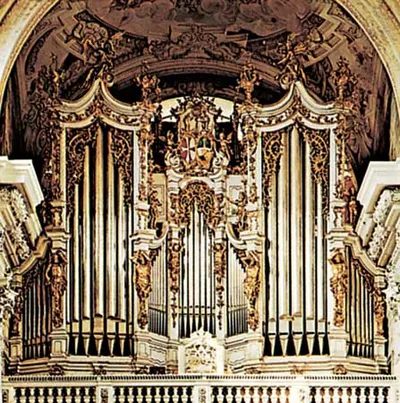
This is a contradiction in music history. The pipe organ is perhaps the most complex machine ever created for art, but its core logic has remained unchanged for 2,000 years. When people say “pipe organ” they usually mean these giant pipe organs with a soaring shell and a hollow sound. Of course, the term loosely covers reed organs and the electronic keyboards of the 1980s that imitated their effects, but the real problem is the noise caused by compressed air coming into contact with wood or metal.
The oldest and largest repertoire of western music belongs to this instrument. That’s a heavy burden for a collection of tubes and levers.
To understand how a pipe organ works, you have to ignore its magic and focus on its function. The basic principle is simple: just blow air into the tube. However, playing with the nuances of Bach and Messiaen is another matter. Traditional organs consist of four different systems. This means a keyboard (manual) and a foot pedal, the pipes that actually sing, a bellows for supplying wind, and a complex mechanism that connects your fingers to the air supply.
Most instruments have only one layer of tubes, one note per key. An organ? It has dozens. These ranks are controlled by stops (or registers). Pull a stop, and you’re inviting a whole set of pipes to join the party. You pedal your feet and steer the baseline through a large wooden or metal tube that usually runs from floor to ceiling.
These pipes are divided into two groups: flue pipes and reed pipes. Flue pipes are like a recorder or a whistle. A reed has a vibrating string similar to a clarinet or trumpet. Changes in tone are caused by changes in the length, shape and material of the pipe.
Here’s the physics without the romance:
The pipes sit on a wind chest. Below that is a compartment, a small valve that opens and closes. Pull the stop to align the holes in the slide. This slider acts as a gatekeeper. Press a key, and the corresponding pallet opens. The air flows out of the bellows along a narrow channel through the open tray and into the pipe.
It’s pneumatic architecture. You are literally breathing music into existence, channel by channel.
The pipe organ is one of the most complex instruments, but its basic principles have remained largely unchanged since its discovery over 2,000 years ago.
So how do players manage such high gas consumption? Why is that even important in the age of synthesizers? The answer lies in the scale of control. Musicians can produce orchestral sounds using only their hands and feet. But this control comes at a price. If the bellows break, the music stops. If the air pressure drops, the pitch wavers.
This is a vulnerable system. It corresponds to the wood and metal of the building and is joined together with leather, glue and air pressure. And it all starts with a push of a key.
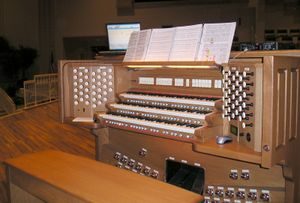

Why do pipe organs have different mechanisms and sounds
Mechanical connections between vacuum tubes and keyboards have existed long before the 19th century. It remained constant until modern technology took over. Today, mechanically assisted operations such as tubular pneumatic systems, electropneumatic systems, and direct electric systems maintain equipment longevity.
An organ is not a sound. It’s a matter of opinion. Each department has a separate level. These are controlled manually. You need at least two manuals and one pedal. This covers most legal songs. A big instrument? There were 5 manuals in the pile. Sometimes more. Each bank controls a specific set of sounds. The tone is different. different sounds.
The real magic is in stopping. Players improve volume and timbre by adding pipes. You can layer high and low sounds. The physics is simple. Length is determined by height.
- An 8-foot pipe played at normal volume.
- A 16 foot long pipe drops an octave.
- 4 feet of pipe jumped down.
The mutation stops adding harmonics. They don’t just play music. They added overtones. Pipe sizes vary widely. 32 feet to less than 1 inch. This gives the instrument 9 octaves. Bigger than any other instrument on earth.
Its history begins in the 3rd century BC. The Greeks built hydraulic systems. Water controls the wind. It’s raw. That’s how it’s been for centuries. About 400 years later, the first bellows-fed organs appeared. In the 8th century, Europe had its own version. In the 10th century, ecclesiastical associations became established.
Significant changes took place in the 15th and 16th centuries. Tonal progression. Mechanical improvements. The National Organ School was born. By the beginning of the 17th century, essential goods were available. In the following centuries, this technique was simply developed. Or try changing your tone.
The pot organ reached its peak of popularity at the height of the Baroque.
The name Johann Sebastian Bach (1685-1750) is significant. He defines what the tool does. At that time, two schools were dominant. The French style favors colorful reeds and mutations. German and Dutch schools focused on good choral music.
Which method do you prefer? German sophistication or French bright reeds? The conversation is definitely not over yet. We just moved into a concert hall and recording studio.
Modern builders still use the old blueprints. However, the material has changed. Accuracy is sharper. sound? After all, that is its overwhelming power. Just one note could fill a cathedral. Or if you say it loud enough, you can rip a little club.

Decline and Digital Shift
After Bach’s death, organ manufacturing began to slow down, but steadily, especially in Germany and England. Pipes made after 1800? Often tonally bankrupt. The builders changed their focus and prioritizing stops imitating orchestral instruments. This is a compromise. Quality gives way to imitation.
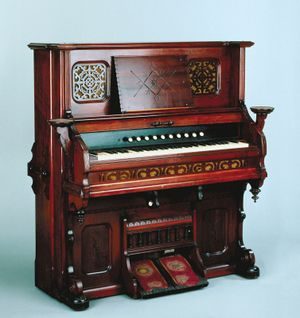
At the same time, in the 19th century, the harmonium rose. Harmoniums. Melodeons. These instruments use freely vibrating reeds instead of the beating reeds of traditional pipe organs, and often lack a resonator. They were smaller. Simpler. Cheaper. They invaded homes and small spaces and dominating the domestic soundscape until the early 20th century. Later, when electronic organs and mass-produced pianos came, the reed organ was out the door.
Revival and Imitation
The 20th century brought with it a complex double narrative. On one hand, there was a revival of classical ideals. The organ re-emerged as an independent instrument with its own unique literature, rather than merely supporting the choir or orchestra.
technology moved fast. When Laurens Hammond introduced the electronic organ in the United States in 1935, it offered an economical and compact alternative. But here’s the problem. Its imitated sound cannot truly reproduce the complexity of the pipe organ sound. It’s a completely different animal.
“Its imitative sounds can never reproduce the tone of an organ.”
Electronic keyboards solve space and cost problems. It creates new markets. However, it left a gap in the authenticity of the sound, which the organ revival sought to fill. Two paths. Instruments divided by era and technology. The debate about which sound is “better” or “more authentic” remains unresolved and lingers in concert halls and living rooms.


