


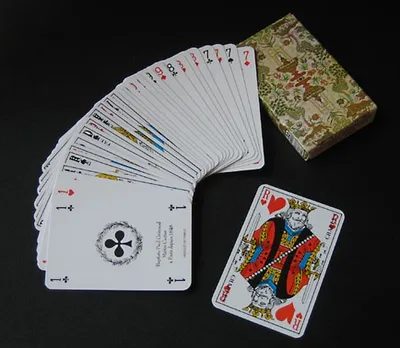
Piquest. It’s a word that sounds like a minor injury. But for centuries, it was the sound of aristocratic boredom being conquered by strategy. Piquet, a two-player card game dating back to 15th-century France, wasn’t just a pastime. It was the apex predator of the card table.
In 1534, François Rabelais named it a favorite of his giant hero Gargantua. By 1892, delegates at a Vienna card congress voted it the most “classic” game in existence. It was intellectual. It was elitist. And because it takes a damn long time to explain, it fell out of favor in the 20th century.
Despite its French roots, piquet naturalized in England around 1625, likely thanks to Charles I’s marriage to Henrietta Maria. You can even catch a surprisingly accurate depiction of Charles II playing it with one of his mistresses in the 1947 film Forever Amber. For three hundred years, it held pride of place in Charles Cotton’s The Compleat Gamester. It was the subject of Edmond Hoyle’s 1744 treatise. If you respected cards, you respected piquet.
Here is how you play the English club version: Rubicon Piquet. 🃏
The Setup and The Deal
Grab a standard deck. Strip it down to 32 cards.
Rankings go from high to low: Ace, King, Queen, Jack, 10, 9, 8, 7. Four suits. Two players.
The goal? Score at least 100 points. This is known as “crossing the rubicon.” The game consists of six deals, collectively called a partie or a rubber.
Cut for the deal. Higher card goes first. Then it alternates.
The dealer becomes the younger hand. The non-dealer becomes the elder hand.
Each player gets 12 cards, dealt in twos or threes. The remaining 8 cards sit face-down in the center. This is the talon.
You need a cribbage board or some other scoring device. Paper works. You’ll be doing math.
The Exchange: Where Strategy Begins
The elder hand moves first. He looks at his 12 cards. He must discard up to five cards face-down. He replaces them from the top of the talon.
In practice, the elder almost always discards five. But he must discard at least one. If he keeps cards, he gets to peek at the cards he would have taken if he had swapped all five.
Now the younger hand gets to move. He can exchange up to as many cards as remain in the talon. Usually, that’s three. He doesn’t have to exchange any.
If the younger hand draws fewer than the maximum, he has a choice. He can expose the untaken cards for both players to see. Or leave them face-down for neither to see.
Players can examine their own discards anytime during play.
There is a specific penalty for bad luck. If you are dealt no face cards, you score 10 points for a blank. You must prove it by playing those cards rapidly face-up on the table.
The elder does this immediately. The younger hand waits until after the elder has exchanged his cards before proving his blank.
The Three Rounds of Combinations
Scoring happens in three distinct rounds: Point, Sequence, Set.
The elder declares first. The younger responds with “Good,” “Not good,” or “Equal,” depending on whether he can beat the declaration.
Point
Whoever holds the longest suit scores. The points equal the number of cards in the suit.
If you tie on length? The player with the highest-value suit wins.
* Aces: 11 points.
* Court cards (K, Q, J): 10 points.
* Index cards (10-7): Face value.
If the value counts are equal, neither player scores for point. It’s a wash.
Sequence
This goes to the player with the longest sequence of three or more cards in a suit.
The longest sequence scores for itself and any other sequences declared.
Tie-breaker? The player with the higher-ranking cards wins the sequence score. Still tied? No points.
The points for sequences are specific:
* 3 cards: 3 points
* 4 cards: 4 points
* 5 cards: 15 points
* 6 cards: 16 points
* 7 cards: 17 points
* 8 cards: 18 points
Set
A set is three or four cards of the same rank. No lower than 10s.
The score goes to the highest-ranking four of a kind (called a quatorze ). If nobody has four, the highest three of a kind (trio ) wins. Ties are impossible here because of the ranking hierarchy.
Points for sets:
* Trios: 3 points each.
* Quatorzes: 14 points each.
The Repique and The Pique
This is where the game gets aggressive.
If the elder summarizes his combination score and hits 30 points before the younger has scored anything, he gets a massive bonus.
Repique : +60 points.
Points for repique are calculated strictly in order: blank, point, sequence, set.
Example: Elder scores 7 for point, 15 + 4 + 3 for sequences, and 3 for a trio. That’s 32 points. He gets 60 more. Total: 92 points.
But watch out. If the younger declares a blank, he gets his 10 points. This prevents the repique bonus.
If the younger scores 30 points in combinations and tricks before the elder scores anything, he gets Pique : +30 points.
The Trick Play
The elder leads to the first trick. He adds one point for leading.
The younger then fully identifies and scores for any combinations that allow him to declare the elder’s score “not good.”
After scoring, the elder leads a card. The winner of the trick leads to the next.
You must follow suit if possible. If not, play any card.
There are no trumps.
The trick goes to the higher card of the suit led.
Trick points:
* If you win the trick you led: 1 point.
* If you win a trick you didn’t lead: 2 points.
Bonuses for trick taking:
* Win 7 to 11 tricks: +10 points for cards.
* Win all 12 tricks: +40 points for capot.
Winning The Rubber
The game ends when someone crosses 100 points.
If you are tied after a rubber? Play two more deals.
If both players are over 100 points when the rubber finishes, the winner earns 100 points plus the difference between the final totals.
If the loser fails to reach 100 points—even if the winner also fails—the loser is rubiconed.
The winner scores 100 points plus the total of the players’ final scores.
It’s brutal. It’s complex. It’s thoroughly aristocratic. And if you can master the talon, you’ll have more than just points to show for it. You’ll have survived the rubicon. 🏆


