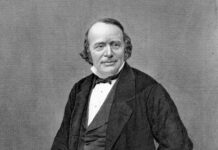
Henri Augustus Rolland did not only study light. He tamed it.
Born in Honesdale, Pennsylvania in 1848, Rowland became one of the most influential physicists of the late 19th century. What is his greatest contribution? concave diffraction grating. The present invention is not merely an adaptation of existing tools. It replaces large prisms and flat gratings, revolutionizing the way to analyze the composition of materials.
Before Rowland, spectrum analysis was complicated. Researchers need lenses and mirrors to focus the light passing through the prism. it’s complicated. It’s easy to make mistakes. Rowland changed this by drawing directly on a curved concave surface. The surface itself collects light. No additional equipment is required. Clean and accurate information.
He began developing this ability in 1872 as a teacher at Rensselaer Polytechnic Institute. In 1876, he transferred to Johns Hopkins University in Baltimore, where he spent the rest of his career. His curiosity knew no bounds.
In 1876 he demonstrated some basic principles. A moving charge has the same magnetic effect as an electric current. Now that sounds easy. At the time, it was an important piece of the puzzle connecting electricity and magnetism. Three years later, he improved his method for measuring heat and resistance. He redefined the mechanical equivalent of heat and the standard value of the ohm. He doesn’t just accept numbers. he improved them.
But efforts to cement his legacy began in 1885.
Rowland built a machine that could engrave 20,000 lines to an inch. This density is unprecedented. He carved these grids into the concave surface of the sphere. result? Accurate spectroscopic analysis. Devices have become smaller, sharper and more reliable.
His 1888 photographic map of the normal solar spectrum was amazing. This is a spectral map over 35 feet long. Walking down the corridor where it is displayed is like walking through the fingerprints of the sun. Each black line on the map represents an element, a specific wavelength of light absorbed by the Sun’s atmosphere.
He didn’t stop there. From 1895 to 1897, he published a table of the wavelengths of the solar spectrum in the Astrophysical Journal. Contains tens of thousands of lines. Over the years it has become a standard reference for astronomers and physicists. If you want to know what’s inside the stars, look at Rowland’s work.
His colleagues recognized the magnitude of his influence. In 1899, he became the first president of the American Physical Society. In the same year, he was elected a foreign member of the Royal Society of London.
Rowland died in Baltimore on April 16, 1901 at the age of 52.
The tools he invented are still in our use today. Modern spectrographs, devices that detect everything from air pollutants to the chemical composition of distant galaxies, rely on the principles he laid out. He turned the rainbow into a language we can read. At the same time, he gave science a new way of looking at the universe.