Cold does weird things.
Drop matter near absolute zero and physics breaks the rules you learned in high school. Electrons move without resistance. Atoms climb walls like spiders. Everything gets fuzzy, governed by quantum statistics instead of Newtonian logic.
Two camps rule this micro-world: bosons and fermions.
Bosons, like photons, are the party animals. They crowd into the same space, acting as one coherent wave. Fermions? No way. The Pauli exclusion principle forbids them from sharing quantum states. An electron stays in its lane. That rule keeps neutron stars from collapsing into black holes, a pretty heavy lift for such a small constraint.
But what if you mess with the rules?
Physicists wanted to see what happened when atoms were forced to flip-flop between repelling and attracting each other, rapidly.
“What happens if one forces interacting atoms to consistently cycle through extreme conditions?”
To test it, Alvise Bastianello and his team grabbed roughly 70,00 cesium atoms. They chilled them to nanoKelvins. Cold enough that the atoms stopped being individuals and acted like a single, blurry entity—a Bose gas.
They trapped this gas in laser tubes. One dimension only. Then came the kicker.
They pulsed the system. Repel. Attract. Repel. Attract Over and over.
The result wasn’t chaos.
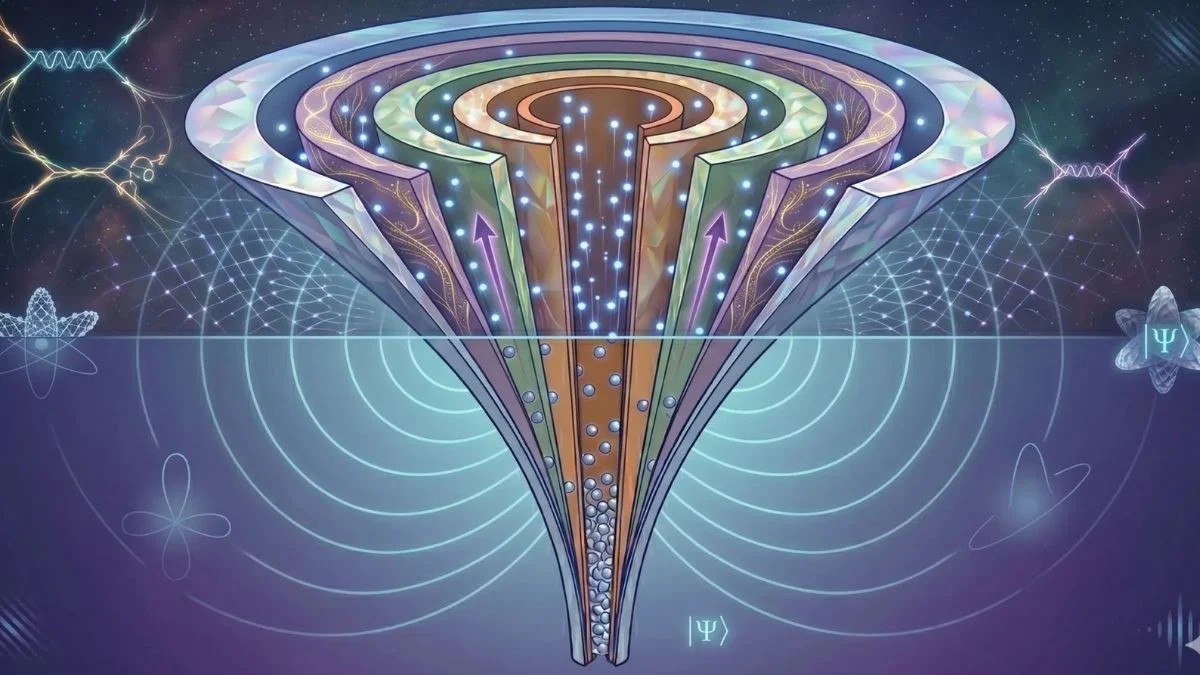
Usually, that kind of energy heats things up. Scatters particles randomly. But here? The atoms reorganized. They settled into something unexpected: a fractional Fermi sea.
Think about it. Fermions don’t stack. They stay separate. Bosons do stack. This new state is neither. It’s halfway between. The quantum states are partially filled, a glitchy hybrid that likely only survives in these lower-dimensional traps.
Yi Zeng, who led the study from Innsbruck, calls it a new many-body state.
“Instead of simply heating the system,” Zeng explains, “the interaction cycle reorganizes the atoms.”
Hanns-Christoph Nägerl notes the order is hidden but there. You can see it in the ripples. The data showed Friedel oscillations, the smoking gun evidence that this wasn’t just random noise. It was a structure. A fragile, complex order born from repeated disruption.
They don’t even know what to call the particles involved yet. “Super-Fermions?” Nägerl jokes.
Maybe.
Why bother?
Because it breaks the paradigm. Most simulations just reproduce what we already know. This setup created a state that textbooks haven’t written yet. It suggests quantum simulators can do more than mimic nature; they can invent new physics to study how reality emerges from the quantum soup.
Better quantum sensors are probably next on the horizon. Or more precise encryption. Or materials we haven’t dreamed of.
For now, they just have a sea that shouldn’t exist. And they aren’t done looking.