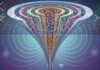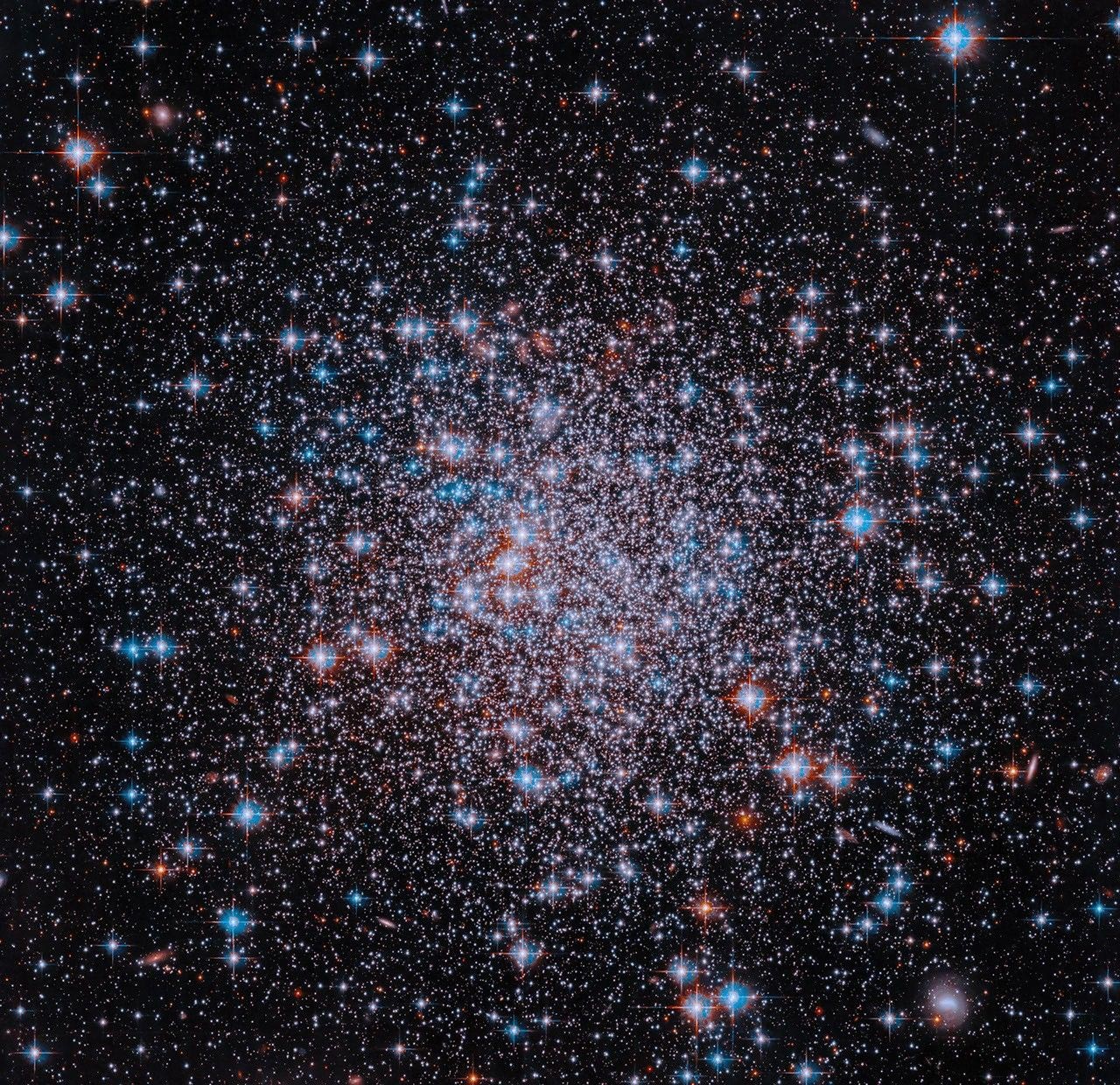
Look up. Not at the sky over your neighborhood, but at a time long before human history. NASA dropped a new Hubble Space Telescope image yesterday. It looks like a red, white, and blue firework stuck on the 4th of July. It is. It was released for the US’s 250th birthday, sure. But it isn’t just propaganda. It shows NGC 6426, one of the ancient, dusty ball-pits of stars hanging out in our galaxy’s outer halo.
The Ancient Clump
Globular clusters are weird. They are tightly packed, spherical knots of stars held together by their own gravity. Our Milky Way has about 150 of them. Think of them as fossil records written in light.
The stars in one of these clumps usually form from the same gas cloud collapse. Same birth cloud, same age. NGC 64 6? Roughly 13 billion years.
The universe itself is 13.7 billion.
That puts this cluster almost as old as everything. Ancient doesn’t cut it. It is a peek at the dawn.
Color and Temperature
You see red. You see blue. What does it mean? It’s physics. Basic, brutal physics. The colors in the Hubble shot come from filtering light into specific wavelengths. Standard processing stuff.
Blue light = short wavelength = hot.
Red light = long wavelength, mixed with near-infrared = cooler.
Simple rule: If it’s blue in that image, it’s burning hot. If it’s red, it’s comparatively chill.
Stars With Little Metals
Here is the kicker. These stars are “low metallicity.” In astronomy, metal means anything heavier than hydrogen and helium. Iron, oxygen, gold—all “metals” here.
NGC 6425 is poor on those heavy elements. It is mostly just H and He. That sounds boring, maybe even cheap. It is not. It matches the young universe. Back when the cosmos was fresh, before heavy elements existed, matter was simple. Pure.
This cluster remembers that time.
But it gets more interesting. Astronomers spotted two distinct groups of stars in the mix. Chemically different.
Why?
A second generation was born after the first died violently.
The first massive stars blew up as supernovae. Boom. They scattered the newly forged heavy elements into the gas. That enriched soup then collapsed to make more stars.
Explosions feed new stars. Death makes the raw material for future planets, and eventually us. Without that messy stellar violence, there would be no rocks, no life. Just gas.
Still Going Strong
Hubble snapped this for a bigger project. A survey of these ancient halos. Scientists want to nail down ages, yes, but really, they want to understand how the Milky Way grew. How it evolved.
Thirty years in orbit. Hubble is an old dog, but it still learns new tricks. It changed how we see the universe. Now other tools pick up the baton. The James Webb Space Telescope expands the view. The Nancy Grace Roman Space Telescope is coming later this summer, set to launch in late July, ready to dig deeper.
The data keeps flowing. The stars stay there. Waiting for the next lens to find them.