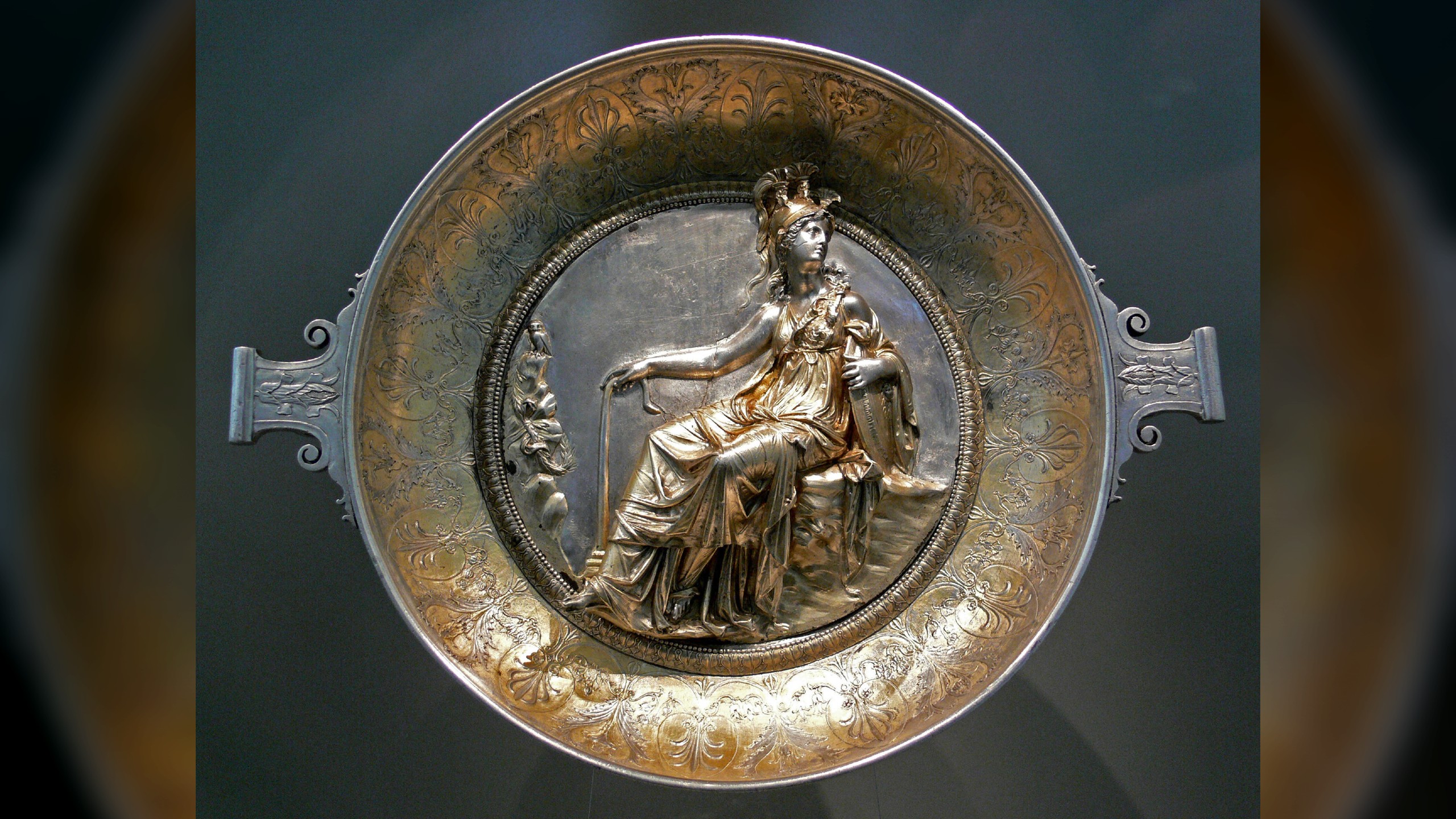
In 1868, the rumble of construction work near Hildesheim, central Germany, uncovered a secret buried for nearly two millennia. Soldiers from an Imperial Prussian Army regiment, laying the groundwork for a new shooting range, stumbled upon a hoard of exquisite silver artifacts. Among them was the Athena Bowl, a masterpiece of Roman craftsmanship that offers a tangible connection to one of the empire’s most catastrophic military defeats.
A Masterpiece of Silver and Gold
The Athena Bowl, also known as the Minerva Bowl, is not merely a vessel; it is a work of art. Measuring roughly 10 inches (25.3 cm) in diameter and weighing a substantial 4.4 pounds (2 kg), the bowl is comparable in weight to a standard cast-iron skillet. Its surface is dominated by an intricate central emblem depicting Athena, the Greek goddess of wisdom and war.
The imagery is striking in its detail:
* Athena’s Pose: She is seated on a rock, holding a shield under her arm and wearing a plumed helmet. Her gaze looks backward, while her protective aegis (shield) hangs like a sash.
* Sacred Symbols: In front of the goddess, a rock encircled by an olive wreath supports her sacred owl, a symbol of wisdom and vigilance.
* Material Contrast: While the bowl is primarily silver, archaeologist Gertrud Platz-Horster notes that gold accents highlight Athena’s dress, her aegis, the owl, and the surrounding rock formations.
This level of artistry suggests the bowl was not everyday tableware but a luxury item intended for display or high-status dining.
A Timeline of Craftsmanship and Use
The bowl’s history is layered, reflecting both artistic tradition and practical use. According to the Altes Museum in Berlin, which houses the Hildesheim Treasure, the central Athena emblem likely dates back to the second century B.C. However, the bowl itself was crafted in the first century A.D. to house this older emblem.
Traces of wear and repair on many of the vessels in the hoard indicate that this collection was not assembled overnight. Instead, it appears to have been gathered over time, suggesting a long history of ownership and use before its sudden burial.
The Shadow of Varus and Teutoburg
The context of the find raises compelling historical questions. Discovered in central Germany during the first century A.D., the treasure aligns with the era of intense conflict between Rome and Germanic tribes. Many experts believe the tableware once belonged to a high-ranking Roman military commander who may have hidden it from advancing enemies—or, alternatively, it could be booty seized and cached by Germanic tribes after a victory.
The most prominent figure associated with this period is Publius Quinctilius Varus. In A.D. 9, Varus suffered a devastating defeat at the Battle of the Teutoburg Forest, losing three entire Roman legions. The loss was so catastrophic that Emperor Augustus was reportedly heard crying out, “Quintili Vare, legiones redde!” (“Varus, give me back my legions!”). Varus subsequently committed suicide, and Augustus halted Rome’s expansion into Germania.
While there is no definitive proof that the Athena Bowl belonged to Varus, its presence in this region during this specific timeframe makes the connection plausible. Whether it was a commander’s prized possession lost in retreat or a trophy of Germanic victory, the bowl stands as a silent witness to this pivotal moment in European history.
Why This Matters
The Hildesheim Treasure is renowned as the largest collection of Roman silver found outside the imperial frontier. This distinction is significant because it challenges the traditional view of Roman culture as strictly confined within its borders. The presence of such high-quality, luxury items in Germany illustrates the extent of Roman influence, trade, and military presence in the region before the Teutoburg disaster.
The Athena Bowl is more than an artifact; it is a physical reminder of the fragility of empire. It represents the intersection of art, power, and violence, preserved in silver and gold for over 2,000 years.
The discovery continues to offer insights into the complex interactions between Rome and the Germanic tribes, highlighting how cultural objects can outlast the empires that created them.