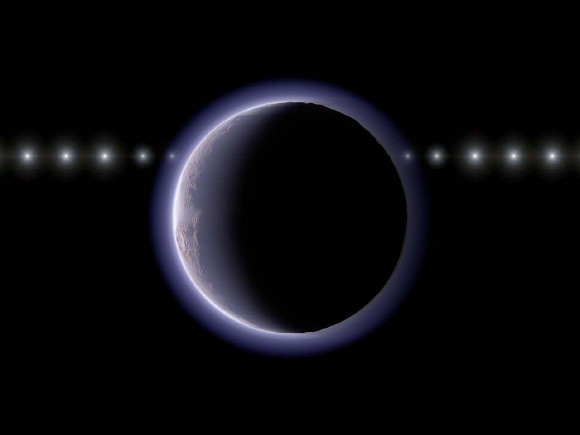
Astronomers have detected a thin atmosphere surrounding a small, frozen world located far beyond Pluto, a discovery that challenges long-held assumptions about the outer Solar System. The object, designated (612533) 2002 XV93, is a trans-Neptunian object (TNO) with a diameter of approximately 500 kilometers.
According to established scientific models, bodies of this size and temperature are too cold and possess too weak a gravitational pull to retain an atmosphere. Yet, data collected by a team led by Dr. Ko Arimatsu from the Ishigakijima Astronomical Observatory suggests otherwise. The findings, published in Nature Astronomy, indicate that this distant icy body hosts a transient atmosphere, raising new questions about geological activity in the deep reaches of our planetary neighborhood.
A Rare Stellar Occultation
The detection relied on a phenomenon known as a stellar occultation. On January 10, 2024, 2002 XV93 passed directly between Earth and a distant background star. As the object moved across the star’s path, astronomers monitored how the starlight changed.
If the object had a solid surface with no atmosphere, the star’s light would have vanished abruptly. Instead, the light gradually faded before disappearing. This gradual dimming indicates that the starlight passed through a layer of gas—an atmosphere—before being blocked by the solid body.
For context, 2002 XV93 is significantly smaller than Pluto, which has a diameter of 2,377 kilometers. While Pluto is known to have a thin atmosphere, previous studies of other TNOs had yielded negative results. Most scientists believed that the extreme cold and low gravity of these distant worlds would cause any gases to freeze onto the surface or escape into space.
A Fleeting Phenomenon
The atmosphere detected around 2002 XV93 is not a permanent feature. Calculations suggest it would dissipate in less than 1,000 years unless it is continuously replenished. This implies that the atmosphere was formed or refreshed relatively recently in astronomical terms.
However, the source of this gas remains a mystery. Observations by the James Webb Space Telescope (JWST) found no evidence of frozen gases on the surface that could sublimate (turn directly from solid to gas) to feed the atmosphere. This rules out the simplest explanation: sunlight warming surface ice.
Two Leading Theories
With surface sublimation unlikely, researchers propose two alternative mechanisms for the atmosphere’s existence:
- Cryovolcanic Activity : An internal event may have brought frozen or liquid gases from deep within the object to the surface. This suggests that 2002 XV93 might still be geologically active, a surprising trait for such a small, distant body.
- Recent Impact : A comet or icy object may have crashed into 2002 XV93, releasing trapped gases and creating a temporary atmosphere.
“This discovery shows that even a few-hundred-kilometer TNO can host, at least transiently, an atmosphere, challenging standard volatile-retention scenarios,” the authors concluded.
Why This Matters
This finding forces a reevaluation of how we understand minor planets in the outer Solar System. It suggests that a fraction of distant icy worlds may exhibit atmospheres, potentially sustained by ongoing internal activity or produced by recent collisions.
If small, cold bodies can maintain atmospheres, it implies that the boundary between “dead” rocks and dynamic worlds is blurrier than previously thought. Further observations are required to distinguish between cryovolcanism and impact origins, but for now, 2002 XV93 stands as a testament to the unexpected complexity of the Solar System’s distant frontier.