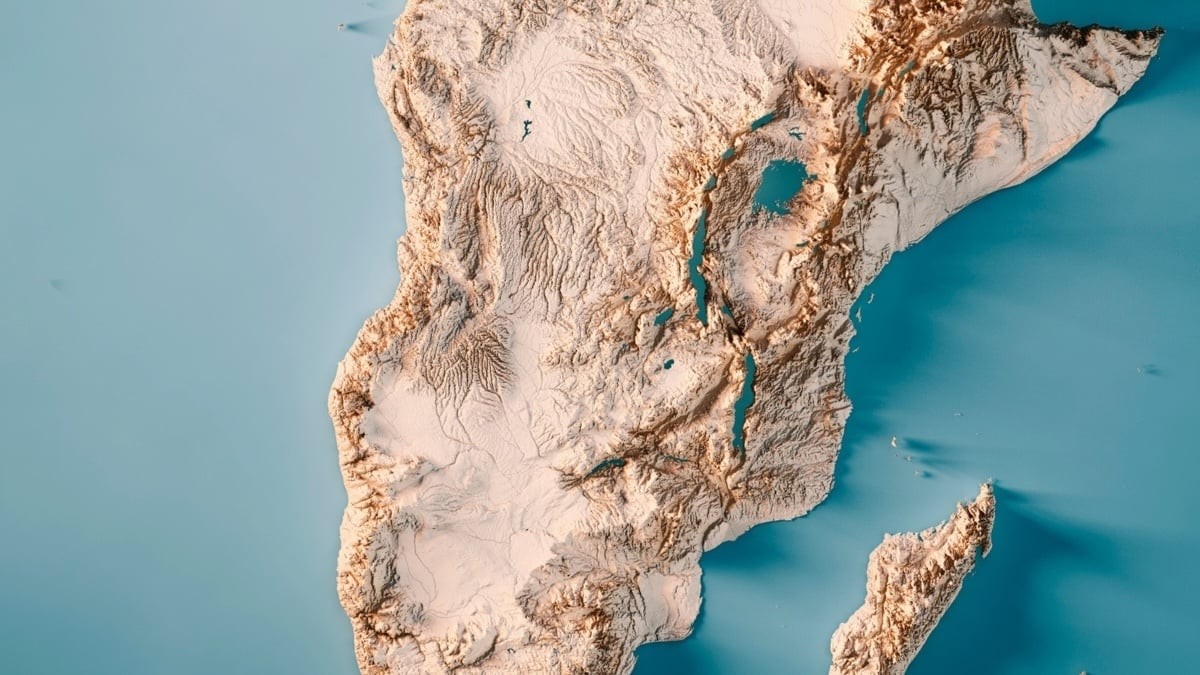
Geological research has revealed that the African continent is undergoing a structural transformation much faster than previously estimated. A critical rift zone is currently reaching a “threshold” that will inevitably lead to the continent splitting apart, paving the way for the birth of a new ocean.
The Mechanics of a Continental Breakup
The Earth’s surface is in a state of constant, albeit slow, motion. While the current arrangement of continents appears permanent, tectonic plates are perpetually shifting. When plates collide, mountains rise; when they pull apart, oceans are born.
The East African Rift System is currently demonstrating the latter process. The African plate is in the midst of dividing into two distinct entities:
– The Nubian Plate: The massive western portion containing the majority of the continent.
– The Somali Plate: The smaller eastern section, which includes much of the eastern coastline and Madagascar.
New research focused on the Turkana Rift, a massive stretch of land running through Kenya and Ethiopia, has provided a breakthrough in our understanding of this split. By analyzing seismic measurements, scientists discovered that the Earth’s crust in the center of the rift is significantly thinner than once believed—measuring only about 13 kilometers (8 miles) thick.
The “Necking” Phase and Oceanization
This discovery is significant because of a geological phenomenon known as “necking.” When the continental crust thins to below a critical threshold—roughly 15 kilometers—the breakup of a continent becomes nearly inevitable.
“The thinner the crust gets, the weaker it becomes, which helps promote continued rifting,” explains Christian Rowan, a geoscientist at Columbia University.
As the crust continues to stretch and weaken, it will enter the stage of oceanization. During this process, the crust will become so thin that magma will erupt from beneath the surface, cooling to form a new seafloor. Eventually, water from the Indian Ocean will rush into these new basins, officially creating a new ocean.
While “soon” in geological terms still implies a timeline of a few million years, this is considered a rapid progression in the context of Earth’s history.
A Connection to Human Evolution
The timing of this geological shift raises fascinating questions about the history of humanity. The Turkana Rift is world-renowned for its abundance of early hominin fossils, which has long led scientists to believe the region was a primary “cradle” of human evolution.
However, the new data suggests a different nuance: the rift’s geological activity might not have made the area more important for life, but rather more important for preservation.
The researchers believe the “necking” phase began approximately 4 million years ago, coinciding with the period when the earliest human ancestors inhabited the area. This tectonic shift caused rapid sedimentation, which acted as a natural preservative, trapping and protecting fossils in thick layers of strata.
This suggests that the Turkana Rift’s status as a paleoanthropological goldmine may be a result of its geological instability, which provided the perfect conditions to archive the history of our ancestors.
Conclusion
The thinning crust of the Turkana Rift marks a definitive turning point in Africa’s geological future, signaling an inevitable transition from a landmass to a new oceanic basin. This process not only reshapes the map but also explains why the region holds such a vital, preserved record of early human history.