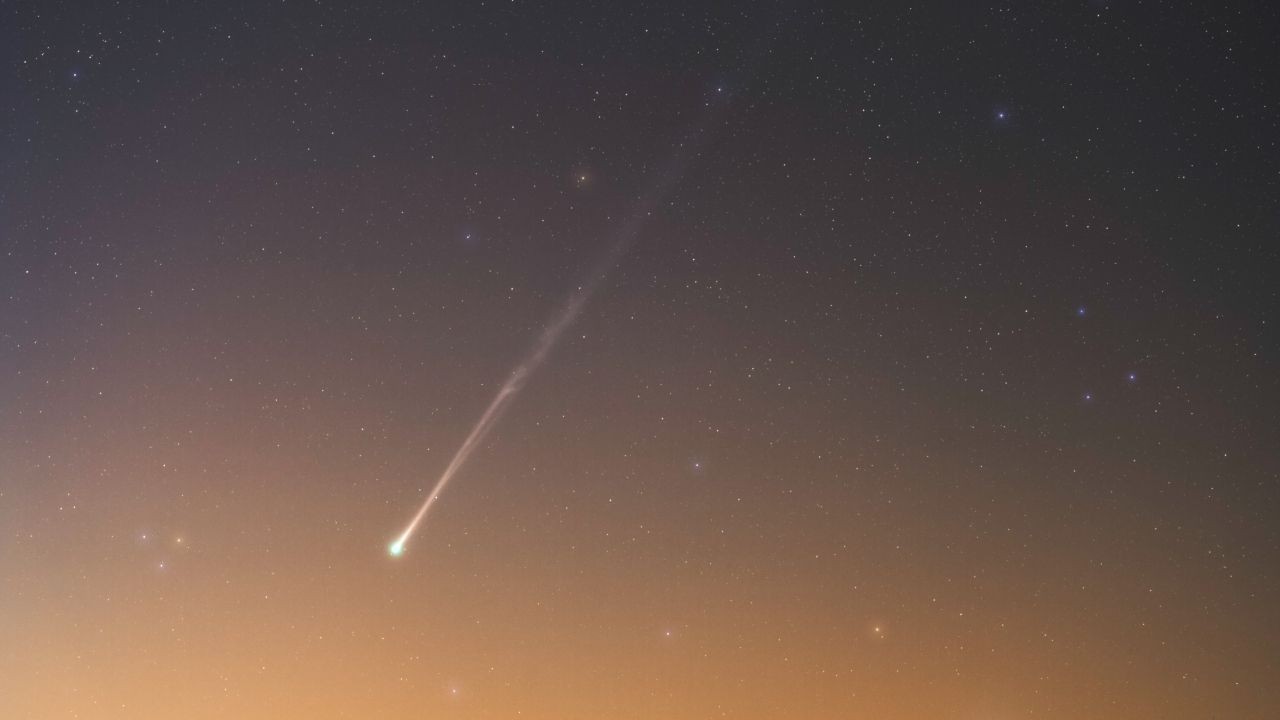
A stunning new long-exposure photograph has captured the ethereal glow of Comet C/2025 R3 (PanSTARRS) as it traverses the predawn sky. Captured by astrophotographer Josh Dury, the image depicts the comet rising over the Mendip Hills in Somerset, England, set against the backdrop of the constellation Pegasus.
The Anatomy of a Comet
The photograph highlights the comet’s bright central nucleus and its sweeping, luminous tail. The tail spans approximately 10 degrees of the sky —a distance roughly equivalent to holding a clenched fist at arm’s length.
This dramatic visual structure is not accidental; it is a dynamic phenomenon caused by the interaction between the comet and our sun. As the comet approaches the sun, reflective material is pushed outward from the nucleus, where it is sculpted into a tail by the solar wind —a stream of charged particles flowing from the sun.
A Meeting of Deep Time
The location of the shoot adds a layer of historical depth to the image. Dury chose the Mendip Hills not only for its landscape but for its profound connection to human history. The region is famously associated with “Cheddar Man,” a 10,000-year-old skeleton that remains one of the most significant archaeological finds in Britain.
While the hills represent the dawn of human presence in the region, the comet represents a much older cosmic timeline:
– Origin: The comet likely hails from the Oort Cloud, a massive shell of icy objects surrounding our solar system at immense distances.
– Longevity: With an estimated orbital period of roughly 170,000 years, the comet is a relic from the very formation of our solar system.
– Scale: The Oort Cloud sits between 10,000 and 100,000 times the distance between the Earth and the Sun, making the comet’s journey into our inner solar system a rare and fleeting event.
How to Observe PanSTARRS
For those looking to witness this celestial event, the comet is currently bright enough to be seen with the naked eye as a faint, hazy patch of light, provided you are in a dark-sky location.
To see more detail, such as the glowing nucleus or the subtle structure of the tail, observers are encouraged to use 10X50 binoculars. The comet is approaching its perihelion —its closest point to the sun—which is expected to occur around April 19–20.
The Art of Astrophotography
Capturing such a detailed image requires significant technical precision. To overcome the challenges of low light and “noise,” Dury utilized a specialized workflow:
– Equipment: A Sony A7S III camera paired with a Sigma 135mm F/1.4 lens.
– Technique: The final image was the result of stacking 33 separate long-exposure shots.
– Post-Processing: Using Adobe Lightroom and Photoshop, these images were combined to increase the signal-to-noise ratio, allowing the faint light of the comet to stand out clearly against the darkness of space.
The comet’s passage from the Oort Cloud connects us to the earliest primitive history of our solar system, bridging the gap between ancient human history and the vastness of deep space.
In summary, Comet PanSTARRS offers a rare glimpse into the ancient origins of our solar system, providing both a scientific marvel and a breathtaking visual spectacle for observers on Earth.